
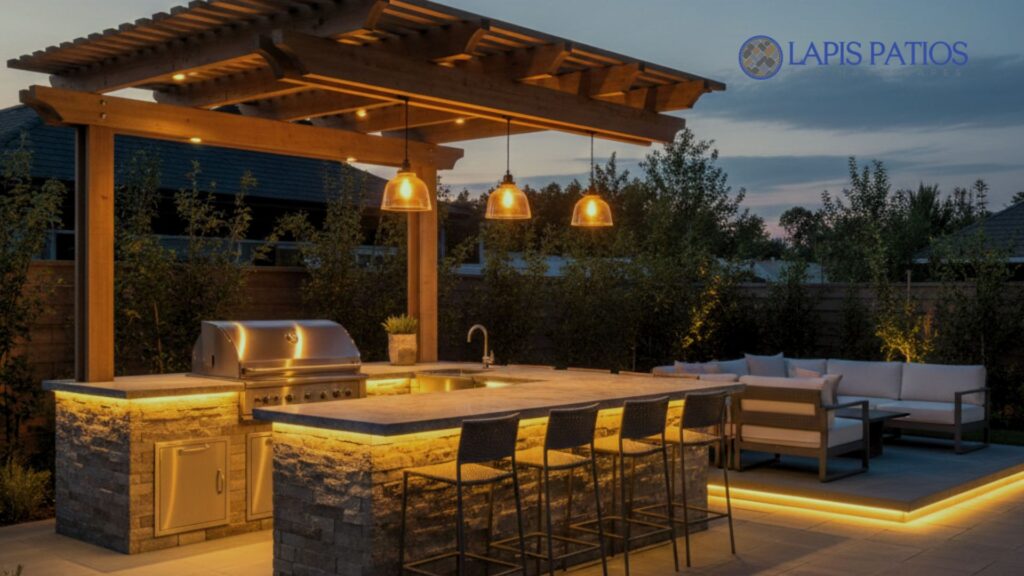
Transform your Charlotte patio with Outdoor Kitchen Lighting design built for grilling, hosting, and calm nights outdoors.
Good outdoor kitchen lighting is not optional, it’s what makes the space usable after sunset. One bulb over the grill won’t carry you from searing a steak to lingering with a drink. Thoughtful lighting lets the patio work in stages, shifting from focused task light to something softer as the night settles in.
It’s what turns a backyard setup into a real extension of your home, not a space you leave once the sun drops. In Charlotte, where evenings invite you to stay outside, that difference matters. Keep reading to see how the right lighting choices make it happen.
Key Takeaways
- Layer task, ambient, and accent lights for a kitchen that works as hard as it entertains.
- Choose fixtures with an IP65 rating or higher to withstand our Southern humidity and storms.
- Use smart dimmers to effortlessly shift the mood from a bright workspace to a soft, social lounge.
The Essential Layers of Illumination
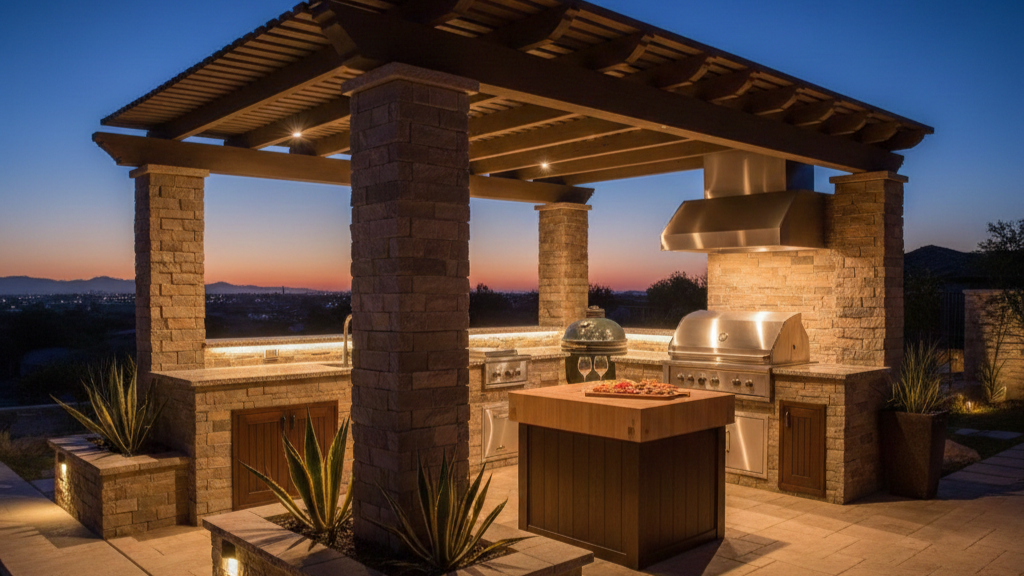
Sometimes an outdoor kitchen looks fine in daylight, then the sun drops and you realize the space has no story, no rhythm, just dark corners and blown-out hot spots. That’s usually a lighting problem, not a furniture or layout issue.
Good lighting outside isn’t about one bright fixture; it builds on the same principles covered in these patio lighting basics, where balance and restraint matter more than raw brightness. You need a strong base, a gentle background, and small highlights that give the space depth.
Relying on a single type of light usually backfires. If everything is bright and direct, the space feels harsh and tiring. If everything is soft and dim, you can’t see what you’re cooking. If you only use accent points, it looks interesting but doesn’t actually work as a kitchen. So we break it down into three working layers:
- Task lighting as your clear, sharp base.
- Ambient lighting as your soft, social glow.
- Accent lighting as your visual interest and drama.
| Lighting Layer | Primary Purpose | Common Locations | Fixture Examples |
| Task Lighting | Visibility and safety during cooking and prep | Grill surface, prep counters, sink, side burners | Recessed lights, under-cabinet LED strips, compact spotlights |
| Ambient Lighting | Overall comfort and social atmosphere | Islands, dining areas, covered patios, pergolas | Pendant lights, string lights, ceiling fan lights |
| Accent Lighting | Visual depth and character | Stone walls, planters, trees, architectural details | Uplights, wall sconces, narrow-beam spotlights |
When these three overlap, the room outside starts to feel as intentional as any room inside.
Task Lighting for Precision & Control
Task lighting is the practical backbone of an outdoor kitchen, the part that makes it feel like a professional workspace instead of a guessing game. Its job is simple: remove shadows where you cook, prep, and clean. When this layer is weak, you find yourself tilting plates toward any available light, trying to judge color or doneness, or fumbling with tools on a dim counter.
Key target zones usually include:
- The primary grill surface, where you read sear marks and interior color.
- Any side burners, where pots can boil over or simmer quietly.
- The main prep counter, especially under a pergola, roof overhang, or cabinet.
- The sink area, where you check if dishes and cutting boards are truly clean.
- A secondary bar or beverage station, where you reach for ice, glasses, or bottles.
Fixtures can be practical and straightforward: recessed cans, compact spotlights, or firm under-cabinet strips. The goal is not decoration, it’s clear, direct, shadow-free light where your hands and tools are. When this layer is done right, the space feels confident and easy to work in, even during the latest part of the evening.[1]
Ambient Lighting for Warmth & Gathering
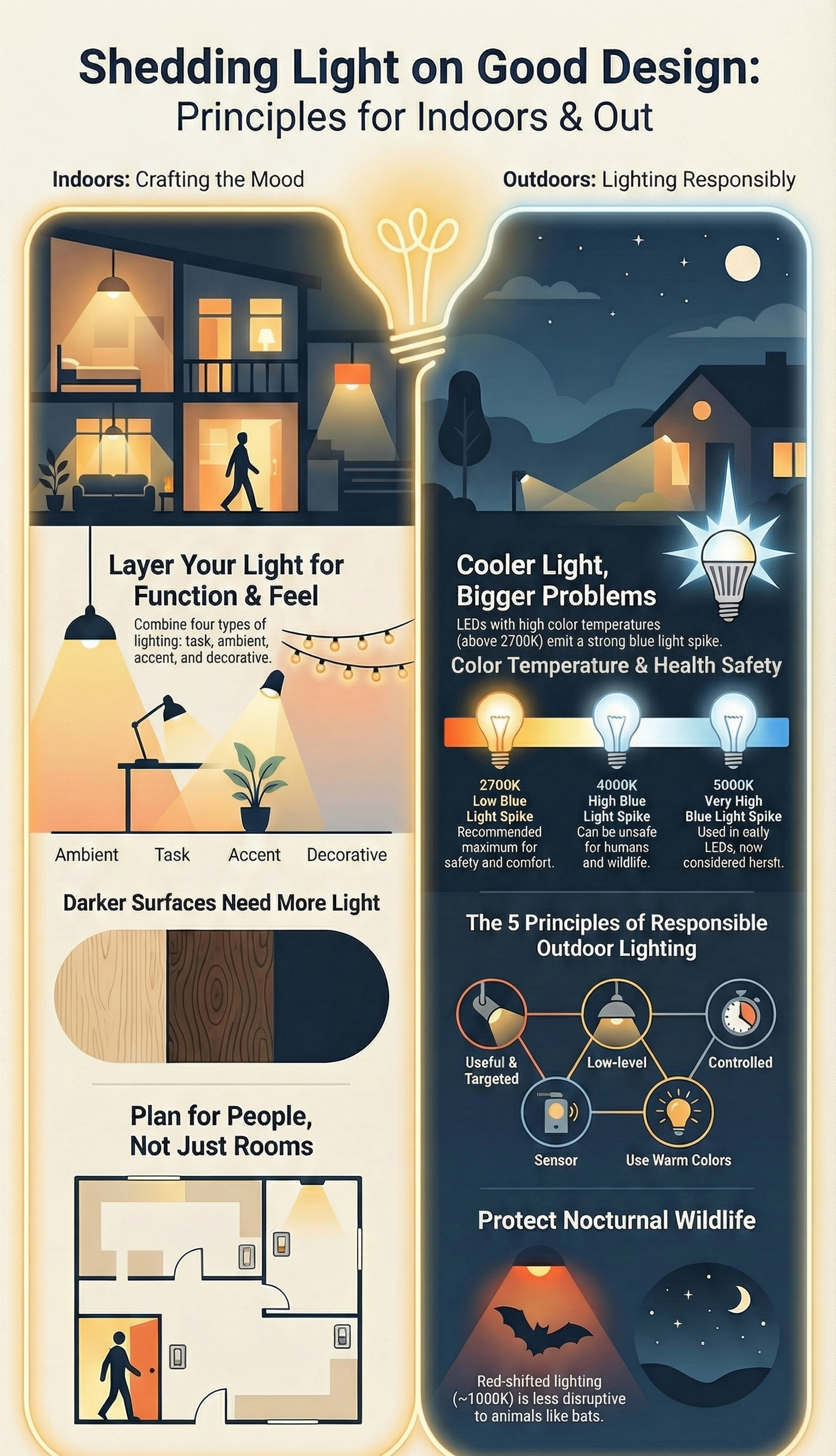
If task lighting is all about precision, ambient lighting is about how the whole place feels when people settle in. It’s the soft layer that wraps the kitchen, dining area, and seating into one shared atmosphere. Faces look warmer, edges feel gentler, and the room stops acting like a work zone and starts acting like a place to stay.
Ambient light usually comes from above or is spread broadly across the area:
- Pendant lights over an island, with woven rattan or frosted glass shades to diffuse the glow.
- String lights stretched across a pergola, forming a canopy of small, warm points.
- A ceiling fan with a built-in light on a covered patio, moving air while sharing even illumination.
You don’t choose these fixtures for intensity, you choose them for how they scatter light. In a place with warm, humid nights, that wide, comfortable glow makes a big difference. It turns “just finished grilling” into “pull up a chair and stay.”
“Ambient lighting creates visual interest to a room by adding contrast in brightness.” — lighting guide on accent and ambient light. [2]
When ambient lighting and task lighting overlap, you get a kitchen that works hard where it needs to, but still feels like a relaxed, social room under the open sky.
This wider, shared glow is part of what defines thoughtful patio lighting for outdoor spaces, where comfort matters just as much as visibility.
Accent Lighting for Character & Depth
Accent lighting is where the outdoor kitchen gains personality, the quieter layer that makes you notice textures, shapes, and details you might otherwise overlook. It doesn’t need to help you read a recipe or scrub a pan. Its role is to reveal, to guide the eye, and to give the space a sense of depth after dark.
Accent fixtures aim at specific targets rather than flooding the whole area:
- A narrow-beam spotlight sliding across a stacked stone grill island, pulling out ridges and shadows.
- A small uplight nestled in a planter, washing the underside of a Japanese maple so it glows softly overhead.
- A subtle sconce aimed at a piece of yard art or the grain of a reclaimed wood beam.
You can build a quiet visual path with a few well-placed choices. None of this is required for cooking, but it changes how the whole backyard feels. Accent lighting gives the eye places to pause and wander, adding a sense of discovery and making the kitchen feel like part of a larger, thoughtful outdoor scene, not just a lit island in the dark.
Selecting Fixtures That Can Take the Weather
Outdoor lights in Charlotte are in a constant fight with heat, humidity, and fast storms. If a fixture isn’t built for that, you see it fast: pitted metal, loose seals, fogged lenses. So you’re not just picking a look, you’re picking gear that can actually survive.
You’ll want every fixture clearly rated for outdoor wet locations, especially if it’s anywhere near rain or heavy spray. Pay close attention to:
- Materials: stainless steel, powder‑coated aluminum, solid brass, or marine-grade metals.
- Seals and gaskets: keep humid air and water from sneaking in.
- Hardware: rust-resistant screws and brackets, especially near pools or grills.
- Finish quality: UV-resistant coatings that won’t peel or fade.
Match the toughness of each fixture to its exposure, fully open, partially covered, or under a solid roof, and the whole system will hold up year after year, instead of failing by the next summer.
Pendants, LEDs, and Directional Fixtures
Once durability is handled, the question shifts to how each type of light shapes the space: what you see, where you walk, and how it all feels at night.
Pendants over an island act like jewelry. They set style and frame conversation. Aim to hang them 30–36 inches above the counter so they light the surface without blocking views or hitting heads. Good options:
- Woven wicker or bamboo for a relaxed, garden feel
- Powder-coated metal drums for a modern look
- Clear glass globes for a bistro vibe
LED strips are your hidden tools. Run outdoor-rated strips:
- Under countertop lips for a “floating” effect
- Inside open cabinets for display light
- Along toe kicks for soft pathway guidance
Use an aluminum channel with a frosted diffuser so the strip becomes a clean line of light, not a row of bright dots.
Wall sconces and spotlights add precision. Sconces give small pools of light near fridges or posts; directional spots on eaves or beams let you highlight herb beds, grill controls, or a sculpture without spilling light into the whole yard.
The Technicalities That Make It Last
We’ve seen plenty of outdoor spaces look great for one season, then slowly fall apart under rain, sun, and humidity. The fixtures didn’t fail because they were ugly, they failed because the specs weren’t built for real weather.
Understanding IP Ratings for Weather Resistance
Outdoor fixtures aren’t decor, they’re gear that has to live with dust, water, and wind for years.
| IP Rating | Protection Level | Suitable Installation Areas |
| IP44 | Protected from splashing water | Fully covered patios with deep overhangs |
| IP65 | Dust-tight and resistant to heavy rain | Open pergolas, exposed beams, posts |
| IP66 | Strong water jet protection | Areas near grills, counters exposed to storms |
| IP67 | Temporary water immersion protection | Ground-level fixtures or areas with pooling water |
IP ratings, IP65, IP66, IP67, tell you how protected a fixture is:
- First digit: solids (dust, debris)
- Second digit: liquids (rain, spray, immersion)
Simple rules that work:
- IP44 – Only for fixtures under a deep, solid overhang.
- IP65 – Minimum for open pergolas, exposed posts, or rail lights. Handles driving rain.
- IP66–IP67 – For harsher exposure, hose spray, or areas where water can pool.
For stormy, humid climates, anything under open sky should be IP65 or higher. That’s what keeps a light from turning into a short-lived ornament, or a risky, water-filled hazard.
Smart Systems and Dimming Capabilities
Credits: Life on the Moose
A single outdoor space usually has more than one personality, and the wiring shouldn’t lock you into just one. Smart dimming lets you shift from bright, practical light to soft, social glow with almost no effort.
You can save simple scenes like:
- Cooking – Task lights at 100%, pendants bright, counters fully lit so every surface is clear.
- Entertaining – Task lights dimmed, pendants softened, wall or stone accents turned up to pull the eye outward.
- Late night – Just path and under-counter lights at 10–20% for safe, quiet movement back inside.
Smart systems also:
- Cut energy use by dimming LEDs instead of running everything at full power.
- Extend fixture life by reducing heat and stress on components.
- Let you schedule lights to turn on at sunset or shut off at set times.
- Divide your layout into zones: task, social, and safety.
You’re not just “using” lights, you’re quietly directing how the space feels hour by hour.
Even at low output, under-counter and toe-kick LEDs play a role similar to garden path lighting, guiding movement without pulling focus from the gathering areas.
Bringing It All Together in Your Space
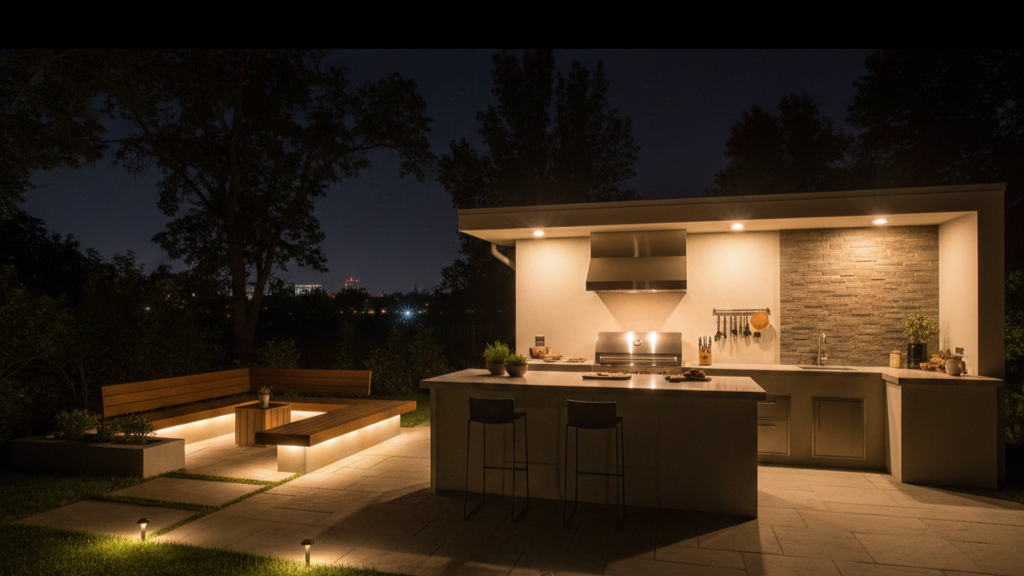
Trends come and go, but in Charlotte, there’s a growing pull toward materials that feel of the earth. Think of pendants with shades made from woven abaca rope, fixtures with bases of cast concrete or textured black iron that shows its age gracefully. It’s a look that sits comfortably among our pine trees and red clay.
Technology is leaning into personalization, too. Color-tuning LEDs let you change the white light from a cool, alert blue-white for a lively party to a warm, amber glow for a quiet dinner. You’re not stuck with one color temperature for the life of the fixture. If your kitchen is under a structure, a pergola, a gazebo, a solid roof, your wiring plan is everything.
Work with your electrician to run conduit before the ceiling or beams are sealed up. Think about where you’ll want switches, and consider placing them indoors where they’re protected from the weather.
For pendants over an island in a covered space, a simple hook-and-chain installation from a central junction box is often cleaner and more adjustable than trying to embed multiple cans in a wood beam ceiling.
FAQ
What outdoor kitchen lighting works best for cooking, dining, and moving safely at night?
Outdoor kitchen lighting works best when it layers different uses. Use outdoor kitchen lights like grill lighting ideas, cooking station spots, and task lighting counters for food prep. Add alfresco dining lights, dining scene pendants, and ambient patio glow for meals. Finish with path safety lights, pathway step lights, and low voltage landscape lighting so people can move safely.
How do I choose weatherproof outdoor kitchen lights that last in rain and heat?
Choose outdoor kitchen lighting with IP65 rated fixtures, weather resistant LEDs, and rainproof gaskets. Look for UV resistant finishes, high humidity seals, and salt air coatings if you live near the coast. Outdoor kitchen lights should be UL listed outdoors or ETL certified wet locations to handle heat, wind, and storms safely.
What are smart and energy efficient options for outdoor kitchen lighting design?
Smart outdoor kitchen lighting design can use smart dimmer switches, smart control systems, and wireless smart hubs. Pair them with energy efficient bulbs, energy star qualified fixtures, and LED landscape kitchen lighting. Dusk to dawn sensors, motion sensor spots, and solar powered options help save power while keeping patio kitchen illumination reliable.
How can we create a mood with outdoor kitchen lighting without making it too bright?
Use kitchen zone layering to control mood. Combine pergola string lights, bistro string bulbs, and ambient patio glow for soft light. Add dimmable outdoor spots, bar top LEDs, and under cabinet strips for control. Dining chandelier dimmers and tunable kelvin LEDs let you shift from warm white ambiance to cooler task whites.
Which decorative outdoor kitchen lights match different patio styles?
Match the style to the space. Rustic lantern pendants and farmhouse billiard pendants suit rural patios. Modern linear fixtures, recessed LED downlights, and minimalist strip designs fit clean spaces. Boho rattan shades, tropical patio lanterns, and balinese bamboo fixtures feel relaxed. Industrial cage lights, contemporary orb clusters, and vintage edison strands add character.
A Final Thought on Nightscapes
Designing your outdoor kitchen lighting isn’t about flooding your yard with brightness. It’s the opposite. It’s about choosing what to reveal and what to leave to the imagination, about carving pools of useful light out of the Southern night.
It’s what lets you flip a burger without guesswork and then, minutes later, lose track of time in a good conversation under a soft, golden haze. Start with one layer. Maybe it’s a string of bulbs overhead to see what the ambience feels like. Then add the spotlight for the grill. Build it slowly, with intention.
If you’re ready to shape those evenings with purpose, talk to a pro about outdoor kitchen lighting design. Your evenings out there are waiting.
References
- https://www.coohom.com/article/when-darkness-fell-on-my-patio-outdoor-kitchen-lights-ideas-that-changed-everything
- https://www.realsimple.com/types-of-lighting-7644711