
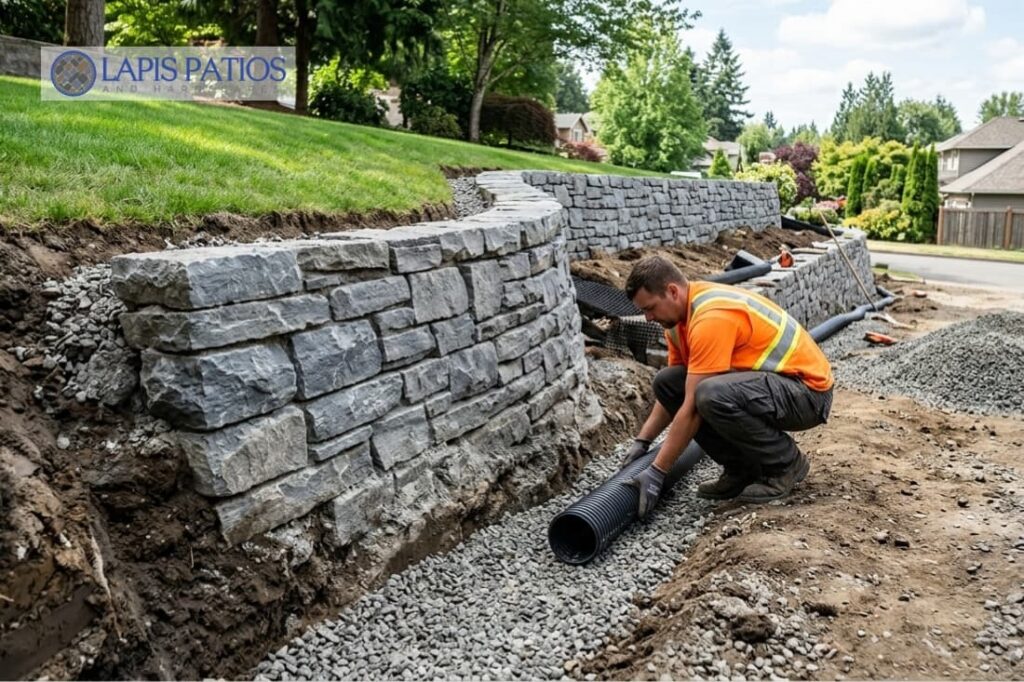
Understand the essentials of stabilizing a gravity retaining wall and how professionals prevent shifting and costly repairs.
A gravity retaining wall stays strong when it has a solid base, enough weight, proper drainage, and stable soil. If any of these fail, the wall can lean, crack, or shift over time. Good drainage is especially important because trapped water adds pressure behind the wall.
For commercial properties, HOA communities, and homes in Charlotte, NC, careful planning helps prevent costly repairs. Lapis Patios evaluates grading, drainage, site conditions, and local requirements before starting work.
Keep reading to learn what keeps a gravity retaining wall stable and when it may need professional repair.
Gravity Wall Stability Essentials
- Build on properly prepared, load-bearing soil.
- Prioritize drainage before considering wall reinforcement.
- Maintain consistent wall batter and adequate base width.
- Compact granular backfill in controlled lifts.
- Address leaning walls before movement accelerates.
- Engineer taller walls for surcharge loads and code compliance.
How Can You Tell if a Gravity Retaining Wall Needs Stabilization?
A leaning wall, bulging face, or open joints can be early signs that a retaining wall is moving. Fixing the problem early can help avoid a larger and more expensive repair.
Many wall problems start below the surface. Poor drainage, a weak foundation, or shifting soil can slowly cause the wall to lean or crack over time.
For commercial properties, these issues can affect parking lots, sidewalks, patios, HOA common areas, and other busy spaces. A small problem today can become a major repair after heavy rain.
Common warning signs include:
- Leaning or bulging wall
- Open joints between stones
- Water coming through the wall
- Soil washing away
- Cracks in nearby pavement
- Ground settling near the wall
- Loose capstones
Fix The Cause, Not Just The Surface
Repairing cracks or replacing mortar will not solve the problem if the wall is still moving. The real cause, such as poor drainage, a weak foundation, or unstable soil, must be corrected first.
For commercial projects in Charlotte, NC, and nearby areas, Lapis Patios first checks the condition of the wall and the site.
After the inspection, the team recommends the best solution. This may include improving drainage, repairing the foundation, stabilizing the wall, or rebuilding damaged sections if needed.
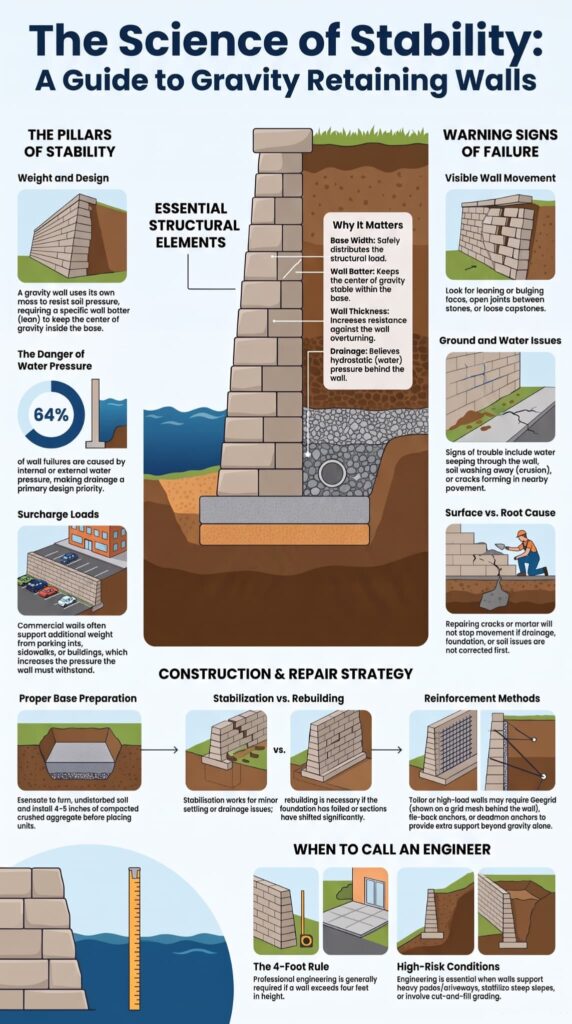
What Makes a Gravity Retaining Wall Stable?
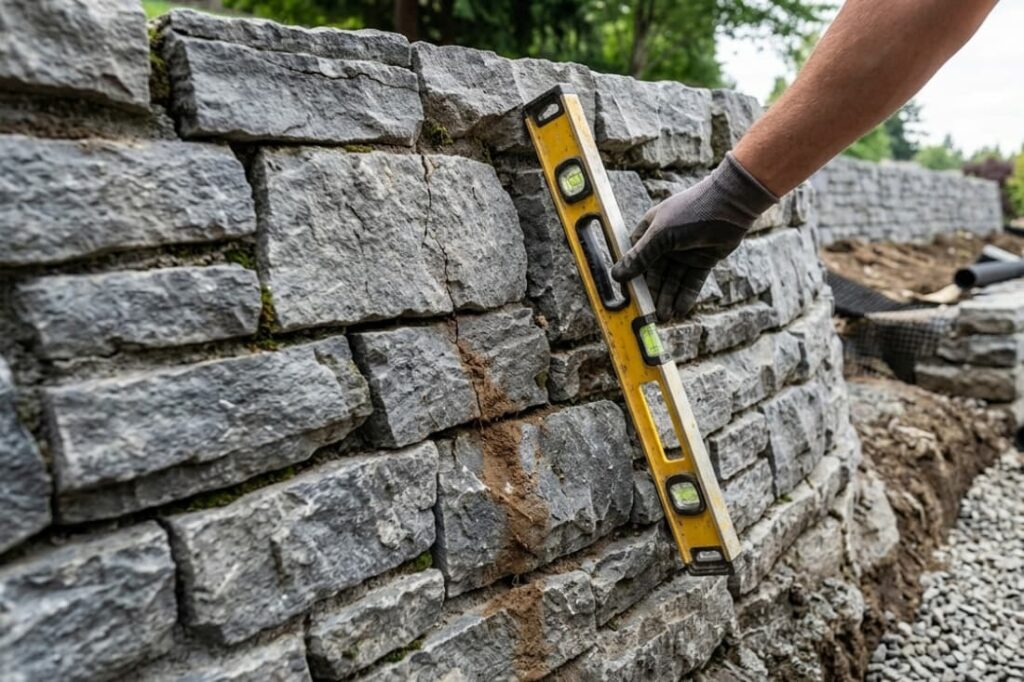
A gravity retaining wall stays stable by using its weight, a strong base, proper wall design, and good drainage to hold back soil, following the same principles used in gravity walls.
The wall’s weight helps resist soil pressure, but it only works if the foundation is strong and stable. Good drainage is also important because it reduces water pressure behind the wall.
Commercial retaining walls often hold more than soil. They may also support parking lots, patios, sidewalks, outdoor seating, or nearby buildings.
This extra weight adds more pressure to the wall. A professional contractor plans for these loads to help keep the wall safe and stable over time.
| Structural Element | Why It Matters |
| Base Width | Distributes structural loads safely |
| Wall Batter | Keeps the center of gravity inside the base |
| Wall Thickness | Increases resistance against overturning |
| Drainage | Relieves hydrostatic pressure |
| Compacted Backfill | Minimizes settlement and wall movement |
The wall also needs the right shape and a strong foundation. A slight backward lean, the correct base size, and proper embedment below ground all help keep it stable. Even the best materials cannot make up for poor installation or improper construction techniques.
Pro Tip: Adding more stone behind a leaning wall usually does not solve the problem. If the drainage and foundation are not fixed first, the extra weight can put even more pressure on the wall.
How Do Base Preparation, Drainage, and Compaction Prevent Failure?
A gravity retaining wall stays strong when it has a solid foundation, good drainage, and properly compacted backfill. These three parts work together to support the wall and reduce movement over time.
For commercial projects in Charlotte, NC, careful construction also helps meet local building codes, HOA requirements, and long-term maintenance goals. Lapis Patios plans the foundation, drainage, and grading as one complete system.
Before construction begins, contractors check the soil. Weak soil, organic material, or loose fill should be removed and replaced with compacted aggregate.
A strong foundation starts with proper wall construction practices:
- Excavating to firm soil
- Removing weak material
- Adding compacted crushed stone
- Building the correct base width
- Compacting the base before placing stone
Build a Stable Foundation
A strong gravity retaining wall starts below grade.
- Excavate to firm, undisturbed soil.
- Remove unsuitable soils and organic material.
- Install 4–6 inches of compacted crushed aggregate.
- Verify proper base width and footing design.
- Compact the base using mechanical equipment before placing wall units.
Transitioning from foundation preparation, water management becomes equally important because even a well-built wall can fail if water pressure accumulates behind it.
Control Water Behind The Wall
Water is one of the biggest causes of retaining wall problems. Good drainage helps move water away before pressure builds behind the wall.
Data from Geotextiles and Geomembranes demonstrates
“191 cases (64%) were due to internal or external water pressure which is clearly a design issue having nothing to do with the reinforcement.” – Geotextiles and Geomembranes
A proper drainage system may include:
- Free-draining backfill
- A perforated drain pipe
- A drain outlet or French drain
- Weep holes when needed
- Filter fabric
Good drainage helps reduce pressure and protects the wall over time.
Compact Backfill The Right Way
Backfill should be placed and compacted in small layers. This helps create a strong base behind the wall.
Professional contractors:
- Place backfill in thin lifts
- Compact each layer
- Avoid loose fill
- Keep the wall aligned
For commercial properties, HOAs, and large residential projects, Lapis Patios follows proven construction practices that support long-term wall performance instead of relying on shortcuts.
Can You Stabilize a Leaning Gravity Retaining Wall Without Rebuilding It?
Credits: GeoTechSoil
Sometimes. Small problems caused by poor drainage or minor settling can often be repaired. If the wall has large cracks, major leaning, or serious movement, rebuilding is usually the better option.
Many property owners hope a quick repair will stop the problem. In many cases, it will not. A lasting repair starts by finding the real cause of the movement.
| Stabilization May Work | Rebuilding Is Often Better |
| Improve drainage | Wall is leaning badly |
| Minor settling | Foundation has failed |
| Small areas of movement | Large sections have shifted |
| Stable foundation | Multiple structural problems |
| Limited erosion | Severe erosion under the wall |
Choosing The Right Repair
If the damage is minor, contractors may recommend:
- Improving drainage
- Repairing the foundation
- Strengthening the wall
- Repointing stone joints
- Repairing capstones
- Fixing damaged joints
If the wall has major movement or the foundation is no longer stable, rebuilding is often the safest long-term solution.
When Do Geogrid, Tie-Backs, or Professional Engineering Become Necessary?
Gravity alone is not always enough. Taller retaining walls, heavy loads, steep slopes, and weak soil may need extra reinforcement to stay stable.
Commercial retaining walls often support parking lots, patios, roads, or HOA common areas. These projects may require engineering before construction begins.
In a recent analysis by Stellenbosch University
“The original design incorrectly calculated the active pressure coefficient, which resulted in a lower active pressure, approximately a quarter of what it should have been.” – Stellenbosch University
| Reinforcement Method | Typical Use |
| Geogrid | Taller retaining walls |
| Tie-back anchors | Stabilizing existing walls |
| Helical anchors | Limited-access repair sites |
| Deadman anchors | Extra wall support |
| Buttress support | Large masonry walls |
| Counterfort wall | High-load retaining systems |
When Is Engineering Needed?
Professional engineering is often recommended when:
- The wall is over about 4 feet tall
- Heavy patios, driveways, or buildings add extra weight
- The soil is weak
- The slope needs stabilization
- The project includes cut-and-fill grading
- Local codes require engineered plans or permits
Depending on the site, engineers may recommend geogrid, anchors, reinforced soil, or other support systems.
How Should a Gravity Retaining Wall Integrate With a Patio?
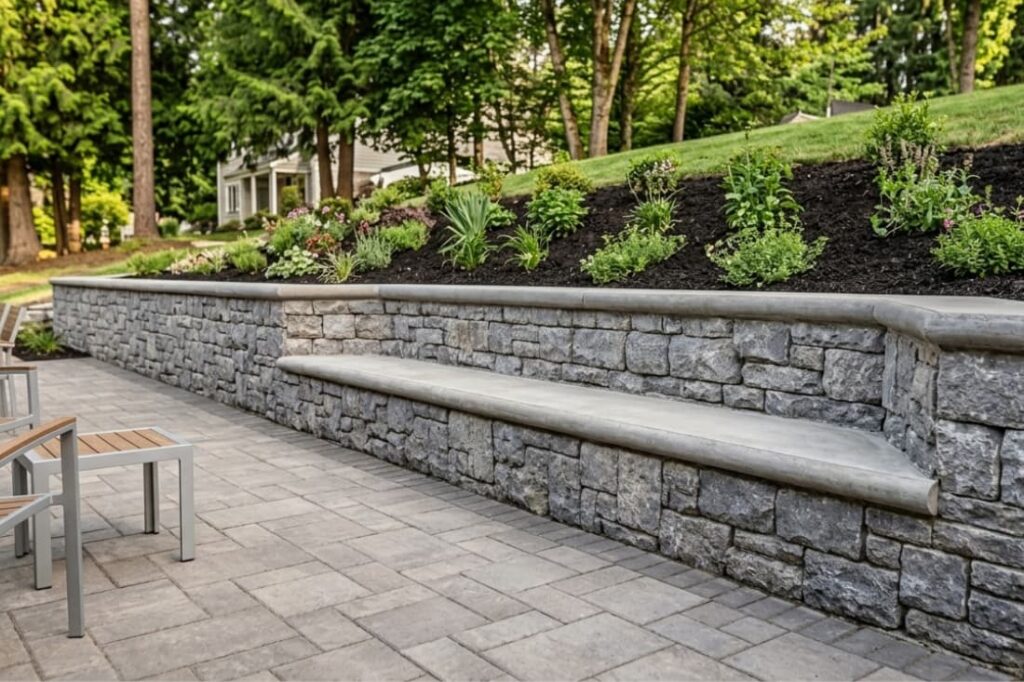
A retaining wall and patio should be planned as one system. When they are built separately, drainage problems, settling, and future repairs are more likely.
Water running off the patio can affect the retaining wall. If runoff flows toward the wall, it can increase pressure, wash away soil, and shorten the life of the structure.
A well-planned project should coordinate:
- Patio slope
- Drainage outlets
- Capstones and wall coping
- Finished grades
- Expansion joints
- Large landscape features
- Terrace transitions
- Multi-level retaining walls
Patios near slopes or outdoor gathering areas often place extra weight on the retaining wall. Furniture, landscaping, and future improvements should all be considered during the design process.
For commercial projects in Charlotte, NC and nearby areas, Lapis Patios plans retaining walls, patios, drainage, and grading together. This approach helps projects meet local requirements and supports long-term performance.
To help protect the wall, runoff should flow away from it. Heavy structures should not be placed behind the wall unless it has been designed to support those loads.
FAQ
What usually causes a gravity retaining wall to become unstable?
A gravity retaining wall can become unstable because of poor drainage, excessive lateral earth pressure, hydrostatic pressure, differential settlement, subgrade failure, toe erosion, or the undermining of the wall.
These problems reduce retaining wall stability over time. Regular inspections and routine retaining wall maintenance help identify problems early and reduce the risk of expensive retaining wall repair.
How can drainage improve retaining wall stability?
Proper drainage improvement reduces water buildup behind the wall and provides hydrostatic pressure relief.
A system that includes a perforated drain pipe, French drain, toe drain, outlet drainage, weep holes, geotextile fabric, filter fabric, free-draining fill, and granular backfill helps reduce water pressure, prevent soil migration, and protect the wall from long-term structural damage.
When does a gravity retaining wall need reinforcement?
Wall reinforcement is often required when stabilising a retaining wall that faces excessive soil pressure, active earth pressure, or poor ground conditions.
Reinforcement methods may include tie-back anchors, soil anchors, ground anchors, helical anchors, wall tie-backs, or buttress support. A structural engineer assessment determines the most appropriate solution based on the site and wall design.
Can a leaning or bulging retaining wall be repaired?
Yes, but the repair method depends on the cause and severity of the damage. Leaning wall correction, bulging wall repair, crack repair, joint repair, mortar repair, repointing stone, capstone repair, and wall coping replacement may restore stability when structural damage is limited. Walls with severe foundation problems often require wall strengthening or complete wall reconstruction.
When should a retaining wall be rebuilt instead of repaired?
A retaining wall should be rebuilt when repairs cannot restore sliding resistance, overturning resistance, bearing capacity, or global stability.
Extensive foundation stabilisation problems, major wall drainage issues, failed footing design, or significant structural movement often make reconstruction the safer option. A structural engineer assessment can determine whether repair or replacement is the better long-term solution.
Stabilize A Gravity Retaining Wall The Right Way
A gravity retaining wall works best when it is built on a solid base with good drainage. The wall also needs the right design and careful installation to stay strong over time. When these parts work together, the wall is less likely to lean, crack, or shift.
Lapis Patios builds retaining walls for commercial developments, large-scale hardscape projects, and residential properties. If you’re planning a gravity retaining wall project in Charlotte, NC, contact Lapis Patios to discuss a solution designed for your site and project needs.
References
- https://www.sciencedirect.com/science/article/abs/pii/S0266114418300748
- https://scholar.sun.ac.za/server/api/core/bitstreams/12d7d155-2944-4555-b478-aca9f61a85c6/content