
Best materials for retaining walls compared by cost, lifespan, and real-world performance. Choose the right option for durable commercial and residential projects.
Concrete blocks, natural stone, and poured concrete are the best materials for retaining walls because they deliver structural strength, long lifespan, and reliable drainage performance across both commercial and residential projects.
In regions like Charlotte, NC, where clay-heavy soils and seasonal rainfall create pressure behind walls, material choice directly affects stability, compliance, and long-term maintenance costs.
Developers and property managers often face failures not from poor installation, but from choosing materials that cannot handle site conditions.
Selecting the right system upfront reduces liability, protects surrounding structures, and extends project lifespan. Continue reading to evaluate which materials truly perform under real-world conditions.
Smart Material Selection: Key Retaining Wall Insights
- Concrete block systems lead modern construction, balancing cost ($20-$35 per sq ft) with durability and scalability
- Natural stone remains the longest-lasting option, often exceeding 100+ years with minimal maintenance
- Drainage design drives wall performance, contributing to over 70% of retaining wall failures when done incorrectly
What Are The Best Materials For Retaining Walls Overall?
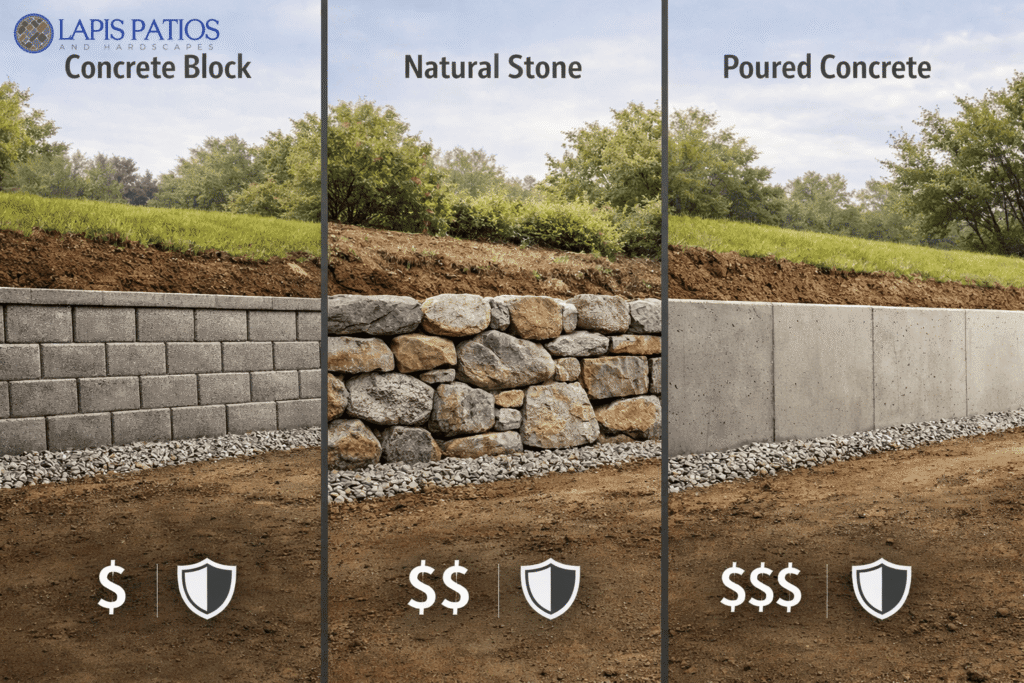
Concrete block systems, natural stone, and poured concrete remain the top choices for retaining walls. Each holds up under load, handles drainage, and lasts for decades. In most commercial projects, concrete block systems are used most often because they scale well and stay within budget.
Concrete block retaining wall systems, including modular and interlocking designs, dominate modern construction. Installed costs typically fall between $20 and $35 per square foot, which keeps large projects financially workable.
Natural stone lasts longer than any other option and drains well, reducing pressure behind the wall. It also gives a clean, high-end finish that fits premium developments.
Poured concrete delivers the highest structural strength. It is often used in cantilever wall designs and areas with heavy loads, such as parking lots or roadway support.
As highlighted by the American Journal of Civil Engineering
“Reinforced concrete (RC) is the most commonly adopted material due to its durability, compressive strength, adaptability in shaping, and long-term resistance to environmental effects. The primary function of a retaining wall is to prevent soil mass failure due to lateral pressure, surcharge loads, water pressure, and seismic forces.” – American Journal of Civil Engineering
Engineered systems combine design specs, reinforcement, and load calculations to meet code. These are standard in commercial builds where compliance and liability matter.
For developers and property managers, these materials meet current building codes and HOA requirements, especially in markets like Charlotte where inspections are strict and long-term performance matters.
Why Concrete Blocks Are The Most Popular Retaining Wall Material
Interlocking concrete blocks are widely used because they balance strength, cost, and installation speed. They are especially common for walls under four feet, but can scale much higher with proper engineering.
Concrete block systems offer consistent performance. Industry data shows properly installed walls can last 50 to 100 years. That level of predictability matters in commercial work, where failure is not an option, especially across large-scale retaining walls where long-term stability directly impacts surrounding structures.
Their modular design allows crews to move quickly across large sites, from retail centers to multi-family housing. They also support tiered walls and slope stabilization without slowing down construction timelines.
From a compliance standpoint, these systems fit well with engineered plans and local inspections. In Charlotte and nearby areas, drainage and structural integrity are closely reviewed, and block systems meet those standards without complication.
Common advantages include:
- Consistent manufacturing and sizing
- Compatibility with reinforced systems using geogrid
- A range of finishes for decorative applications
- Faster installation compared to poured systems
These walls follow Segmental Retaining Wall standards, making them a reliable option for both structure and appearance.
Is Natural Stone The Most Durable Retaining Wall Option?
Natural stone lasts longer than any other material. In many cases, well-built stone walls stand for over 100 years.
Dense stone like granite resists weathering and handles freeze-thaw cycles without breaking down. Its natural gaps allow water to pass through, which reduces pressure behind the wall.
Key performance points include:
- A lifespan that can exceed a century
- Strong resistance to erosion and climate changes
- Natural drainage that lowers failure risk
- A high-end look suited for visible commercial spaces
Stone does require skilled installation. Poor placement can lead to shifting or uneven load distribution. For large-scale or high-visibility projects, experienced crews make the difference.
For commercial clients, stone often means a higher upfront cost but fewer repairs over time. It works best when long-term value matters more than initial spend.
When Does Timber Make Sense For Retaining Walls?
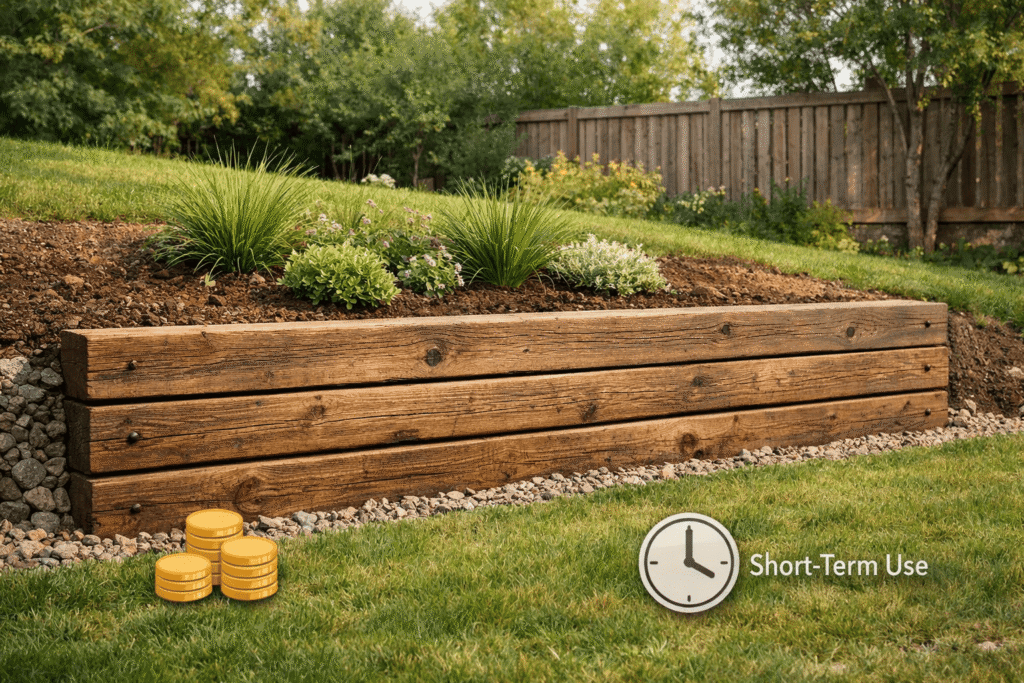
Timber is limited to small, low-load applications. It is usually used for walls under three feet where cost is the main concern.
Even pressure-treated wood breaks down over time, especially in wet soil. Most timber walls last between 10 and 15 years before needing replacement.
Typical use cases include:
- Small garden walls
- Temporary structures
- Projects with tight budgets
In commercial settings, timber rarely meets long-term requirements. Maintenance costs, safety concerns, and shorter lifespan make it a poor fit for most developments.
Concrete Vs Timber Vs Stone: Which One Should You Choose?
Cedits: Buildi
Material choice depends on wall height, soil conditions, and how long the structure needs to last.
Concrete works for most projects. It offers strong performance, controlled costs, and long service life.
Stone lasts the longest and requires little maintenance, but comes with higher installation costs.
Timber is a short-term solution and does not meet the demands of most commercial work.
- Concrete: 50-100 years, low maintenance, best for most commercial and residential builds
- Stone: 100+ years, very low maintenance, best for high-end or long-term projects
- Timber: 10-15 years, higher maintenance, best for temporary or low-load use
For developers and property managers, lifecycle cost usually outweighs upfront savings. Concrete and stone deliver better long-term results and meet code requirements more easily.
Why Drainage Matters More Than Material Choice
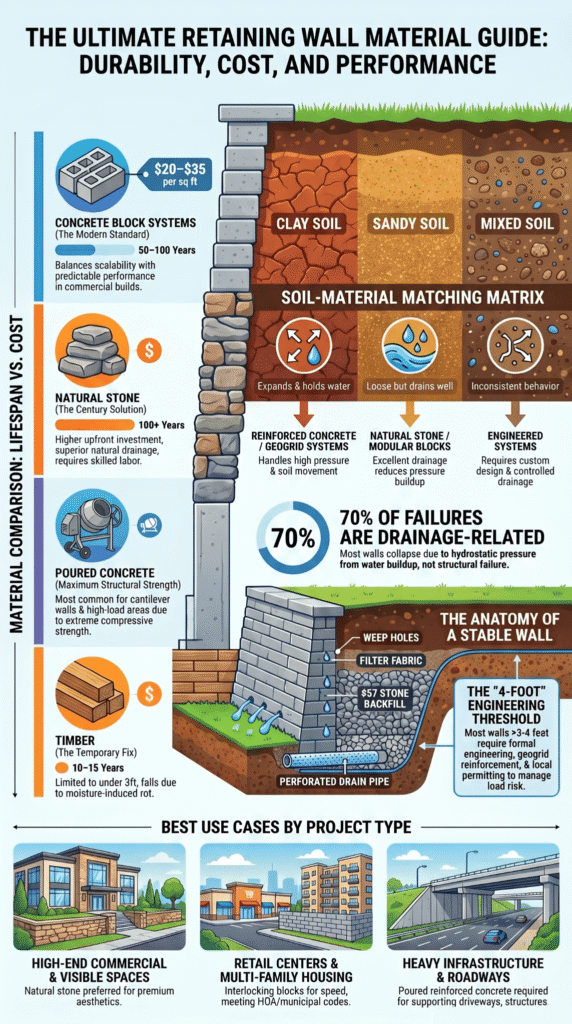
Most retaining wall failures come from poor drainage, not weak materials. Water buildup behind a wall creates pressure that pushes against the structure until it cracks or shifts.
Studies show that over 70 percent of failures are tied to water pressure. That risk applies to every material. In a recent analysis by the Open Jica Report
“Gravity [retaining walls] support the earth pressure by their deadweight… Applicable on good ground foundations because of the great ground reaction. Cantilever [walls]… the vertical wall resists the lateral load or earth pressure, and the weight of backfill over the heel slab can be used to support the earth pressure. Precast concrete is frequently used.” – Open Jica Report
A proper drainage system includes:
- Gravel backfill to allow water movement
- Perforated drain pipes to carry water away
- Weep holes to release pressure
- Filter fabric to prevent clogging
In commercial construction, drainage is reviewed during permitting and inspections. Skipping this step leads to failures, repairs, and liability issues.
At Lapis Patios, drainage design is treated as part of the structure, not an add-on. That approach keeps retaining walls stable over time and aligned with local building codes in Charlotte and surrounding areas.
What Are The Best Backfill And Base Materials?
Crushed, angular stone is the standard for backfill. Materials like 3/4-inch minus gravel and #57 stone drain well and lock together under pressure.
Backfill does two jobs. It supports the wall and moves water away from it. If either fails, the wall fails.
For the base layer, contractors use compactable material such as crusher run. It forms a stable footing that keeps the wall from shifting over time.
Base material should be placed in 4 to 6-inch layers and compacted between lifts. Skipping this step leads to settling, uneven walls, and early failure, which often results in costly patio repair issues when adjacent outdoor structures begin to shift or crack.
Best-performing materials include:
- #57 stone for drainage
- 3/4-inch minus gravel for compaction
- Crushed stone base for structural support
Proper installation includes grading the base so water flows away from the wall. On sloped sites, this detail matters even more. Poor base prep shows up fast, usually as leaning or cracking within a few seasons.
At Lapis Patios, base and backfill are treated as structural elements, not filler. That approach keeps walls stable across large commercial sites in Charlotte.
Which Retaining Wall Material Works Best For Different Soil Types?
Soil type changes how a wall performs. In North Carolina, clay-heavy soil creates the biggest challenges.
Clay expands when wet and shrinks when dry. That movement adds pressure behind the wall and can push it out of line. In some cases, soil volume can increase by up to 10 percent.
Material choice should match soil conditions:
- Clay soils: reinforced concrete or geogrid-reinforced systems
- Sandy soils: stone or modular block systems
- Mixed soils: engineered systems with strong drainage control
| Soil Type | Key Challenge | Recommended Material | Reason |
| Clay Soil | Expands & holds water | Reinforced concrete, geogrid systems | Handles pressure and movement |
| Sandy Soil | Loose but drains well | Natural stone, modular blocks | Good drainage reduces pressure |
| Mixed Soil | Inconsistent behavior | Engineered systems | Requires controlled design and drainage |
Sandy soil drains well, which reduces pressure. Clay holds water, which increases it. That difference drives design decisions.
Commercial projects should include soil evaluation before construction starts. It is not a formality. It determines the wall type, reinforcement needs, and drainage plan.
In the Charlotte area, building codes and inspections often reflect these conditions. Ignoring soil behavior leads to failed inspections or costly repairs later.
When Do You Need Reinforced Or Engineered Retaining Walls?
Reinforcement becomes necessary when loads increase or risk rises. Most walls above 3 to 4 feet require added support, especially in commercial settings.
Geogrid reinforcement ties the wall into the soil behind it. This can increase stability by two to three times when installed correctly.
Reinforced or engineered walls are required when:
- Wall height exceeds local limits
- The wall supports a driveway, parking area, or building
- Soil conditions are unstable or expansive
- The site has high water exposure
In Charlotte and the surrounding areas, permitting often requires engineering review for taller walls. Plans must show load calculations, drainage, and reinforcement details.
Skipping this step can delay projects or stop them altogether. For developers and property managers, engineered design is part of risk control, not an upgrade.
Lapis Patios works with engineered plans on commercial builds to meet code, pass inspections, and avoid liability.
Are There Cost-Effective And Eco-Friendly Retaining Wall Materials?
Some projects look for lower-cost or environmentally conscious options. These can work, but they come with trade-offs.
Common alternatives include:
- Gabion walls filled with stone
- Recycled concrete materials
- Sustainably sourced timber
Gabion systems allow strong drainage and can reduce costs by 20 to 30 percent. They are often used in erosion control or utility areas.
Recycled concrete can work as fill or structural material in certain designs. Timber has a lower upfront cost but does not last as long, especially in wet soil.
For commercial properties and HOA-regulated communities, appearance and compliance matter. Some of these options may not meet design standards or long-term performance expectations.
Material choice should balance cost, durability, and code requirements. Short-term savings can lead to long-term repairs.
Common Retaining Wall Mistakes That Lead To Failure
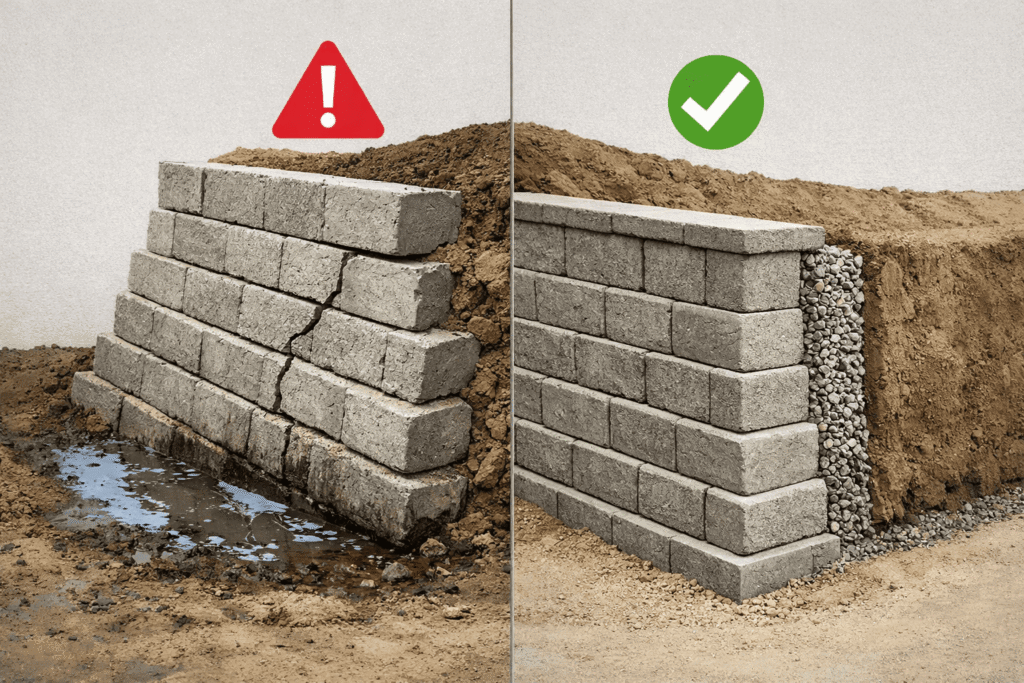
Most retaining wall failures come from installation errors, not the material itself.
Common problems include:
- Missing or poorly designed drainage systems
- Weak or uneven base compaction
- No reinforcement where it is required
- Undersized or low-quality materials
Water buildup behind the wall remains the biggest issue. Without a way to release pressure, the wall will crack, bow, or collapse, creating long-term structural problems that routine patio maintenance practices are designed to prevent when addressed early.
In high-load conditions, additional support such as tieback anchors may be required. These systems add strength where standard reinforcement is not enough.
For commercial projects, these mistakes can lead to code violations, failed inspections, and liability exposure. Repairs often cost more than doing it right the first time.
Experienced contractors plan for these risks from the start.
Best Materials For Retaining Walls Based On Your Project Type
Material selection should match the use of the space and the load it must handle.
Typical pairings include:
- Patios and outdoor spaces: interlocking concrete block systems
- Sloped sites: poured concrete or reinforced block systems
- High-end developments: natural stone
- Heavy-load areas: engineered cantilever wall systems
Walls under four feet may not require formal engineering in some cases, but commercial projects still need professional oversight. Code compliance, drainage, and long-term performance cannot be left to guesswork.
Lapis Patios approaches each project with a focus on structure first, then appearance. That process keeps retaining walls compliant with local codes and HOA standards across Charlotte and nearby communities, while holding up under real-world use.
FAQ
What are the best materials for retaining walls in a landscaping project?
The best materials for retaining walls depend on soil conditions, budget, and design goals. Concrete block, natural stone, and poured concrete are common choices.
Wood retaining walls use pressure-treated timber or treated timber. Gabion walls use wire cages filled with rock. Each material handles soil pressure differently, so choose based on site needs and expected load.
How do drainage systems help prevent damage in retaining wall construction?
Drainage systems control water flow and reduce hydrostatic pressure behind retaining walls. Without proper drainage, trapped water increases water pressure and can cause cracks or failure.
Builders use drainage stone, perforated pipe, and weep holes to move water away. These elements protect the wall, reduce soil erosion, and improve long-term performance in wet conditions.
Which retaining wall materials work best in cold climates with freeze-thaw cycles?
Cold climates require materials that resist frost heave and freeze-thaw cycles. Natural stone, reinforced concrete, and frost-resistant brick perform well under these conditions.
Segmental retaining wall blocks also adapt to slight ground movement. Proper drainage systems are essential because trapped water can freeze, expand, and increase soil pressure behind the wall.
Are gabion walls and recycled materials good for environmentally-friendly retaining walls?
Gabion walls and recycled materials are effective options for environmentally friendly materials. Gabion baskets filled with rock or reused concrete reduce waste and support sustainable materials use.
These systems allow natural water flow, which lowers hydrostatic pressure. They also fit well into outdoor spaces and support practical land management techniques in many landscaping projects.
What factors affect material choice for residential retaining walls?
Material choice depends on soil conditions, water exposure, climate resilience, and wall height. Reinforced concrete or cantilever walls handle high soil pressure. Wood retaining walls use pressure-treated lumber but require maintenance.
Natural stone and segmental blocks provide durability. Proper installation methods and drainage systems are essential for safe and long-lasting residential retaining walls.
Final Thoughts on Retaining Wall Materials
You feel it when a wall starts to shift or hold water, and it turns into a bigger problem fast. The material matters, but poor drainage or setup will ruin even the strongest option. That’s the reality.
Working with a team like Lapis Patio makes the choice simpler and more reliable. They handle the details that actually protect your build over time, so you’re not guessing or fixing issues later. It’s a smarter next step.
References
- https://www.sciencepublishinggroup.com/article/10.11648/j.ajce.20261402.14
- https://openjicareport.jica.go.jp/pdf/11922267_04.pdf