
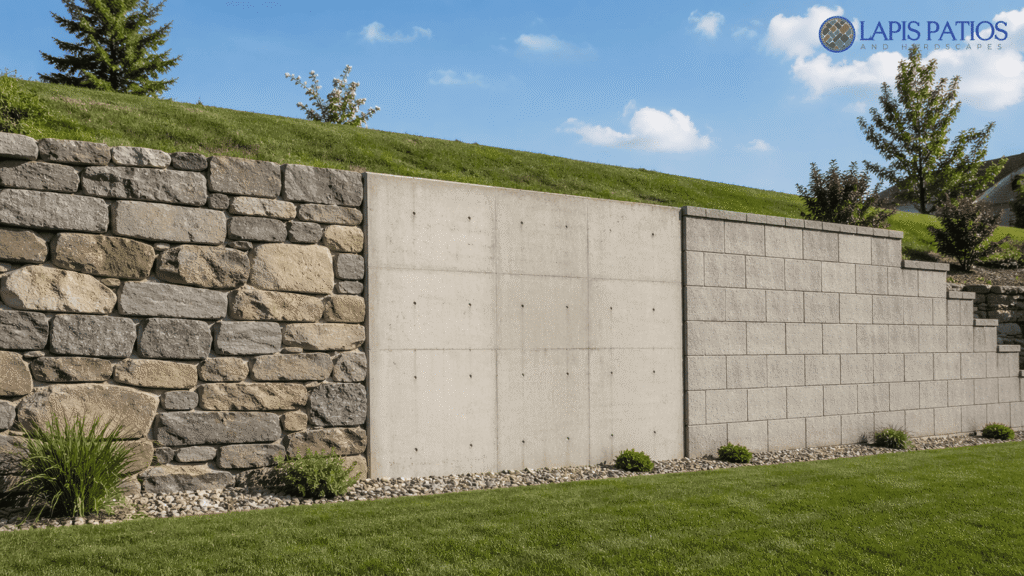
Explore the most durable retaining wall materials for commercial projects built to handle pressure, weather, and long-term use.
Natural stone and poured concrete last the longest. They can hold up for decades if they’re built the right way. But here in Charlotte, the material is just one part of the story. Bad soil, poor drainage, and water pressure can ruin a wall even if it’s made from the strongest stuff.
For people managing a property or a development, a broken wall isn’t just a repair job. It can stop a project, cause safety issues, and get you in trouble with building inspectors. Our company builds walls for commercial sites and large homes, and we focus on getting the structure, drainage, and permits right. Let’s look at what might work for your project.
What Makes a Retaining Wall Last?
- The material. Stone and concrete are top choices.
- The drainage. Water is a wall’s biggest enemy.
- The build. It has to be done right for the local soil and weather.
What Does “Durable” Even Mean for A Wall?
A durable wall can handle three things: the heavy push of the dirt behind it, lots of water, and the passage of time. The blocks or stones you pick are important, but the design and construction are just as critical.
Most walls fail because of water. When water gets stuck behind the wall, it builds up pressure and shoves the wall forward. Without a good way for that water to escape, even a strong wall will crack or start to lean in a few years.
A good wall system manages that pressure. It uses things like gravel backfill, fabric barriers, and little drain holes (called weep holes) to let water out. In North Carolina, this is extra important. We get heavy rain, and our freeze-thaw cycles put a lot of stress on a wall’s foundation.
How the wall is built decides everything. For a big project, the contractor, engineer, and site planner all need to work together. They have to check the soil, the slope, and where the water will run off before any digging starts. We handle this whole process for jobs around Charlotte, making sure walls meet city codes and pass any neighborhood reviews without holdups.
What you need for a wall that lasts:
- A design that can resist the pressure of the soil.
- A drainage system with gravel and weep holes.
- Materials that can stand up to our weather.
- Approval from local building officials.
Skip these steps, and the wall won’t hold, especially on a big commercial lot.
Which Materials Last the Longest?
Natural stone and poured concrete are the champions. Both can easily last over 100 years if they’re installed correctly, which is why they’re the go-to for serious projects. Many commercial builders compare different retaining wall materials early in planning to avoid long-term structural issues.
Some materials fall apart quickly under pressure and wet conditions. Others keep their strength for a lifetime. You see the real difference in your long-term costs, not just the initial price.
| Material | How long it usually lasts | How tough is it? |
| Natural Stone | 100+ years | Excellent |
| Poured Concrete | 50–100+ years | Excellent |
| Concrete Blocks | 50–100 years | Very Good |
| Wood (Timber) | 7–15 years | Poor |
Why some materials are better:
- Natural stone doesn’t erode easily and stands up to weather.
- Poured concrete is incredibly strong against heavy soil loads.
- Interlocking concrete blocks can shift a little without collapsing.
- Wood rots, attracts bugs, and gets weak from moisture.
For a property manager, a cheaper wall now often means replacing it sooner, which causes more disruption and cost down the road.
Is Natural Stone The Toughest Choice?
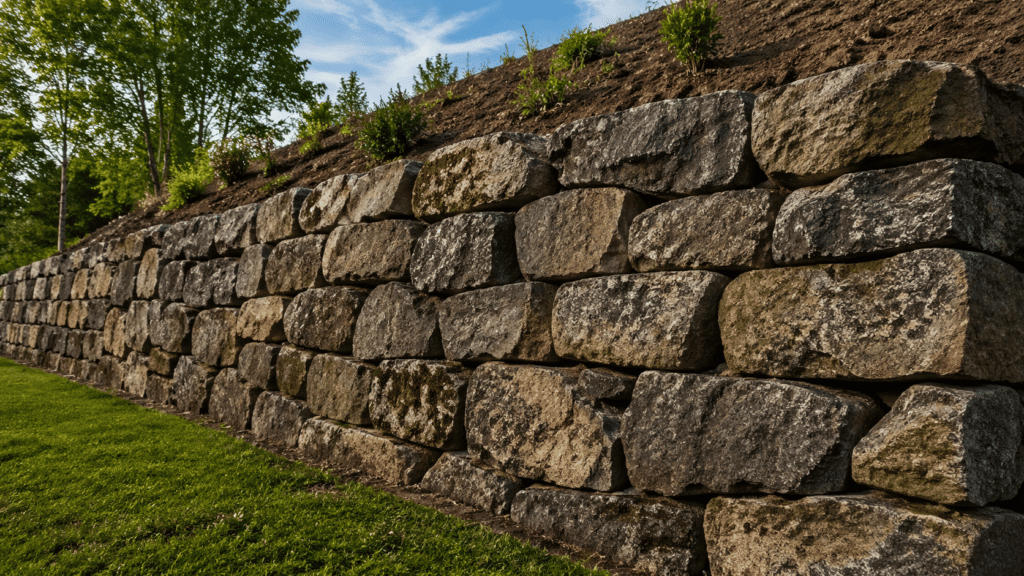
Yes. Natural stone typically outlasts almost everything else. A well-built stone wall can stand for more than a century with hardly any care. This is why it’s often listed among the best materials for retaining walls when long-term durability is the top priority.
Stone doesn’t rot, and the sun doesn’t damage it. It also deals with water naturally. The small spaces between the stones let water drain through, which relieves pressure.
This makes stone a great option for big commercial properties, community developments, and high-end homes where you need both strength and good looks.
Why stone works so well:
- It lasts over 100 years.
- It fights off weather and wear.
- Water drains through the joints.
- It fits nicely with the natural land.
What to think about:
- It costs more upfront.
- You need an experienced crew to install it.
- The base has to be perfectly prepared for big walls.
For commercial projects in Charlotte, stone gives you great long-term value when an expert builds it. We construct these walls to handle real site conditions and pass all the necessary inspections.
The Real Strength of Poured Concrete Walls
Picture the dirt behind a wall. When it gets wet, it gets heavy. Really heavy. It pushes against the wall with a lot of force. Poured concrete is the champion at standing up to that push. That’s why you see it on the biggest construction sites and commercial properties.
Unlike a wall made of blocks, a poured wall is a single thing. It’s all connected. There are no cracks or gaps between pieces for water to sneak into and force apart. This makes it much tougher against the constant pressure from the ground and from water building up behind it.
If the wall is going to be taller than a person, workers put steel bars inside the concrete while it’s still wet. Think of this like the bones inside your body. These steel “bones” give the wall its real strength, especially down at the bottom where all the weight is.
As highlighted by Missouri Department of Transportation (MoDOT)
“A 75 year minimum design life shall be used for permanent walls (if the retained foundation requires 100 years, then consider a 100 year minimum design life for the wall). Cast-In-Place Concrete Retaining Walls shall be Class B Concrete (f’c = 3000 psi) unless the footing is used as a riding surface in which case Class B-1 Concrete (f’c = 4000 psi) shall be used.” – Missouri Department of Transportation (MoDOT)
The good stuff:
- Unbeatable strength against wet, heavy soil.
- Perfect for holding back steep banks or lots of dirt.
- It lasts for generations, 50 years at a minimum.
- That hidden steel skeleton locks in the strength.
The not-so-good stuff:
- It requires a precise engineering plan and a skilled crew.
- Workers have to cut control joints to guide where any cracking happens.
- The initial price tag is higher than other options.
For a major project around Charlotte, poured concrete is the reliable choice. It meets the heavy demands and passes the tough local codes. Our team builds them correctly, with the steel reinforcement, the right drainage, and all the oversight needed to get it approved.
Can Concrete Blocks Be A Good Deal?
Credits: History of Simple Things
Sometimes, yes. Concrete block walls give you a mix of good strength and a price that doesn’t break the bank. If you build them the right way, they’ll stand for 50 to 100 years. They’re often compared alongside brick retaining wall options when balancing cost, flexibility, and appearance.
The blocks snap together. Then, a plastic grid gets buried in the dirt behind them. This whole setup can wiggle a little without falling down, which is helpful if your soil likes to move.
People use them for business properties and big houses all the time, especially if they want to get creative with the shape.
| Thing to think about | Concrete Blocks |
| How long it lasts | 50–100 years |
| How much it costs | A medium price |
| How fast it builds | Quicker than stone |
| What you can design | Almost anything |
The plus side:
- Cheaper than using real stone.
- You can build it faster on a big lot.
- Water can drain out between the blocks.
- It’s easy to make curves or steps.
The catch:
- You have to use that plastic grid. No skipping.
- If the drainage is bad, the wall will fail.
- It still needs to follow all the local building laws.
When we put in a block wall, we don’t cut corners. We add the full drainage system, the fabric, and the grid. That’s what makes it strong enough for a business, not just a garden.
Why Do Wood Walls Fail So Quickly?
Wood retaining walls break down much faster than other materials. Most only last 7 to 15 years before they have major problems.
The wood is constantly wet from the soil. Over time, it begins to rot. Even pressure-treated lumber can’t hold off insects and fungus forever.
Our weather makes it worse. When water in the wood freezes and thaws over and over, it makes the wood warp, crack, and lose its strength.
Where wood walls go wrong:
- Rot from being wet all the time.
- Damage from termites and other bugs.
- Warping from freeze-thaw cycles.
- The anchors holding it all together get weak.
Wood might be okay for a small, temporary garden wall. But it doesn’t meet the needs of a commercial construction site. For developers in Charlotte, a wood wall usually means more headaches and an early replacement bill.
What Do Real-World Failures Reveal About Material Choice?
Most retaining walls fail because of poor drainage and missing reinforcement, not the material itself.
On job sites, failures often show up within a few years when water has nowhere to go. Pressure builds behind the wall, and the structure starts to move. This happens with every material, including concrete, when the system behind it is not built correctly.
As noted by FEMA (Federal Emergency Management Agency)
“Replace existing framing and sheathing with reinforced concrete or reinforced masonry. These materials are stronger and/or more resistant to wind and water [than standard materials]. This approach works well for concrete or masonry buildings in riverine flood zones.” – FEMA (Federal Emergency Management Agency)
Common Failure Patterns
- Bulging walls caused by trapped water and pressure buildup
- Collapsed block walls without proper geogrid support
- Erosion behind the wall from missing drainage stone
- Poor grading that sends water toward the structure
Even poured concrete can crack or shift if the base is not prepared the right way. For commercial projects, these issues lead to repair costs, delays, and failed inspections.
Lapis Patios approaches each project with a full site review, including soil, slope, and water flow. That level of planning helps prevent early failure and keeps projects on schedule.
How Important Is Drainage And Reinforcement For Longevity?
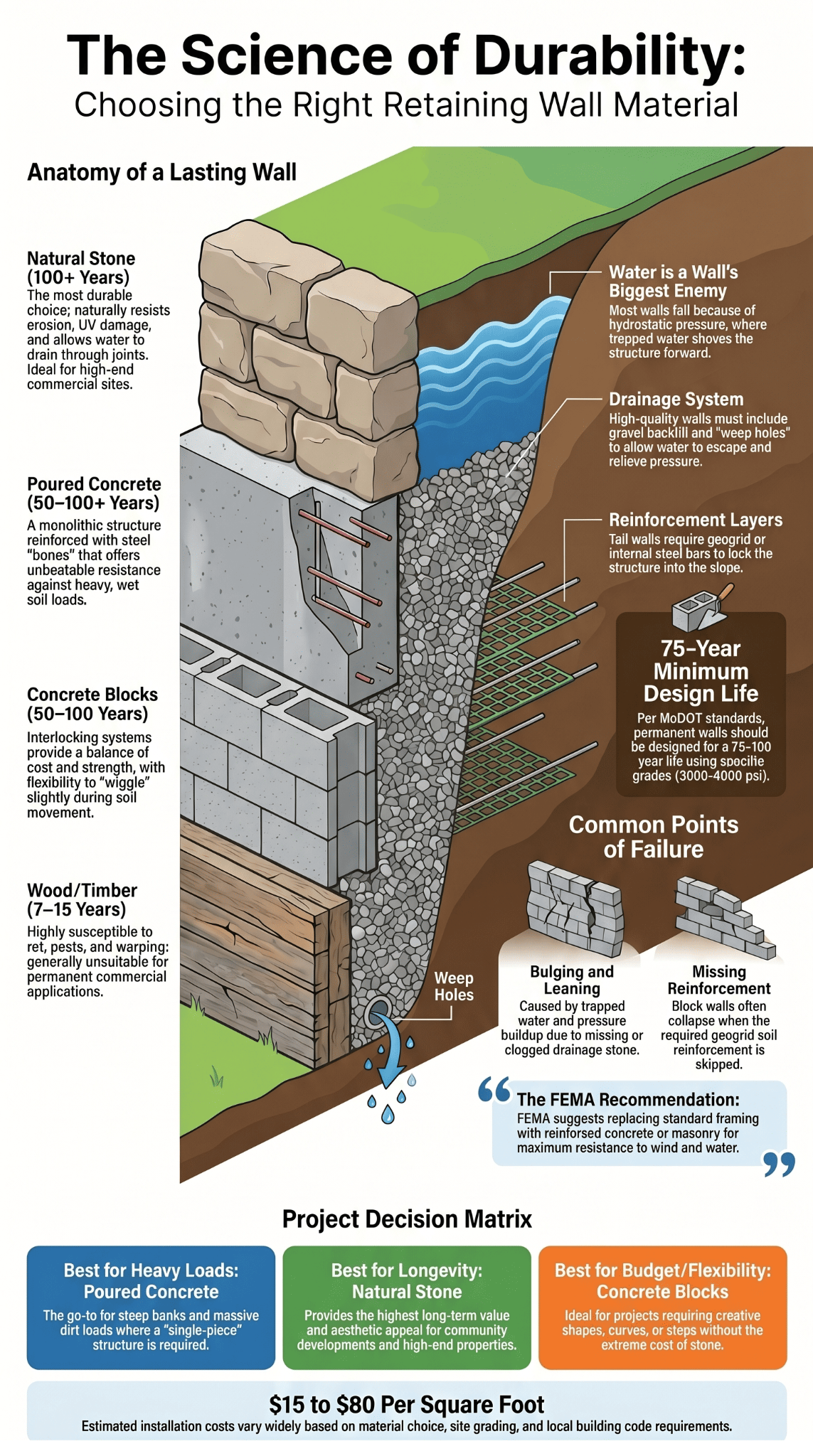
Drainage and reinforcement are what keep a retaining wall standing long-term. Without them, water builds up and pushes the wall out over time.
A proper system moves water away from the structure and adds strength where the soil applies pressure. When both are in place, the wall can last decades longer than one built without them.
What A Proper System Includes
- Gravel backfill to allow water to drain
- Weep holes to release pressure
- Geogrid reinforcement for added strength
- Grading that directs water away from the wall
These parts work together. Remove one, and the system weakens.
For commercial sites in Charlotte, these details are not optional. Building codes and HOA guidelines require proper drainage and reinforcement, especially for taller walls and large developments. Lapis Patios installs every layer with these standards in mind.
Which Material Should You Choose Based On Your Project Needs?
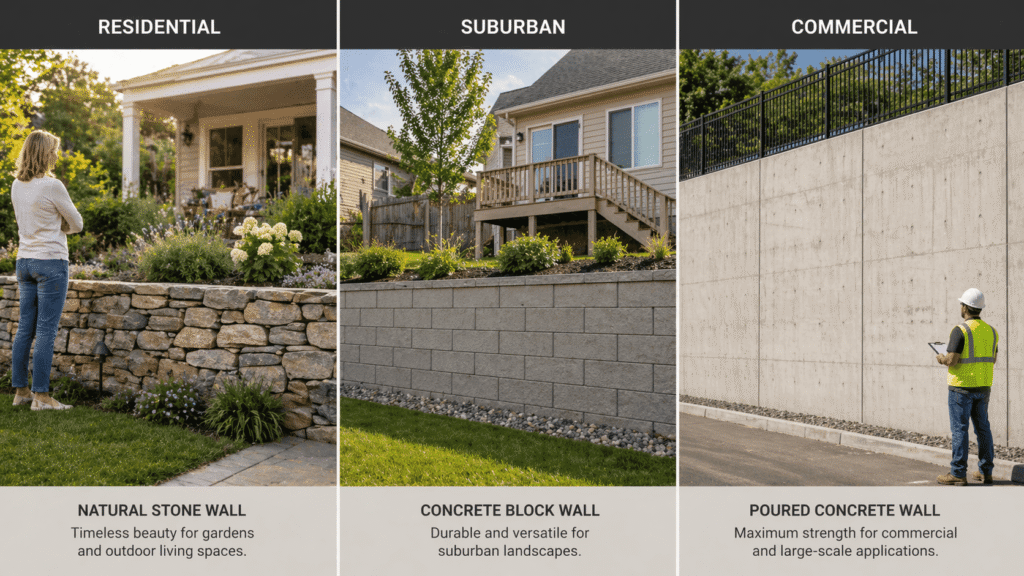
The right material depends on the job. Some projects need maximum strength. Others need flexibility or cost control.
| Use Case | Best Material |
| Long-term durability | Natural Stone |
| Heavy load/slopes | Poured Concrete |
| Budget-conscious | Concrete Blocks |
| Temporary structures | Timber |
What To Consider Before Choosing
- Site grading and soil conditions
- Local building codes and HOA rules
- Wall height and overall scale
- How the wall fits into the full site plan
Costs typically range from $15 to $80 per square foot installed, depending on material and design.
For developers, contractors, and property managers in Charlotte, the focus should be long-term performance, not short-term savings. Lapis Patios builds retaining wall systems that meet code, handle site demands, and hold up over time across commercial and large residential projects.
FAQ
What are the most durable retaining wall materials for long-term use?
The most durable retaining wall materials depend on soil conditions, water flow, and climate considerations. Natural stone and poured concrete are among the strongest options.
Concrete blocks, including interlocking concrete blocks and segmental retaining wall blocks, also perform well. Proper drainage stone, a weep hole, and solid foundation preparation reduce hydrostatic pressure, soil pressure, and soil erosion over time.
Are timber retaining walls as strong as concrete or stone walls?
Timber retaining wall systems, such as pressure-treated timber or pressure treated lumber, are suitable for small residential retaining walls.
However, wood and timber retaining walls do not last as long as natural stone, masonry retaining walls, or poured concrete walls. Moisture, freeze-thaw cycles, and frost heave can weaken timber. Strong drainage capabilities and filter fabric can help extend their lifespan.
When should I use gabion walls or dry stone wall systems?
Gabion walls, also known as gabion-style retaining walls, use wire cage structures filled with local stone. These walls allow water runoff and help reduce soil erosion.
Dry stone wall systems and boulder embankments also work well in certain landscape features. A structural engineer or landscape architect should review soil conditions, drainage capabilities, and building codes before installation.
How do drainage and weep holes affect retaining wall performance?
Drainage plays a critical role in the performance of any concrete retaining wall or brick retaining wall. Drainage stone, a weep hole, and filter fabric help control water flow behind the wall.
These elements reduce hydrostatic pressure and soil pressure. In some cases, geogrid soil reinforcement or a geogrid fabric system is needed to improve stability and support proper retaining wall construction.
How do I choose materials that match my landscape design and climate?
Material selection should match the landscape design, architectural style, and climate conditions. For example, stamped concrete or stone veneer suits a contemporary home, while natural stone veneer and frost-resistant brick offer long-term durability.
Consider water exposure, salt-air environments, frost line depth, and water runoff. A structural engineer can design cantilever walls or hybrid structures that meet building codes.
Choosing the Most Durable Retaining Wall Materials for Your Project
You don’t just build a retaining wall, you set the line between control and failure. After one hard rain, one wall still stands straight, the other starts to lean and crack. That gap is not luck.
It comes from smart choices, materials, drainage, soil prep, and proper reinforcement. If you manage properties or build at scale, you know one weak wall can create bigger issues across the whole site.
Shortcuts seem cheaper, until they fail and cost more to fix. Lapis Patios builds to code, meets HOA rules, and handles real site demands in Charlotte, NC. Protect your project and timeline. Schedule your retaining wall project consultation before construction begins.
References
- https://epg.modot.org/index.php/751.24_Retaining_Walls
- https://www.fema.gov/sites/default/files/documents/fema_p-2181-fact-sheet-3-2-wall-openings.pdf