
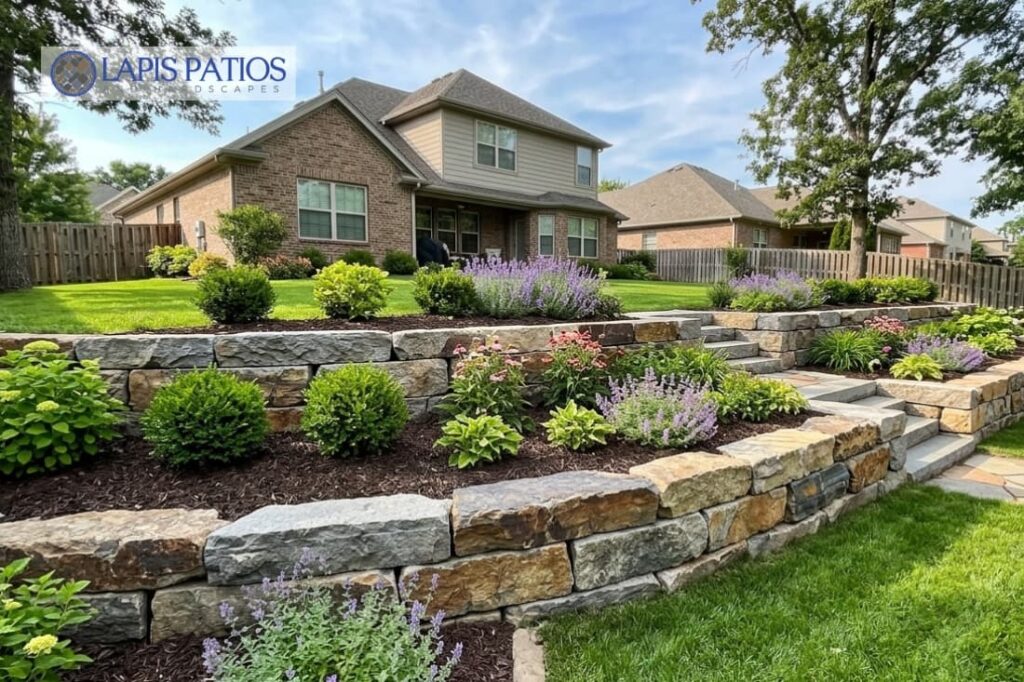
Discover stone retaining wall designs that balance strength, appearance, and proper construction for lasting performance.
A stone retaining wall creates usable land, manages water, and defines an outdoor space with permanent grace. For developers and property managers, it’s key infrastructure. For homeowners, it makes a sloped yard finally work.
The best designs mix structural strength with visual appeal, ensuring the wall works under pressure and looks good. Getting it right means knowing the stone, the slope, and the steady push of water behind it. Keep reading to see what makes a wall last.
Retaining Wall Success: The Fundamentals That Last
These key points summarize the essential principles behind retaining walls that remain strong, stable, and attractive for years to come.
- Drainage is non-negotiable. Without a good system of gravel, fabric, and pipe, water pressure will cause failure.
- Design must follow function. The wall’s height, style, and materials are decided by the slope and soil conditions.
- Professional planning prevents problems. Code compliance, correct foundations, and commercial-grade work are key for long-term performance
What Is a Stone Retaining Wall Really For?
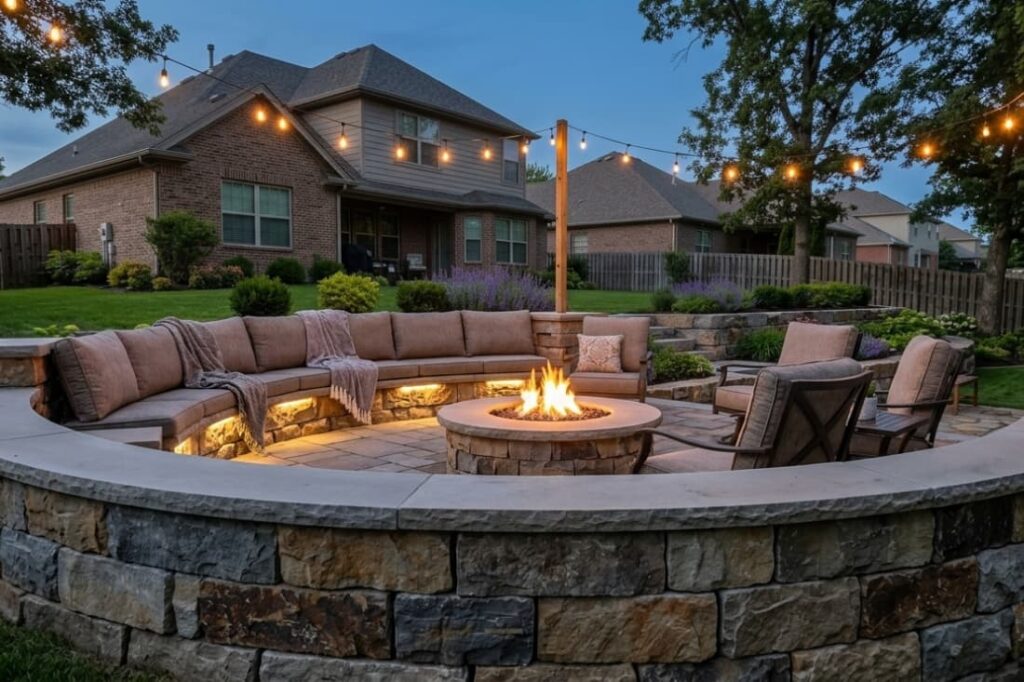
It’s easy to see just the stone and clean lines. But the job runs deeper. A retaining wall negotiates with the land itself. It creates level terraces from slopes, turning a hillside into planting areas, a pool deck, or a flat patio.
It controls soil erosion, stopping the slow movement of earth during a heavy Carolina rain. It defines space, making clear zones for an outdoor kitchen, a fire pit, or garden paths.
In a business setting, like the patio we built at Charlotte Premium Outlets, it creates a safe, accessible, and inviting spot from a tough slope.
The Primary Jobs of a Retaining Wall
Its main tasks are simple:
- Create stable, level ground for hardscaping and use.
- Prevent erosion and manage water flow.
- Add topographic interest and visual structure.
- Increase property utility and, always, its curb appeal.
How Do You Choose the Right Design for Your Landscape?
The land tells you what it needs. A steep slope behind a new apartment complex needs a different solution than a gentle rise in a backyard. The best retaining wall design is not about the prettiest stone. It is about the right use of force, drainage, and form. You have to listen to the land first.
Comparing Design Approaches
The table below breaks down common design styles we think about for every project, business or home, in Charlotte and beyond.
| Design Style | Best Application | Key Advantages | Professional Considerations |
| Dry-Stacked Natural Stone | Lower walls (<3 ft), rustic or natural landscapes. | Breathable, ages well, no mortar lines. | Needs skilled placement; requires a compacted gravel base and careful slope. |
| Mortared Stone Wall | Taller walls, areas needing rigid strength. | Superior strength, clean look, variety in stone styles. | Needs footings, precise masonry, and built-in weep holes for drainage. |
| Terraced Retaining Walls | Big slope changes, creating many usable levels. | Reduces load per wall, improves drainage, creates planting spots. | Needs more space and coordination between wall levels. |
| Curved or Organic Walls | Softening hardscape changes, framing patio edges. | More natural fit, can follow land shapes. | More complex to plan and build with steady structure. |
| Walls with Integrated Seating | Maximizing function in patios, pool decks, public spaces. | Saves space, adds built-in seating for outdoor living. | Must be engineered for live loads; seating capstones need secure install. |
Why Is Drainage the Most Critical Factor?
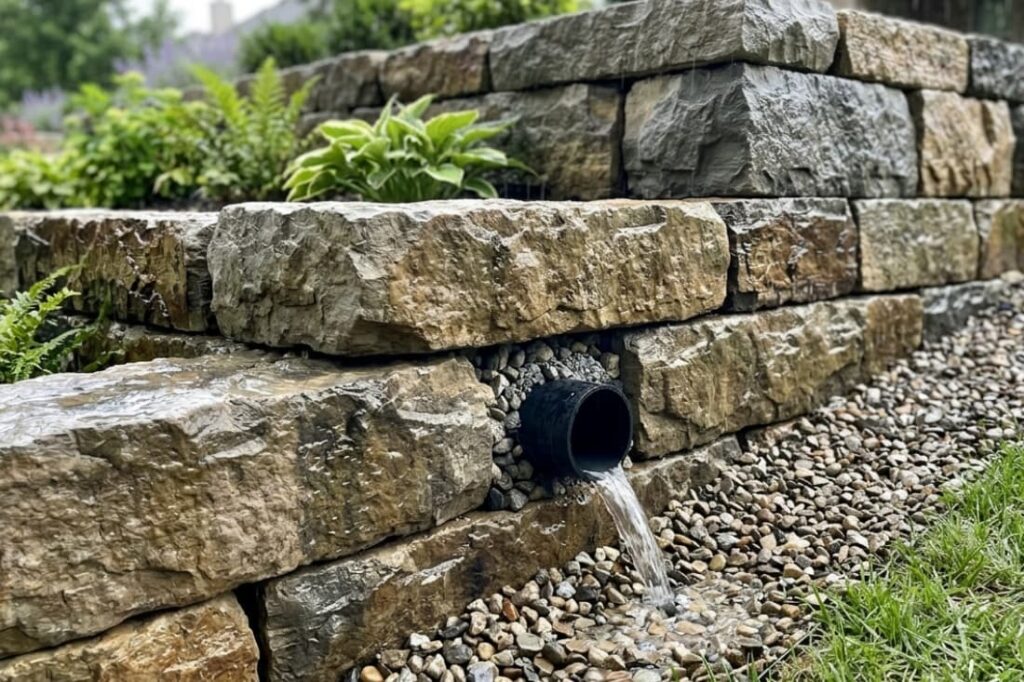
You can build a wall from the best granite, but if you trap water behind it, it will fail. It’s not an if, it’s a when. Hydrostatic pressure is a powerful, silent force.
We have seen walls, even professionally built ones, bulge and crack because someone thought the stone alone was enough. It never is. The drainage system is the unseen hero of every lasting retaining wall.
Research from Land Degradation & Development shows
“The presented model is able to describe hydrological processes on a terraced slope and to analyze the destabilizing pressures acting on the retaining dry-stone walls… The results show a good capability of the model to predict the distribution and intensity of stresses on the instrumented dry-stone wall over time and space. Such stresses were related to the earth pressure and to hydrostatic pressures (water accumulation).” – Land Degradation & Development
How a Proper Drainage System Works
A proper system starts with a base of clear crushed stone behind the wall. A perforated drain pipe sits at the bottom, buried in more stone.
Everything is wrapped in landscape fabric to keep soil from clogging the spaces. The water hits this zone and finds the easiest path, flowing down and out.
In mortared walls, we include weep holes, small, hidden openings at the base, to let any moisture escape the face. This is not an extra. For us at Lapis Patios, it is step one in the plan. It is what lets the beauty of a stone wall last for decades.
How Can a Retaining Wall Improve Your Patio Design?
Credits: DIY & Crafts
When a retaining wall is done right, it stops being just a wall. It becomes the defining feature of your outdoor living space. It is the backdrop for evening gatherings, the sturdy edge of a patio that works as casual seating.
We use them to frame outdoor fireplaces, create raised beds for an herb garden, or subtly separate a dining area from a lounging space, creating stylish retaining wall designs that improve both function and appearance.
With built-in low-voltage lighting, the textured face of a stone wall becomes a landscape feature at night, adding depth and drama.
Multi-Functional Hardscaping
Think of it as multi-functional hardscaping. A single well-planned element solves several problems:
- It holds the slope.
- It provides informal seating, saving the cost and space of extra furniture.
- It offers a vertical surface for plants or up-lighting.
- It gives the entire patio a sense of purpose and enclosure.
What Are the Most Common Design Mistakes to Avoid?
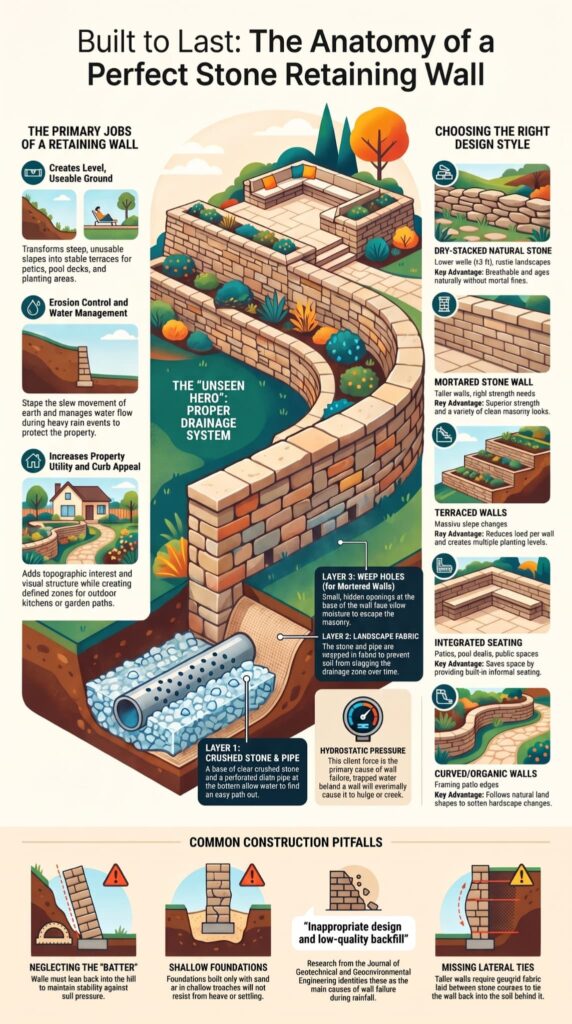
In our years of building across the Carolinas, we see the same errors repeated. Often, it is a well-meaning effort that misses a basic rule.
A homeowner tries a DIY dry stack without proper base work. A contractor cuts corners on drainage to save a day’s work. The results are predictable, and they are never cheap to fix.
Insights from Journal of Geotechnical and Geoenvironmental Engineering indicate
“The investigation revealed among other things that the inappropriate design and the low-quality backfill were mainly responsible for the wall failure, although the primary triggering factor was the rainfall infiltration.” – Journal of Geotechnical and Geoenvironmental Engineering
Common Construction Errors
The list of frequent mistakes is short, but important.
- Neglecting drainage: The top error. No gravel backfill, no pipe, no fabric. It guarantees future failure.
- Under-building the foundation: A shallow trench filled with just sand will not resist frost heave or settling.
- Choosing the wrong wall for the height: Trying to dry-stack a 5-foot wall is asking for trouble.
- Ignoring the batter: Walls need to lean back into the hill for stability,Walls need to lean back into the hill for stability, especially when building curved retaining wall designs where proper alignment is even more important.
- Forgetting about lateral ties: In taller walls, geogrid fabric laid between stone courses ties the wall back into the soil.
- Mismatching the style: A sleek, geometric cut stone wall might look wrong in a lush, informal garden.
How Does Lapis Patios Approach a Commercial Project?
For a business client, a property manager, an HOA, a developer, the stakes are different. It is about scale, compliance, and long-term liability.
A retaining wall in a shopping center, apartment complex, or public park must meet building codes, handle major water runoff, and stand up to constant, often heavy, use. Our process shows that.
Commercial projects require transforming challenging landscapes into functional, accessible spaces,
The retaining walls had to work with the paver system’s slope for drainage, work around underground lines, and be built on a tight schedule with public safety first. Every stone placement was a mix of engineering and efficiency.
Our Commercial Methodology
- Detailed Site Analysis: We map the land shape, soil conditions, and existing drainage.
- Code and Compliance First: We make sure all designs meet local Charlotte and North Carolina building codes, a key step for HOA and business approvals.
- Integrated Drainage Planning: Walls are planned with the site’s overall water management strategy.
- Phased Construction Logistics: We plan crew setup, material staging, and workflow to lower disruption to your operations.
- Commercial-Grade Materials: We pick materials like reinforced concrete blocks for cores or durable natural rock veneers made for high-traffic areas.
FAQ
How do I choose the right stone for a retaining wall?
Selecting natural stone requires matching density with local climate conditions. High-density, low-porosity materials like local granite or deep-quarried limestone prevent freeze-thaw spalling, ensuring the structural face resists degradation far better than soft, manufactured concrete substitutes.
Can a stone retaining wall include other landscape features?
Yes. A retaining wall can support flower beds, a herb garden, seating walls, or concrete planters. It can also connect to an outdoor kitchen, outdoor fireplace, pool deck, patio edges, and garden paths.
You can add a water feature, cascading waterfalls, or a vertical garden to create attractive and functional outdoor living spaces.
How does a stone retaining wall help prevent soil erosion?
A garden retaining wall holds soil in place and controls water flow across sloped ground. Good drainage is equally important. Drain tile, landscape fabric, crushed stone, and clear chips allow water to move away from the wall.
These materials reduce pressure behind the wall and help prevent soil erosion and wall damage.
What should I prepare before building a stone retaining wall?
Start by removing loose soil and creating a solid foundation. Compact the base with a plate compactor before placing the first stones. Some wall designs also require landscape adhesive for added stability.
Following local building codes and preparing the base correctly helps improve slope stabilization and extends the life of the retaining wall.
Which stone retaining wall style suits a modern landscape?
A dry stacked stone wall gives your yard a natural appearance, while a limestone wall or geometric cut stone wall creates a cleaner, modern style.
A gabion wall or feature wall can also add topographic interest. Choose a style that matches your home, planting areas, and the way you use your outdoor space.
Building Stone Retaining Walls That Deliver Lasting Value
A great stone retaining wall is built from the ground up. Strong foundations, proper drainage, and expert construction are what keep it stable, safe, and attractive for years. For developers, property managers, construction companies, and homeowners in Charlotte, NC, the right retaining wall is a long-term investment in both performance and property value.
Planning a project? Contact Lapis Patios to discuss a retaining wall solution designed for your site, built to code, and engineered for lasting results.
References
- https://onlinelibrary.wiley.com/doi/abs/10.1002/ldr.2926
- https://ascelibrary.org/doi/10.1061/(ASCE)1090-0241(2006)132:12(1538)