
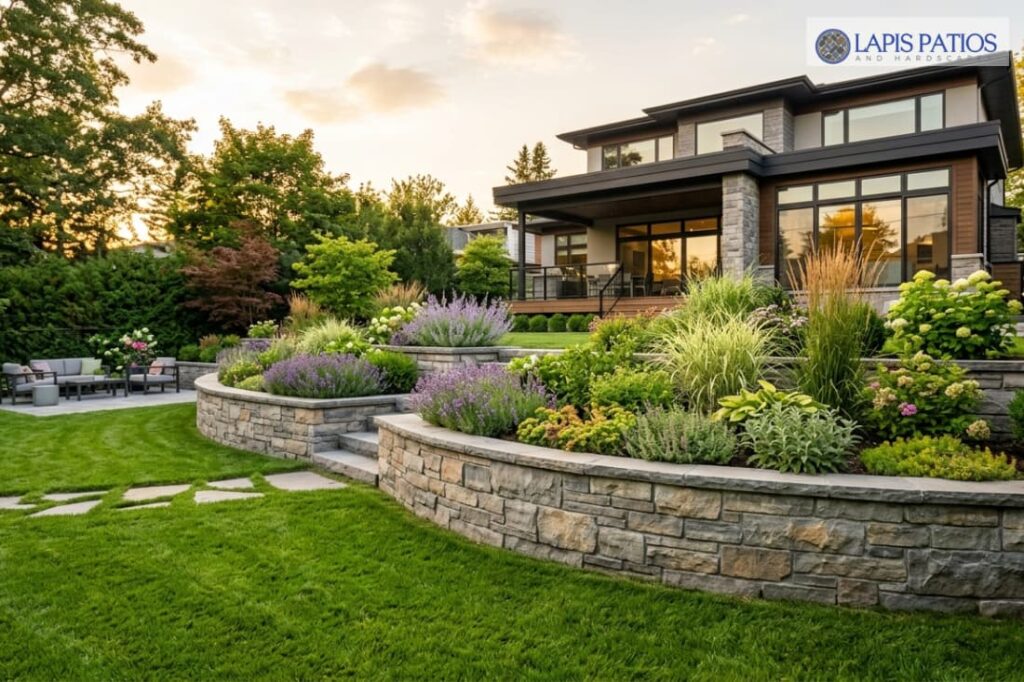
Curved retaining wall designs bring softer lines, stronger support, and a more finished look to patios and gardens.
Curved retaining walls handle slopes while transforming a space. They soften hard edges, guide people naturally through a patio, and create more inviting outdoor areas. For Charlotte commercial properties and upscale homes, they add significant design value.
A curved wall can define a dining terrace, manage foot traffic, and enhance curb appeal better than a straight line. Their strength is solving the engineering problem of a grade change while elevating the entire aesthetic. For developers, this dual benefit is key for impactful projects.
See how a curved wall can reshape your site.
Curved Retaining Wall Essentials: Build It Right from the Start
These key points highlight the foundation of successful curved retaining wall projects, where structure, function, and craftsmanship all work together.
- Structural integrity comes first: Every curved retaining wall must be engineered for local soil conditions, drainage needs, and Charlotte building requirements.
- The curve should serve a purpose: Good designs improve traffic flow, define gathering spaces, or frame views instead of acting as decoration alone.
- Professional installation prevents failures: Accurate layout work, proper materials, and skilled construction help avoid cracking, bulging, and long-term instability.
How Curved Walls Improve Patio Function
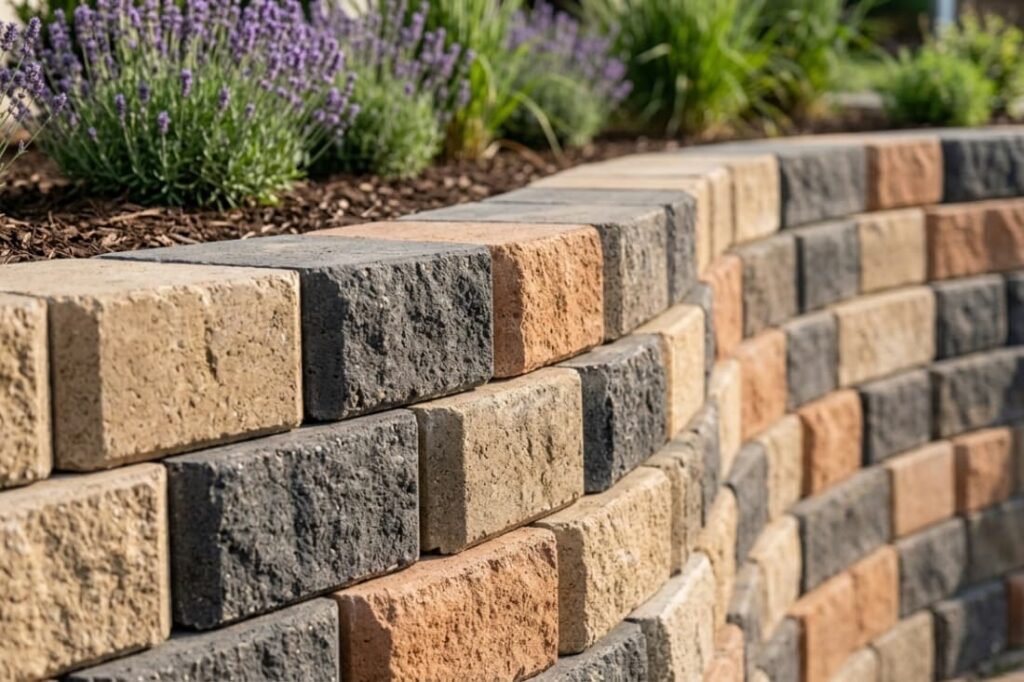
A curved retaining wall makes a patio work better. It guides people naturally toward seating or entrances, which cuts down crowding in restaurant or community spaces. The smooth shape also blends the hard patio surface with the surrounding gardens, making the area feel larger and more connected.
Insights from International Journal of Geo-Engineering indicate
“Most research on reinforced soil retaining walls focus on two-dimensional linear parts. The behaviour of curved parts in reinforced soil retaining wall is questionable, and collapse of that also occurs frequently. This study aims to raise the necessity of research on the curved parts.” – International Journal of Geo-Engineering
For HOA or commercial properties, this creates a polished, unified look. The curve can include permanent seating, saving on extra furniture and upkeep. On sloped sites, curved terraces can create separate levels for different activities, all while maintaining a cohesive design.
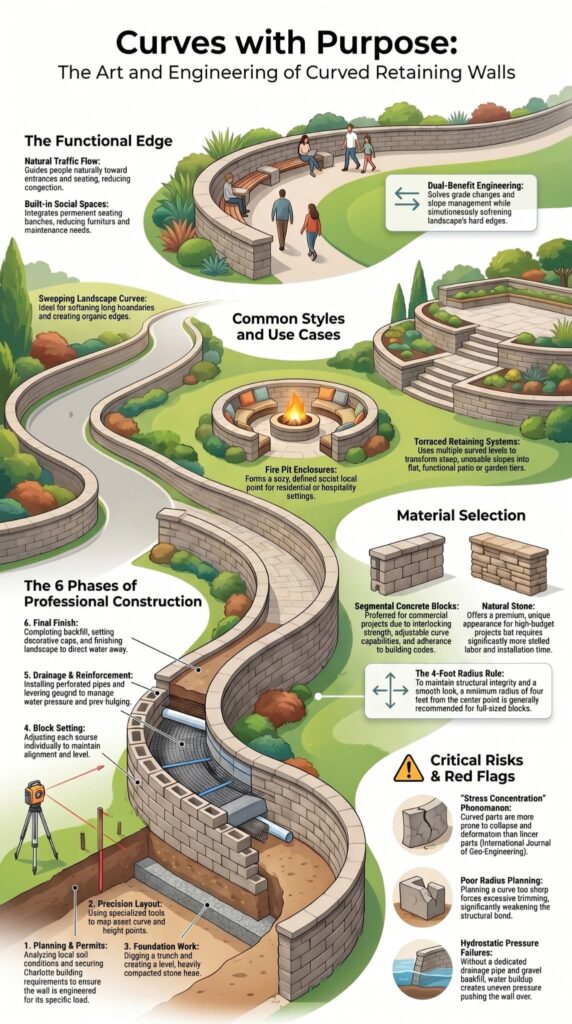
Common Styles for Curved Walls
Curved retaining walls come in several key styles. Each one serves a different purpose in a commercial or residential landscape. Your choice depends on how the site will be used.
This table shows the main types and their functions.
| Design Type | Best Use Case |
| Sweeping Landscape Curve | Softening long boundaries, creating natural edges along drives or walkways. |
| Integrated Seating Wall | Defining a patio edge, providing built-in seating for dining or events. |
| Terraced Retaining System | Creating flat, usable areas on a sloped site for patios or gathering spaces. |
| Fire Pit Enclosure | Forming a cozy, defined circle for a social focal point. |
| Garden Bed Border | Framing planting areas with a low, structured edge. |
These designs do more than hold soil. They shape how people use and move through the outdoor space.
Best Materials for Curved Walls
Credits: Thrifty Garage
Choosing the right material is key for a strong, good-looking curved wall, especially when the overall retaining wall design needs to balance structural performance with visual appeal. The two main options are segmental concrete blocks and natural stone.
Segmental Concrete Blocks
- Best for: Most commercial and large residential projects.
- Why: The blocks lock together. This lets builders create smooth, adjustable curves easily.
- Important for Commercial: The block system must be rated for strength, have a tough finish, and meet Charlotte building codes.
Natural Stone
- Best for: High-end, custom looks where the budget is more flexible.
- Why: It offers a unique, premium appearance.
- The Trade-off: It needs more skilled labor and can be slower to install, especially on tight curves.
For most large-scale work in our area, engineered block systems offer the best balance of strength, design choice, and faster installation, making them one of the most durable retaining wall materials for commercial landscapes. Professional builders ensure the caps line up perfectly for a seamless finish.
How Curved Walls Are Built Professionally
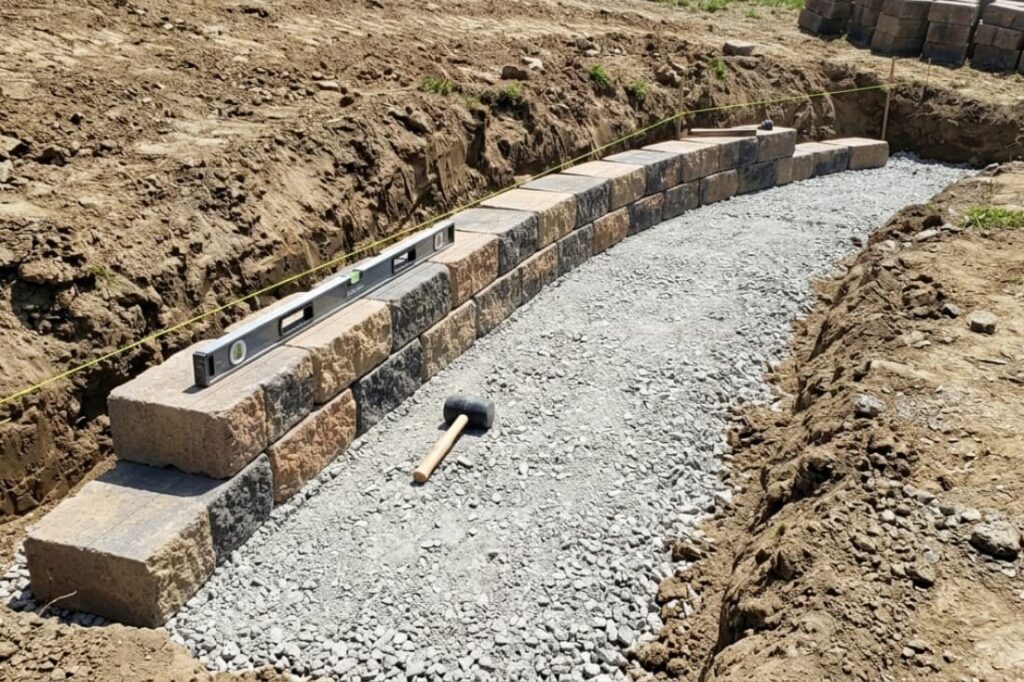
Building a curved retaining wall starts with planning and engineering, not just stacking blocks. For walls over a certain height or under heavy loads, this professional groundwork is essential. The process follows a strict sequence.
First, the site is evaluated and permits are secured. The exact curve is mapped out with precise tools. A trench is dug and filled with compacted gravel for a solid base.
Blocks are then laid, with careful adjustments for the curve, sometimes trimming block edges or managing gaps.
For taller walls, reinforcing grids are layered into the backfill as planned, since proper wall height and design considerations become more important as structural loads increase.
A drainage system is installed behind the wall. Finally, the area is graded, caps are set, and landscaping is finished to direct water away.
Key Phases of Construction
A reliable wall depends on each step being done right.
- Planning & Permits: Analyzing soil, designing reinforcement, getting local approvals.
- Precision Layout: Marking the exact curve and height points for excavation.
- Foundation Work: Creating a level, compacted stone base.
- Block Setting: Adjusting each course to maintain the curve and level.
- Drainage & Reinforcement: Adding drain pipes and structural grids.
- Final Finish: Backfilling, installing caps, and completing the landscape.
Understanding Radius Limits
How sharp you can make a curve depends on three things:
- The type of block you use.
- How tall the wall will be.
- Whether the wall curves inward or outward.
There’s no one-size-fits-all answer. Each block system has its own limits. A common rule of thumb is to keep the curve’s radius to at least four feet from the center point for a smooth look with full-sized blocks. Tighter curves are possible but more challenging.
How Builders Handle Tight Curves
To make a sharper turn, professionals might:
- Switch to a smaller block size.
- Use half-sized units.
- Choose a block style designed specifically for curves.
Key Details for a Professional Build
Two critical points need extra attention:
- The Transition: Where the curved section meets a straight wall must be planned carefully. This keeps the wall looking seamless and structurally sound.
- Constant Checks: Builders monitor spacing and alignment constantly. A tiny error in a curve becomes a big problem as the wall rises.
Why Drainage Is Critical for Curved Retaining Walls
Proper drainage stops water from building up behind the wall. Water pressure is a main reason walls fail, and curved walls face this same risk. Without good drainage, pressure can become uneven along the curve.
The standard method is a perforated drain pipe at the wall’s base, surrounded by gravel. This pipe must slope to an outlet where water can escape. The curved shape requires extra care to ensure the gravel backfill is even and compacted, with no empty spaces that could funnel water.
For Charlotte commercial sites, managing this runoff is a vital part of the overall stormwater plan and is often reviewed during the permit process.
Common Construction Mistakes
Several common mistakes can cause big problems with curved retaining walls. These issues often happen when the builder lacks specific experience with curves. They can lead to costly repairs, a weak structure, and a wall that doesn’t look right.
Data from Applied Sciences demonstrates
“A phenomenon in which a block is cracked or dropped owing to deformation has been frequently reported. In particular, this phenomenon is concentrated at the curved parts of a reinforced soil retaining wall and is mainly known as a stress concentration.” – Applied Sciences
A professional contractor knows how to avoid these four key risks:
1. Poor Radius Planning
- The Problem: Planning a curve that’s too sharp.
- The Result: Builders have to cut too much off the blocks, which can make the wall weaker.
2. Drainage Failures
- The Problem: Not using enough gravel or a drain pipe that gets clogged.
- The Result: Water builds up behind the wall, creating pressure that can push it over.
3. Awkward Block Alignment
- The Problem: A bad layout from the very start.
- The Result: The wall looks wavy and uneven, and built-in seating won’t be level or comfortable.
4. Weak Reinforcement
- The Problem: Not using the special grid reinforcement, or installing it wrong.
- The Result: The wall can bulge or lean over time, especially on the outside of a tight curve.
Preventing these mistakes takes careful planning and following the engineer’s plans and block manufacturer’s instructions exactly.
How Do Curved Walls Improve Commercial Patio Projects?
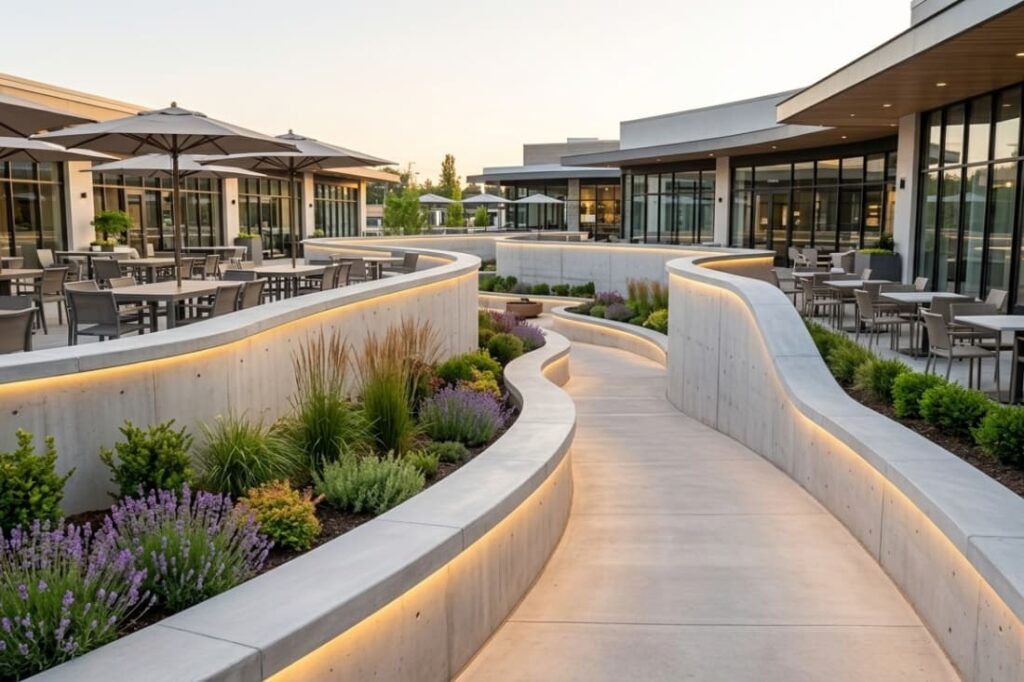
A curved retaining wall elevates a commercial patio by improving how people move through it, boosting curb appeal, and creating natural gathering spots.
For a developer or property manager, this means higher property value, longer visits from guests, and a market advantage.
Building a feature like a curved seating wall on an active site requires careful coordination. The wall must be built precisely to be level, comfortable, and withstand public use.
Managing foot traffic and safety during construction is critical. Integrating the wall with the site’s overall drainage and grading plan is complex and needs professional oversight.
A well-built curved wall provides several key benefits:
- Better Circulation: Guides people naturally, reducing congestion.
- Stronger Curb Appeal: Creates a polished, integrated look for the property.
- Natural Gathering Spaces: Defines areas for seating and socializing.
- Increased Property Value: Enhances the site’s overall appeal and functionality.
It does more than hold back earth; it shapes how people use the space, turning a basic patio into a unified, welcoming outdoor room.
FAQ
What are the benefits of a curved retaining wall design?
A curved retaining wall improves erosion control while creating smoother transitions across outdoor landscapes. Many homeowners choose curved walls because they soften sharp edges around bluestone patios, water features, terraced gardens, and outdoor seating spaces.
A curved retaining wall also helps maximize usable yard space near a fire pit or patio table area while improving the overall visual flow of the landscape design.
Which materials work best for curved retaining walls?
Concrete blocks, retaining wall blocks, natural stone, and gabion wall systems are popular materials for curved retaining wall projects because they provide different textures, strengths, and drainage performance.
Many homeowners also use stacked stones or precast concrete modular facing systems for decorative finishes. The best material depends on wall height, minimum radius requirements, soil conditions, drainage needs, and long-term maintenance expectations.
How do contractors build smooth inside and outside curves?
Contractors typically begin with careful base course preparation, a string line, and a radius chart to create accurate inside and outside curves.
Many curved and serpentine walls also require precise cutting with a paver saw, hammer and chisel, metal straight edge, and wax pencil for cleaner alignment.
Proper drain pipe installation and compacted foundation materials help maintain long-term structural support and wall stability.
Are curved retaining walls stronger than straight retaining walls?
A curved retaining wall can distribute soil pressure more evenly than some straight retaining wall layouts because the curved shape naturally strengthens the structure.
Many retaining wall blocks also include a connection system, lipped retaining wall block design, or reinforced facing panels for additional support.
However, wall strength still depends heavily on drainage systems, foundation preparation, soil conditions, and correct installation methods.
What design features improve curved retaining wall projects?
Many homeowners improve retaining wall projects by adding wall cap options, low-voltage lighting, outdoor patio lights, and decorative vertical score marks for stronger visual appeal.
Features such as split texture finishes, tri-face wall block patterns, integrated seating areas, and nearby water features also create more functional outdoor spaces. These additions help curved retaining wall installations blend naturally with patios, gardens, and entertainment areas.
Planning A Durable Curved Retaining Wall In Charlotte
A curved retaining wall should improve both site function and long-term property value. For commercial developers, property managers, and homeowners in Charlotte, success depends on proper engineering, drainage, material selection, and code compliance from the start.
Work with a contractor experienced in commercial-scale installations, HOA requirements, and reinforced retaining wall systems to avoid costly structural issues later. Careful grading, drainage control, and final inspection also play a major role in long-term performance.
If you’re planning a curved retaining wall project in Charlotte, Lapis Patios can help deliver a durable, professionally built result.
References
- https://link.springer.com/article/10.1186/s40703-018-0091-1
- https://pure.seoultech.ac.kr/en/publications/behaviour-analysis-of-reinforced-soil-retaining-wall-according-to-2/