
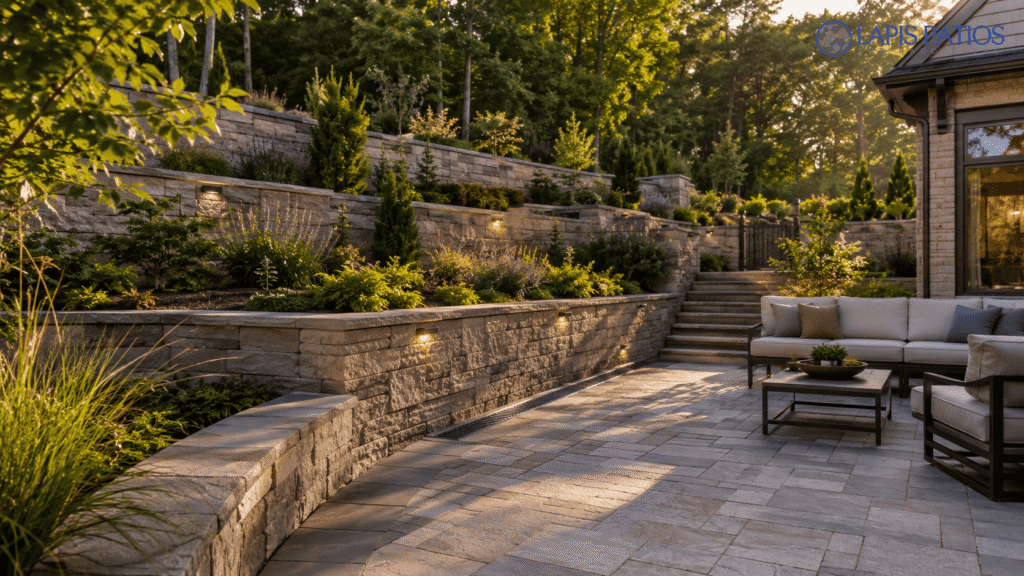
Retaining Wall Design strategies for patios, slopes, and drainage that help meet commercial hardscape rules and improve long-term stability.
Retaining walls help stop soil, water, and slope problems before they damage your property. In Charlotte, many lots look flat at first, but grading issues often show up once work begins. Commercial spaces, HOAs, and large homes use retaining walls to keep patios, sidewalks, and shared areas safe and level.
Lapis Patios builds retaining wall systems for projects across Charlotte, from small patio walls to large engineered builds. Keep reading to learn when a retaining wall may be needed.
Retaining Wall Design Basics
- Retaining walls help hold soil in place on sloped properties.
- Drainage behind the wall matters as much as the wall itself.
- Proper installation helps reduce movement and future repairs.
Retaining Wall Design Fundamentals For Modern Hardscapes
Charlotte gets enough rain that drainage becomes a problem quickly on sloped sites.
Without a retaining wall, water can carry soil downhill little by little. At first, it may not look serious. Then, the pavers start separating. Patio edges settle. Mulch washes away after every storm.
Retaining walls help stop that cycle.
Commercial retaining walls often carry more pressure than residential walls. Parking lots, sidewalks, outdoor seating areas, and gathering spaces all add weight behind the structure.
Apartment communities often use retaining walls around courtyards and pools. Restaurants place them near outdoor dining areas. HOA properties use them near walking paths and clubhouse spaces.
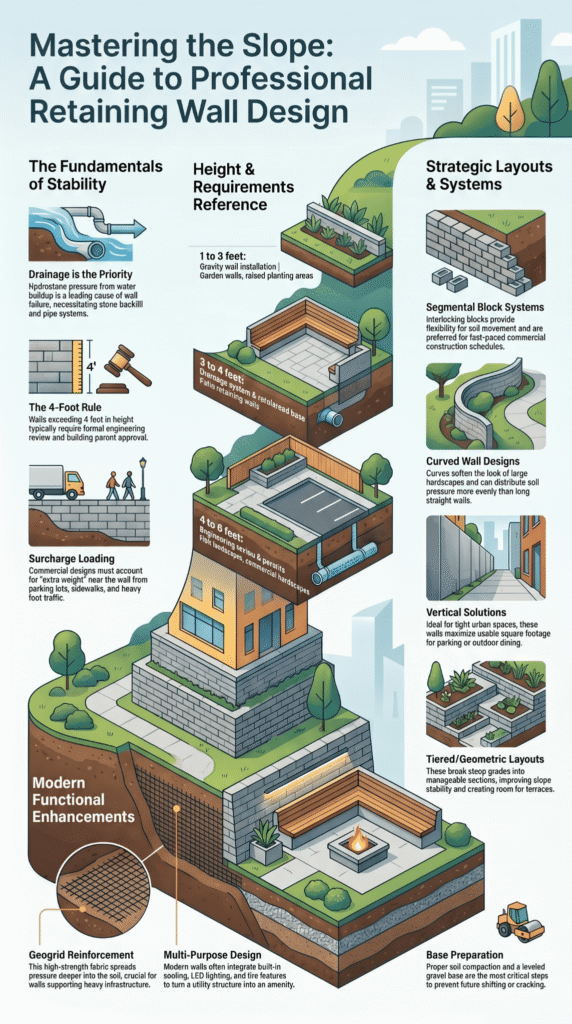
Walls taller than 4 feet usually need engineering review and permits in Charlotte. Large commercial projects often involve engineers before the first excavation starts.
Drainage is one of the most important parts of the build. Water pressure behind the wall can slowly push the structure forward if the drainage system is poor.
Most retaining wall systems include:
- Gravel backfill
- Drainage pipe
- Filter fabric
- Reinforcement grid
- Compacted base stone
Those materials help move water away from the wall instead of trapping it behind the structure.
Lapis Patios builds retaining wall systems designed for Charlotte soil conditions, drainage needs, and long-term hardscape performance.
Common retaining wall systems include:
- Segmental retaining walls
- Gravity retaining walls
- Reinforced concrete walls
- Stone retaining walls
- Gabion retaining walls
Many retaining wall projects also include:
- Patios
- Seating walls
- Outdoor lighting
- Fire feature areas
- Raised planting beds
Retaining Wall Height And Design Considerations
Wall height changes the entire construction process, especially when retaining wall height affects drainage loads, reinforcement needs, and long-term structural stability.
A small retaining wall around a planting bed may only need compacted gravel and drainage stone. A taller retaining wall near a parking lot or apartment building usually needs reinforcement and engineering review before construction begins.
Most residential retaining walls are between 2 and 4 feet tall. Commercial retaining walls are often much taller because they support steeper slopes and heavier traffic areas.
As walls get taller, drainage becomes even more important.
After heavy rain, water pressure can build quickly behind the structure. Without proper drainage, the wall may lean, crack, or shift over time.
Commercial retaining wall projects often include:
- Geogrid reinforcement
- Soil testing
- Drainage systems
- Gravel base layers
- Reinforced backfill
- Wall embedment planning
Base preparation matters from the start. If the foundation settles later, the retaining wall may move with it.
As highlighted by PLOS ONE
“In general, the [retaining wall] design needs to check the anti-sliding stability, anti-overturning stability, wall section strength, and foundation bearing capacity. In this process, Rankine earth pressure theory or Coulomb earth pressure theory is usually used to calculate earth pressure, the safety factor of the retaining wall increases by 0.45 for every 0.5m increase in the width of the wall heel plate.” – PLOS ONE
| Retaining Wall Height | Typical Requirements | Common Applications |
| 1 to 3 feet | Gravity wall installation | Garden walls, raised planting beds |
| 3 to 4 feet | Reinforced base and drainage | Patio retaining walls |
| 4 to 8 feet | Engineering review and permits | HOA and commercial landscapes |
| 8+ feet | Structural engineering and reinforcement systems | Large commercial retaining walls |
Commercial developers also pay attention to construction schedules. Segmental retaining wall systems usually install faster than poured concrete walls, which helps larger projects stay on track.
Lapis Patios works with developers, contractors, HOAs, and property managers throughout Charlotte to build retaining wall systems designed for drainage control and long-term durability.
Curved Retaining Wall Designs For Outdoor Flow
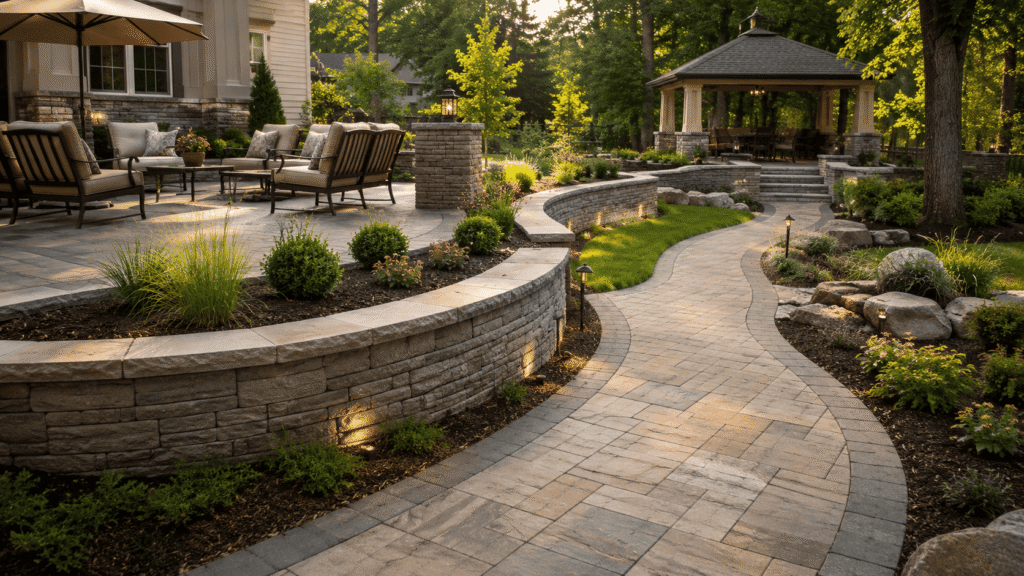
Curved retaining walls can make outdoor areas feel easier to move through, particularly in projects using curved retaining wall designs to improve outdoor flow and usable gathering space.
Long straight walls sometimes make patios and walkways feel boxed in. Curved walls break up those hard lines and help connect different outdoor spaces together.
That is one reason curved retaining walls are common in apartment communities, hospitality properties, and HOA gathering spaces around Charlotte.
Curved retaining walls are often built around:
- Patio seating areas
- Fire pits
- Walkways
- Raised planting beds
- Pool decks
They also pair well with paver patios and outdoor lighting.
Curved retaining walls help smooth out elevation changes across a property. Many commercial projects use curved layouts to improve movement between patios, sidewalks, and gathering spaces.
Stone retaining walls are especially popular for curved layouts because they fit naturally with landscaping and outdoor living areas.
In Charlotte commercial projects, curved retaining walls are often paired with patio leveling plans to create more usable seating space and improve accessibility.
Lapis Patios has completed retaining wall projects for HOA communities, commercial properties, and upscale residential developments across the Charlotte area. These projects require grading, drainage planning, and careful wall placement before construction starts.
Areas where curved walls meet stairs or sidewalks usually need extra planning during the layout stage.
Geometric Retaining Wall Layouts For Commercial Properties
Some commercial properties need a more structured layout, especially sites using geometric retaining wall layouts for tiered elevations, walkways, and organized drainage planning. That is where geometric retaining wall designs are often used.
These retaining wall layouts are common in office parks, apartment communities, retail centers, and HOA developments throughout Charlotte.
Many commercial projects use tiered retaining walls to break steep slopes into smaller sections. That creates more room for patios, sidewalks, landscaping, and outdoor seating areas.
Geometric retaining wall systems often include:
- Straight wall lines
- Tiered wall sections
- Stair-step layouts
- Symmetrical elevations
- Structured planting areas
Many property managers prefer these layouts because they help outdoor spaces feel organized and easier to maintain.
Terraced retaining wall systems can also help direct stormwater away from sidewalks, patios, and building foundations.
Popular geometric retaining wall layouts include:
- Tiered retaining walls with stairs
- Symmetrical wall systems
- Modular retaining wall layouts
- Vertical terrace walls
- Permeable retaining walls with drainage zones
These retaining wall systems are often paired with:
- Decorative wall caps
- Stone veneer finishes
- Landscape lighting
- Commercial paver systems
- ADA walkways
Commercial retaining wall projects also need to fit around parking lots, drainage systems, and pedestrian traffic areas. Many projects require engineered drawings and permit approval before construction begins.
Lapis Patios works with developers, builders, HOAs, and property managers throughout Charlotte on retaining wall systems designed for drainage performance, code compliance, and long-term reliability.
Vertical Retaining Wall Solutions For Tight Spaces
Vertical retaining wall systems help maximize usable space on commercial properties with limited room, making vertical retaining wall solutions common in dense urban and mixed-use developments. These walls are common in urban developments, restaurants, apartment projects, and mixed-use construction.
In many Charlotte commercial projects, outdoor space is limited. Vertical retaining walls help preserve parking areas, patio seating, sidewalks, and access routes while still supporting soil retention needs.
Concrete retaining walls are often used for taller vertical systems because they handle heavy loads and create a clean architectural look. Reinforced segmental retaining walls are also common when projects need a more finished hardscape appearance.
Before construction starts, retaining wall contractors evaluate several important factors:
- Geogrid reinforcement requirements
- Soil pressure conditions
- Wall block connection strength
- Frost and soil movement risks
- Drainage system planning
Vertical retaining walls are often used around:
- Elevated patios
- Outdoor dining areas
- Loading zones
- Parking structures
- Commercial walkways
Modern retaining wall systems can also include built-in lighting, seating walls, and architectural finishes. These features improve visibility and help commercial properties create more usable outdoor areas.
Drainage remains one of the most important parts of vertical wall construction. Water pressure behind the wall can increase quickly if drainage systems are not installed correctly.
Lapis Patios builds retaining wall systems for commercial and upscale residential projects across Charlotte and surrounding areas, with a focus on structural performance, code requirements, and long-term reliability.
Stylish Retaining Wall Designs For Patios
Patio retaining walls now do more than support soil, with many projects incorporating stylish retaining wall designs that improve both functionality and outdoor appearance. Many commercial and upscale residential projects use retaining walls to create outdoor spaces that feel organized, comfortable, and easy to use.
Restaurants, apartment communities, clubhouse patios, and HOA gathering spaces often combine retaining walls with seating, lighting, and landscaping features. These walls help define the space while supporting elevation changes around patios.
Stone retaining walls remain a popular choice because they pair well with pavers, outdoor kitchens, and landscape designs. Textured wall systems also help commercial spaces feel more finished without sacrificing durability.
Stylish patio retaining walls often include:
- Built-in seating walls
- Fire pit retaining walls
- Raised planting beds
- LED lighting beneath wall caps
- Smooth decorative capstones
Commercial developers also focus on maintenance and long-term performance. Modular retaining wall systems with proper drainage and reinforced backfill help reduce future repair issues.
Modern retaining wall layouts often use clean lines, neutral colors, and larger paver systems to match newer commercial architecture. These designs are common in Charlotte hospitality spaces, HOA clubhouses, and luxury residential communities.
Lapis Patios has completed retaining wall and patio integration projects throughout Charlotte and nearby markets for developers, property managers, HOAs, and upscale residential properties.
Segmental Retaining Walls For Garden Areas
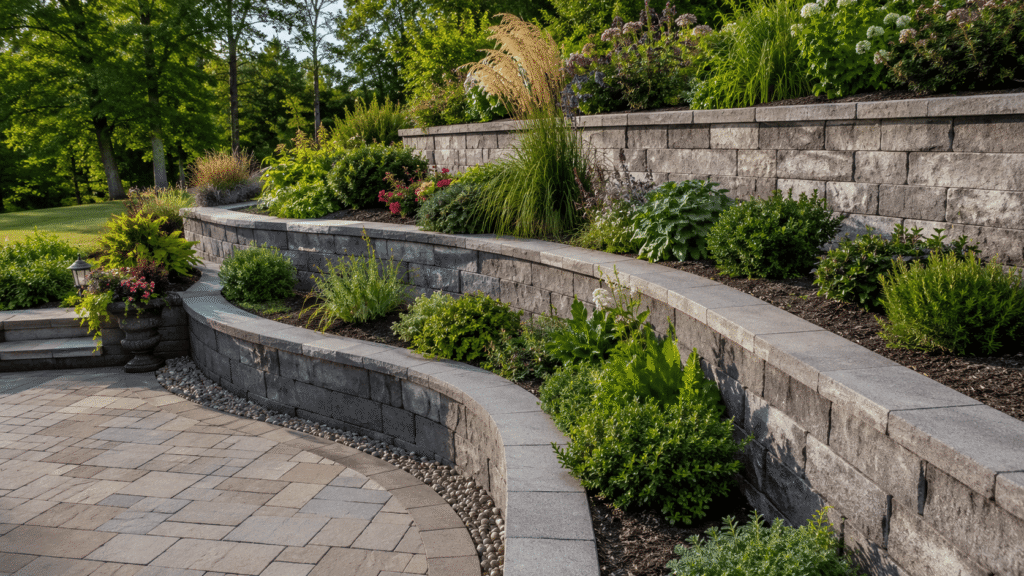
Segmental retaining walls are one of the most common choices for commercial landscapes and upscale residential properties, especially in segmental retaining walls used for sloped garden and planting areas. These walls use interlocking blocks instead of mortar, which helps speed up installation and improve flexibility over time.
Many developers, HOAs, and property managers in Charlotte choose segmental wall systems because they work well on sloped properties and fit many landscape styles. They also handle drainage and soil movement better than some traditional wall systems when installed correctly.
Geogrid reinforcement helps strengthen the wall by spreading pressure deeper into the soil behind it. This matters on larger commercial projects where walls support parking areas, sidewalks, patios, or shared outdoor spaces.
Garden retaining wall projects often include:
- Raised planter beds
- Terraced walls on slopes
- Decorative landscape borders
- Irrigation zones
- Multi-level planting areas
Segmental retaining walls are also popular because repairs are usually simpler. In many cases, damaged sections can be replaced without rebuilding the entire wall. That helps reduce long-term maintenance costs for commercial properties and HOA communities.
Research from BIO Web of Conferences shows
“To achieve the required stability, [retaining walls] are designed to be proportional in their dimensions; the width of the wall base and its height are designed to meet a specific ratio, the proposed average and optimum value of this ratio is 1/2, while the value of 1/2 to 4/5 was recommended to include in the design practice.” – BIO Web of Conferences
Proper installation still matters. Retaining wall contractors must carefully manage:
- Base preparation
- Gravel compaction
- Drainage placement
- Wall alignment
- Footing depth
Poor drainage or weak base preparation can lead to wall shifting and expensive repairs later.
Lapis Patios installs segmental retaining wall systems for commercial developments, HOA properties, and large outdoor projects across Charlotte and surrounding areas. Every project is planned around drainage performance, local code requirements, and long-term durability.
Stone Retaining Wall Designs For Premium Landscapes
Credits: Architecture Inspiration X
Stone retaining walls create a more natural and high-end look for outdoor spaces, with many luxury projects favoring stone retaining wall designs for premium landscape integration. These systems are common in luxury residential communities, hospitality projects, commercial courtyards, and upscale outdoor gathering areas.
Natural stone works well with pavers, patios, landscape lighting, and outdoor seating areas. Many developers use stone retaining walls to improve the appearance of entry features, clubhouse spaces, and outdoor amenities.
Different stone materials create different styles and performance benefits. Granite walls are known for strength and durability, while limestone often gives projects a lighter and more modern appearance.
Stone retaining wall systems may include:
- Boulder retaining walls for erosion control
- Flagstone retaining walls near patios
- Stone veneer over reinforced wall systems
- Gabion walls filled with decorative stone
- Multi-tier stone terraces for sloped properties
Commercial properties often use stone retaining walls near:
- Restaurants
- Apartment communities
- Retail developments
- Outdoor gathering areas
- HOA entrances
Stone retaining walls also pair well with stairs, water features, and landscape lighting systems. These details help outdoor spaces feel more complete and easier to use after dark.
Material selection is important during planning. Stone size, weight, and layout all affect drainage, wall stability, and installation time. Larger commercial projects often use grading plans and 3D layout models before construction begins.
Lapis Patios builds stone retaining wall systems throughout Charlotte for commercial properties and premium residential projects that need both structural support and long-lasting curb appeal.
Modern Retaining Wall Design Ideas For Commercial And Residential Projects
Modern retaining wall design focuses on clean lines, durable materials, and outdoor spaces that serve more than one purpose, especially in projects using modern retaining wall design ideas for integrated commercial hardscapes. Today’s retaining walls are often built to support seating areas, lighting systems, patios, and landscape features at the same time.
Commercial developers and property managers across Charlotte are choosing retaining wall systems that improve both appearance and long-term performance. These walls are no longer treated as hidden support structures. They are now part of the overall property design.
Modern retaining wall projects often include:
- Smooth concrete finishes
- Large-format paver systems
- Built-in seating areas
- Integrated wall lighting
- Concealed reinforcement systems
Many newer commercial projects also use permeable wall systems to improve drainage and help manage stormwater runoff.
Current retaining wall trends include:
- Vertical retaining wall layouts
- Neutral color palettes
- Geometric wall patterns
- Modular wall systems
- Low-maintenance landscape integration
Large commercial hardscape projects often involve engineers, architects, contractors, and property managers working together during planning. Digital layout tools and grading models help improve coordination before excavation starts.
Lapis Patios supports commercial and upscale residential retaining wall projects throughout Charlotte, NC, and nearby communities. The company focuses on code-compliant construction, HOA requirements, drainage performance, and long-term hardscape reliability.
FAQ
How do patio retaining walls help with sloped yard solutions?
Patio retaining walls help level a sloped yard by holding back soil and creating flat usable spaces. They reduce soil movement during rain and help control erosion.
Many people use them for patio hardscaping, backyard retaining wall projects, and raised garden beds. A proper retaining wall design also improves water flow, supports landscaping, and makes outdoor areas safer and easier to walk on.
What makes curved retaining wall designs easier to fit into small yards?
Curved retaining wall designs fit small yards better because they follow natural land shapes instead of forcing straight lines. This makes the space feel more open and balanced.
A curved wall layout also helps guide movement around patios, walkways, and gardens. Many homeowners choose curved retaining wall styles because they soften hard edges and work well for garden retaining walls and landscape retaining walls.
Why do wall drainage systems matter in retaining wall construction?
Wall drainage systems are important because they prevent water from building up behind the wall. When water collects, it creates hydrostatic pressure that can push the wall forward or cause cracks.
Proper backfill drainage, clean stone backfill, and weep hole design help water move away safely. Good drainage protects the retaining wall footing and improves long-term strength, especially in heavy rain or wet soil conditions.
Are segmental retaining walls better than concrete retaining wall systems?
Segmental retaining walls are often easier to install and adjust compared to a concrete retaining wall. They use retaining wall blocks that lock together and allow slight movement without cracking.
Concrete walls can be stronger for very tall structures, but they need precise construction and reinforcement. The best choice depends on retaining wall height, soil pressure calculation, and whether the project is residential or engineered retaining wall work.
What should homeowners know before starting a DIY retaining wall project?
A DIY retaining wall requires careful planning to avoid failure and safety issues. Homeowners must check retaining wall permits and follow local safety standards. A stable base course gravel layer is needed to support the wall.
Proper wall batter angle, drainage, and geogrid reinforcement are important for taller walls. Understanding slope stabilization, lateral earth pressure, and backfill compaction helps ensure the wall stays strong and long-lasting.
Bringing It All Together in Retaining Wall Design
A retaining wall does more than hold back soil. It helps protect your property, improves drainage, and keeps outdoor spaces safe and easy to use. For commercial sites, HOA communities, and large properties in Charlotte, the right wall system can also lower future repair costs. Poor planning causes problems fast.
That’s why many developers, property managers, and homeowners work with experienced contractors like Lapis Patios. From drainage planning to code compliance, their team helps manage large retaining wall projects built for long-term performance.
If you’re planning a commercial or residential project, contact the team for expert help with retaining wall construction in Charlotte.
References
- https://pmc.ncbi.nlm.nih.gov/articles/PMC10852246/
- https://www.bio-conferences.org/articles/bioconf/pdf/2024/16/bioconf_iscku2024_00101.pdf