
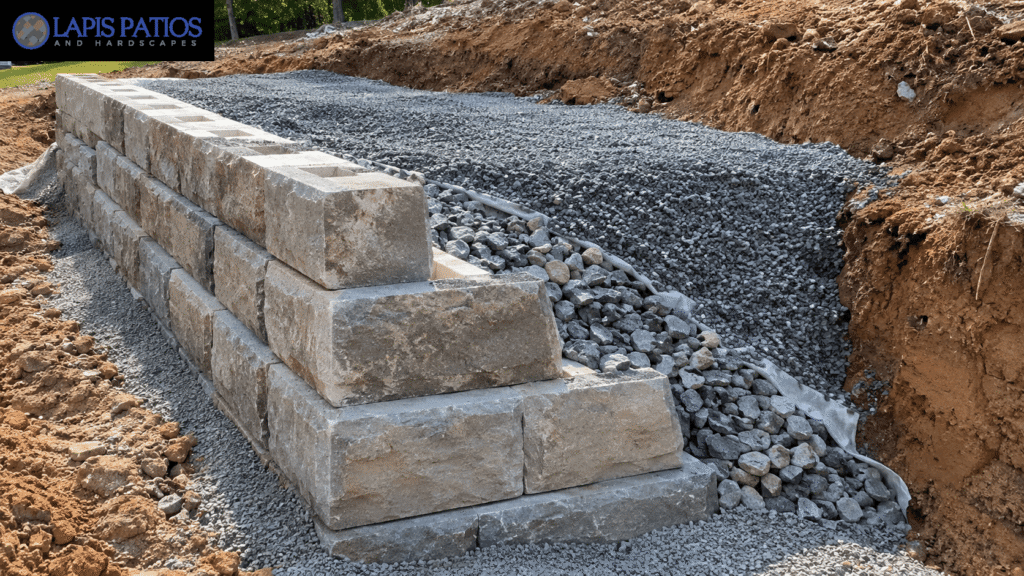
Compare common backfill soils for gravity retaining walls and see why granular materials, proper compaction, and drainage matter.
Gravity retaining walls perform best with suitable granular backfill, stable foundation soil, and effective drainage. Clean crushed stone and well-graded gravel can help manage water and provide the friction needed for wall stability when properly specified.
For commercial developers, property managers, and homeowners in Charlotte, North Carolina, choosing the right materials helps protect patios, landscaped areas, and surrounding hardscapes. Lapis Patio considers soil conditions, drainage needs, and site requirements when planning retaining wall projects.
Keep reading to learn which soils work best, which common mistakes to avoid, and how proper construction supports long-term wall stability.
Retaining Wall Soil Selection: Key Points to Remember
Choosing the right soil, managing water, and following proper construction methods help keep gravity retaining walls stable and protect nearby patios and hardscapes.
- Choose approved granular backfill and clean crushed stone to support wall stability and improve drainage.
- Keep water moving away from the wall, using suitable filters and clear drain outlets to prevent pressure buildup.
- Test soil conditions, follow compaction requirements, and account for patio loads before construction begins.
What Are the Best Soils for Gravity Retaining Walls?
The best soils for gravity retaining walls are usually approved, free-draining granular materials with adequate shear strength, particle interlock, and drainage. The final choice depends on wall design, foundation conditions, and project specifications.
Geotechnical engineering principles require soil selection to consider permeability, friction angle, compaction, and groundwater conditions. ASTM International publishes standards for soil classification and evaluating engineering properties.
For commercial patios and residential landscapes, suitable materials often include clean angular crushed stone, well-graded gravel, and approved coarse granular fill.
| Material | Main Benefit | Typical Application |
| Clean angular crushed stone | Excellent drainage and particle interlock | Specified drainage zones and suitable structural fill |
| Well-graded gravel | Good compaction and load distribution | Engineered structural backfill |
| Coarse sand | Drainage and easy placement | Approved granular fill applications |
| Sandy gravel soil | Potential balance of drainage and friction | Properly graded structural backfill |
| Native clay | Retains moisture and may expand | Generally unsuitable as structural backfill without engineering approval |
| Organic soil | Unpredictable settlement and poor structural performance | Remove from foundation and backfill zones |
Material suitability depends on its intended use. Contractors should not treat all granular aggregates as interchangeable.
- #57 Clean crushed stone is commonly specified for drainage and certain segmental retaining wall systems.
- Well-graded granular soil supports compaction and frictional resistance.
- Fine native soils may need separation from drainage aggregate to reduce clogging.
Professional recommendation: Confirm manufacturer requirements and engineering specifications before ordering materials. A qualified contractor should assess foundation soil and finished patio loads.
Why Should You Avoid Native Clay Behind a Retaining Wall?
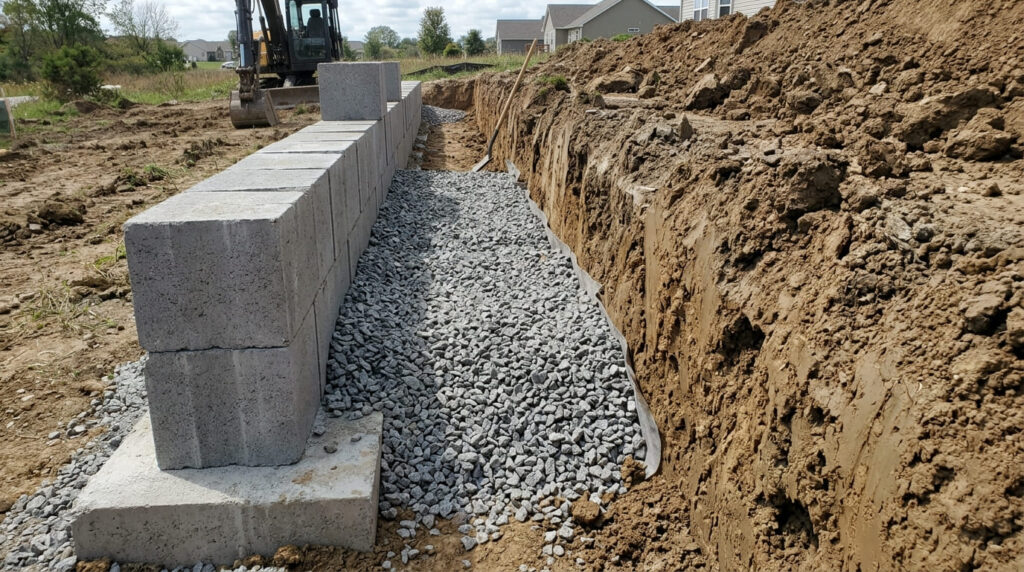
Clay-rich soil holds water and can expand as it gets wetter. This can increase pressure behind gravity retaining walls. Whether clay is suitable depends on its type, drainage, and the wall’s design. The main issue is how clay changes with moisture. Some clay and silty soils drain poorly, which can affect wall stability after construction.
Three problems to watch for:
- Water retention: Poorly draining soil can trap water and increase pressure behind the wall.
- Expansion and shrinkage: Changes in moisture can cause soil to swell, shrink, and shift.
- Reduced stability: Too much water can weaken some soils and reduce their ability to resist movement.
These problems can cause a wall to slide, tilt, settle, or bulge. The risk depends on the wall’s design, foundation, groundwater, and construction quality.
For example, a patio built above a clay-rich slope can add pressure to a retaining wall. Poor drainage can make the problem worse.
Avoid using excavated clay as backfill without engineering approval. A drain pipe alone cannot make unsuitable soil safe. Water must reach the drain and flow out properly, and the wall must suit the site conditions.
For Charlotte-area projects, a site assessment can help identify soft ground, changing soil layers, or ongoing groundwater issues before the wall is built.
Which Is Better: Granular Soil or #57 Crushed Stone?
Well-graded granular soil and clean #57 crushed stones have different uses. Choosing suitable materials for retaining walls depends on whether the wall needs compacted backfill, a drainage layer, or both.
Well-graded soil contains a mix of particle sizes that fit together when compacted. When properly graded, it can create a firm base behind the wall and help limit settlement.
Clean #57 crushed stone has few fine particles, leaving gaps that let water drain through. Its rough, angular pieces also lock together, but its suitability depends on the stone size and the wall system’s requirements.
| Factor | Well-graded granular soil | Clean #57 crushed stone |
| Drainage | Depends on gradation and fines content | Generally excellent when clean |
| Compaction | Usually compacted in controlled lifts | Placement follows the aggregate and wall specifications |
| Particle interlock | Depends on particle shape and grading | Angular particles can provide strong interlock |
| Typical role | Approved structural backfill | Drainage layer or specified wall fill |
| Main consideration | Moisture, density, and fines content | Stability, placement, and drainage-zone design |
When should you choose each material?
Choosing the right backfill helps keep a retaining wall stable and manage water.
- Use approved, well-graded soil when the wall needs compacted backfill.
- Use clean crushed stone when the design calls for a drainage layer.
- Add a suitable filter when needed to stop fine soil from mixing with drainage stone.
The U.S. Department of Transportation provides guidance on soil, earth pressure, and drainage. However, each project must follow its own engineering plans.
Not all gravel works the same way. Check the wall manufacturer’s requirements and site conditions before choosing materials.
How Does Hydrostatic Pressure Cause Retaining Wall Failure?
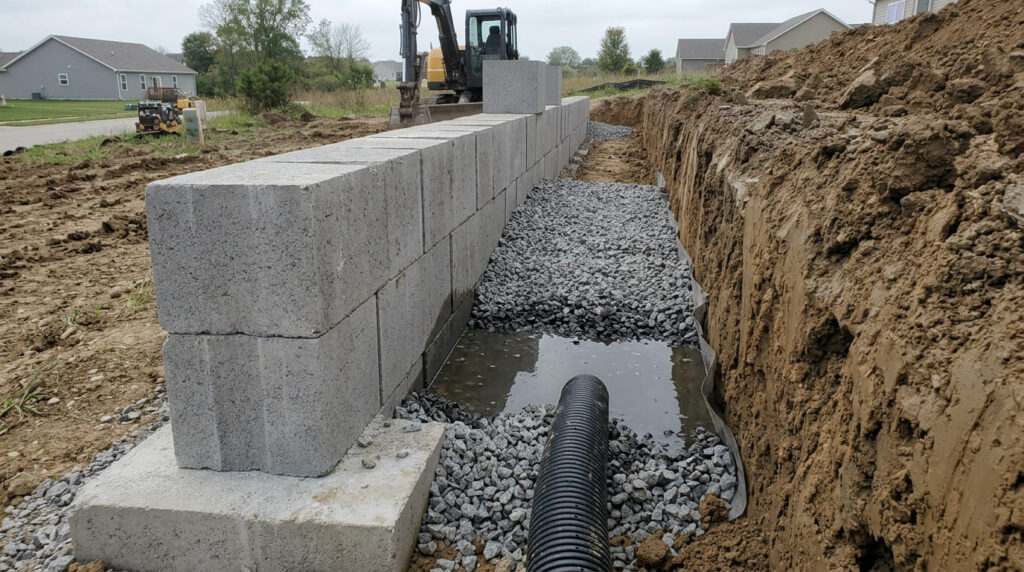
Water trapped behind a gravity retaining wall adds pressure that can cause the wall to slide, tilt, or fail. Good drainage helps reduce this pressure and keeps the wall stable.
Rain and surface runoff can enter the backfill through slopes, patio joints, or poorly graded ground. When water cannot drain away, pressure builds behind the wall, especially if fine soil blocks the drainage path.
Watch for these warning signs:
- Bulging or leaning: May indicate wall movement or too much pressure.
- Efflorescence: White mineral deposits that may point to moisture moving through masonry.
- Persistent wet spots: May signal poor drainage or trapped groundwater.
- Cracked patio surfaces: May result from settlement or movement in the soil or wall.
These signs do not confirm the cause, but they call for a professional inspection. A heavy wall cannot always withstand poor foundations, extra loads, and trapped water.
For large commercial projects, drainage planning should account for ground levels, stormwater, pavement heights, and landscaping. Property managers should also keep drainage outlets clear and accessible for checks and maintenance.
A lasting wall needs more than gravel. Its drainage system must give water a clear way out while accounting for loads from the patio and surrounding ground.
What Soil Classifications Meet Retaining Wall Backfill Requirements?
The Unified Soil Classification System (USCS) helps engineers assess retaining wall backfill based on particle size, gradation, and plasticity. These soil groups help guide material selection but do not prove that a soil is safe for every wall.
ASTM D2487 covers common soil groups, including gravel, sand, and fine-grained soils. Some gravel and sand types may work as structural backfill if they meet project requirements.
As highlighted by ASTM International
“The various groupings of this classification system have been devised to correlate in a general way with the engineering behavior of soils. This standard provides a useful first step in any field or laboratory investigation for geotechnical engineering purposes.” – ASTM International
The table below covers five USCS groups often reviewed when selecting retaining wall soil.
| USCS classification | General description | Main consideration |
| GW | Well-graded gravel | Often suitable if strength, gradation, and drainage requirements are met |
| GP | Poorly graded gravel | Drains well but needs review for its intended use |
| SW | Well-graded sand | Can provide good friction and compaction when properly specified |
| SP | Poorly graded sand | Drains well, but gradation can affect stability and compaction |
| SM | Silty sand | Needs closer checks for fines, drainage, and moisture sensitivity |
A 2026 municipal retaining wall specification from Apple Valley, Minnesota, lists GP, GW, SP, SW, and SM as potentially acceptable groups if project criteria are met. However, not all silty sand is suitable. Fines, plasticity, and strength must meet the relevant requirements.
Before use, soil classification should be backed by testing and approval.
- Check particle size and gradation.
- Confirm fine content and plasticity index.
- Assess moisture sensitivity and permeability.
- Verify the material meets the wall’s strength requirements.
USCS classification is a starting point, not a replacement for engineering approval. Requirements vary by wall system, local rules, and loads.
How Does the Soil Friction Angle Affect Wall Stability?
The internal friction angle (φ) measures how well soil resists sliding. Engineers use it to work out how much pressure the soil puts on a retaining wall. The right backfill can help reduce this pressure.
Granular soil gets its strength from particles pressing against each other. Particle shape, density, gradation, and stress within the soil all affect how well it holds together.
For cohesionless backfill, engineers use the Rankine active earth pressure formula to estimate soil pressure:
[ K_a=\frac{1-\sin\phi}{1+\sin\phi} ]
In this equation:
- (K_a) is the active earth pressure coefficient.
- (\phi) is the soil’s internal friction angle.
The formula estimates soil pressure under certain conditions. It does not cover every part of wall design.
The supplied guidance gives 32° to 36° as a possible friction-angle range for suitable granular fill. Engineers should confirm the actual value through testing rather than guess based on the material type.
A higher friction angle usually means lower calculated soil pressure under these conditions. Wall stability also depends on the foundation, wall shape, groundwater, sloping backfill, and patio loads.
For commercial projects, soil testing helps engineers check friction angle, cohesion where relevant, bearing capacity, and possible settlement.
The aim is to choose backfill that meets the wall’s design needs, based on test results rather than the product label.
Should You Compact Drainage Stone Behind a Gravity Wall?
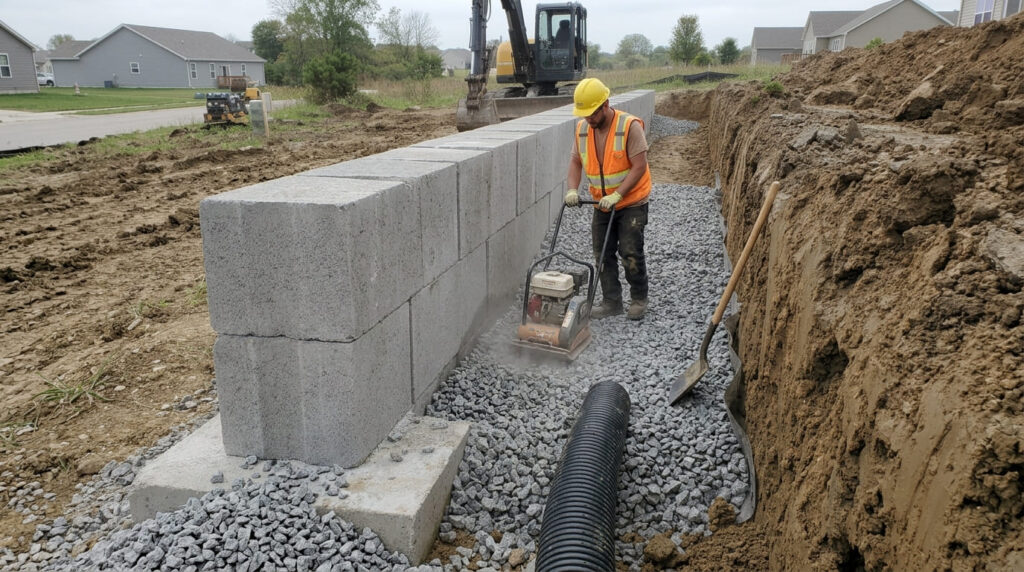
Drainage stone lets water escape, while structural backfill supports the soil behind a retaining wall. Each needs the right placement method to avoid drainage problems or extra pressure on the wall.
Construction teams should follow the wall manufacturer’s instructions and project plans.
- Drainage aggregate: Place clean stone as specified. Avoid compaction that could damage the wall or affect drainage.
- Structural backfill: Add approved soil in layers and compact each layer to the required density.
- Near the wall face: Use suitable equipment and follow the project’s limits on equipment type and distance.
- Moisture control: Adjust soil moisture when needed to meet compaction targets.
The supplied guidance recommends backfill layers of about 100 to 150 millimeters. The right thickness depends on the soil, equipment, wall system, and project requirements.
A Proctor test shows how moisture affects soil density. Field tests check whether the installed backfill meets the required level.
Drainage stone and structural backfill are not interchangeable. Each must be placed according to the wall design.
Professional tip: Set clear placement rules for both materials before work begins. This helps the construction team avoid mistakes during installation.
How Should You Install Drainage Behind a Patio Retaining Wall?
When building a dry-stack retaining wall, the drainage system must carry water away and reduce pressure behind the wall. The setup depends on the soil, wall design, and available outlets.
Drainage must also work with the foundation, backfill, patio grading, and stormwater plan. On commercial sites, these details should be settled before paving or landscaping begins.
As noted by the Federal Highway Administration
“Some issues are critical to the successful installation regardless of the retaining wall system being installed. As we discussed, drainage of groundwater and surface runoff must be properly addressed in design and construction.” – Federal Highway Administration
A typical installation includes these steps.
- Prepare the Foundation. Remove soft soil, organic matter, and other unsuitable material. Dig to the required depth and prepare the base.
- Add Drainage Stone. Place the specified clean gravel or crushed stone, keeping it separate from unsuitable soil.
- Install the Drain Pipe. Where required, fit a perforated pipe with the correct slope and a clear outlet.
- Add a Filter. Use approved filter stone or geotextile fabric to keep fine soil out of the drainage layer.
- Place Structural Backfill. Add approved soil in layers and compact it to meet project requirements.
- Direct Surface Water. Grade the patio and nearby ground so rainwater flows away from the wall.
Pipe size, drainage width, filter materials, and outlet design must follow the approved plans and suit the site.
For Charlotte projects, Lapis Patios coordinates drainage with site grading and stormwater needs. North Carolina building code resources are available through the Office of State Fire Marshal.
Good drainage starts with a sound plan. A drain pipe cannot fix a weak foundation, an undersized wall, or poor backfill.
Can Geotextile Fabric Prevent Fine Soil From Clogging Drainage Stone?
Geotextile fabric helps keep fine soil out of drainage stone while letting water pass through. The right fabric depends on the soil, fabric properties, and site conditions.
Fine soil can wash into clean gravel and block the gaps that water flows through. Over time, this can slow drainage and increase pressure behind the wall.
A suitable filter must do three things:
- Keep Soil in Place: Stop soil particles from washing into the drainage layer.
- Let Water Through: Allow enough water to pass through the fabric.
- Resist Clogging: Keep working under the site’s soil and groundwater conditions.
Clay and silty soils need careful attention because their fine particles can affect filter performance. A fabric suited to sandy soil may not work well with soil that contains more fines.
The U.S. Federal Highway Administration provides technical resources on soil, drainage, and geotechnical design that project teams can use for guidance.
When choosing geotextile fabric, consider soil gradation, fabric opening size, water flow, and installation needs. The fabric must also work with the drainage stone and collection system.
Geotextile fabric cannot replace a working drain outlet. Even the right filter will not help if the pipe is blocked or the outlet is poorly designed.
How Do Patio Surcharge Loads Change Backfill Requirements?
Credits: Civil All rounder
A patio built above a retaining wall adds weight that can increase pressure on the wall. The wall design and backfill must account for these extra loads, not just the weight of the soil.
The load depends on how the space will be used. A garden patio puts less demand on a wall than a commercial dining area or a paved surface used by maintenance vehicles.
Common loads to consider include:
- Patio paving and base materials.
- Heavy planters, outdoor fixtures, and concentrated loads.
- Vehicles, construction equipment, and delivery access.
- Sloping ground or nearby structures above the wall.
A wall built for a small garden may not support a commercial patio with heavier loads. These demands can affect wall size, foundation needs, backfill choice, and drainage design.
Developers and property managers should confirm how the finished space will be used before construction starts. Layout or access changes may require a design review.
Before approving materials, check the wall height, foundation, groundwater, soil conditions, and expected loads. Every part of the wall system must work together to provide lasting support.
What Are the Most Common Backfilling Mistakes to Avoid?
Poor soil, weak drainage, and improper compaction can cause retaining wall problems. Quality checks should start before backfill arrives and continue through the final inspection.
The table below covers common mistakes and how construction teams can address them.
| Common mistake | Recommended professional response |
| Using clay as backfill without approval | Check the soil and select suitable engineered backfill |
| Leaving out required drainage | Install the drainage system and outlet shown in the plans |
| Letting fine soil enter drainage stone | Add a suitable filter where required |
| Overcompacting near the wall | Follow equipment limits and required working distances |
| Placing backfill in thick layers | Follow the approved layer thickness and compaction method |
| Ignoring patio loads | Design for how the finished area will be used |
| Building on soft soil | Check soil strength and remove or improve unsuitable material as specified |
| Skipping backfill tests | Complete the required lab and field tests |
Check native soil carefully when excavation reveals mixed soil layers, soft clay, silt, or organic matter. Further testing may be needed before approving the foundation.
Contractors should record material deliveries, compaction tests, drainage work, and approved design changes. These records help developers and property managers confirm that hidden work meets project requirements.
A wall may look stable after construction but still have drainage or foundation problems. Finding these issues early is easier than fixing them after paving and landscaping are complete.
Consistent quality checks help protect the retaining wall and the surrounding property.
How Can Lapis Patios Help With Retaining Wall Material Selection?
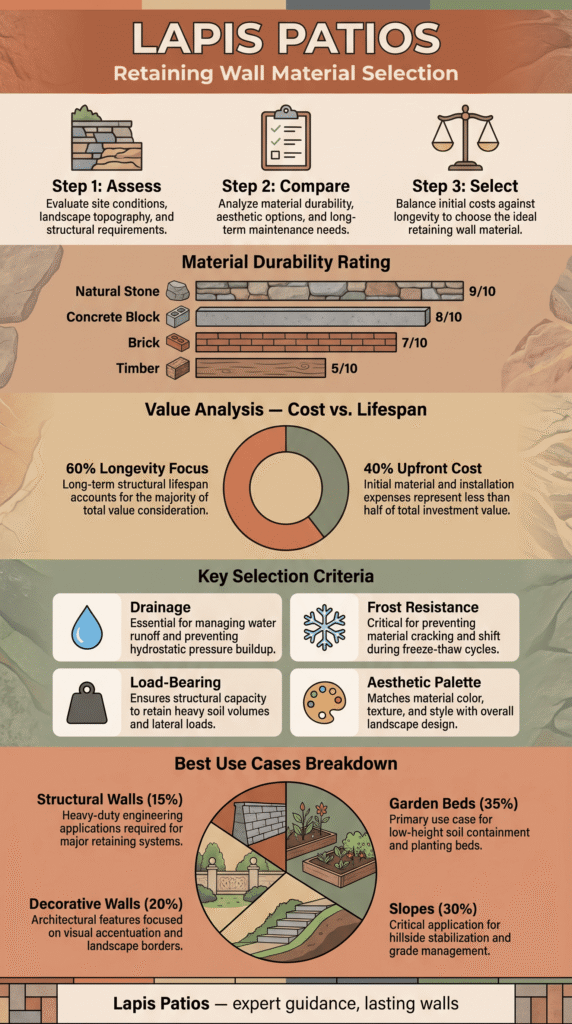
A retaining wall needs the right materials, a solid base, and good drainage. Lapis Patios builds patios and retaining walls for commercial sites, new developments, and homes in Charlotte, NC, and nearby areas.
Large hardscape projects need careful planning. The team must check the wall design, foundation, backfill, compaction, and drainage. The work must also meet engineering plans and local building codes.
Before work starts, the team should check:
- The required backfill and drainage stone.
- Foundation and compaction needs.
- Drainage outlets and soil separation.
- The weight the finished patio will place on the wall.
- Permits, building codes, and engineering approvals.
- HOA rules for patio layouts, wall design, and property changes.
For homeowners, planning ahead can help avoid costly repairs. For developers and property managers, it helps keep projects on track and meet site requirements.
Lapis Patios should review each site before choosing materials or construction methods. Soil, drainage, and loads vary from one project to another.
Planning a patio or commercial hardscape project in the Charlotte area? Work with an experienced contractor to make sure the retaining wall suits the site and meets local rules.
FAQ
Can You Use Native Soil as Backfill Behind a Gravity Retaining Wall?
You can use native soil as backfill if its properties meet the project’s engineering requirements. A soil assessment identifies drainage problems, excessive clay, organic matter, and compaction issues.
If the native soil cannot provide adequate drainage or stability, replace it with suitable engineered backfill soil. A qualified professional should evaluate the soil before construction begins.
How Does Soil Classification Affect Gravity Retaining Wall Performance?
The Unified Soil Classification System (USCS) groups soils according to their grain size and other properties. GW and SW soils generally provide good drainage when properly graded, while GP and SP soils may require additional attention during compaction.
Soil classification helps engineers select suitable backfill, but they must also assess soil strength, fine content, and site conditions.
What Happens If Backfill Soil Holds Too Much Water?
Backfill soil that retains too much water can increase hydrostatic pressure behind a gravity retaining wall. Silty soil and high-plasticity clay can restrict drainage and increase the risk of wall movement.
Using free-draining backfill material, installing retaining wall drainage aggregate, and providing a properly designed drain pipe can help control water buildup and protect wall stability.
How Can You Tell If Retaining Wall Soil Is Properly Compacted?
Contractors can assess soil compaction by comparing field density measurements with the target density established through a Proctor compaction test. The test also helps determine the optimum moisture content for compaction.
Properly compacted backfill reduces the risk of excessive settlement and uneven ground support. Contractors should follow the compaction requirements specified in the project’s engineering plans.
When Should You Get a Soil Test Before Building a Gravity Retaining Wall?
You should arrange soil testing when the ground is soft, groundwater is present, or the retaining wall will support heavy loads. A geotechnical soil investigation can evaluate foundation bearing strength, soil shear strength, and settlement risks.
Engineers use these findings to select suitable backfill, prepare a stable foundation, and determine whether drainage improvements or ground reinforcement are necessary.
Choose the Right Soil for a Stable Retaining Wall
The wrong soil can lead to poor drainage and an unstable retaining wall, putting nearby structures and site operations at risk. Getting the soil right matters.
Lapis Patios provides professional hardscape construction for commercial properties in Charlotte, NC, and surrounding areas. The team can help project owners address site conditions, drainage needs, and applicable building codes before construction begins.
For large-scale projects, early planning also helps address HOA requirements and site-specific engineering needs. Contact Lapis Patios to discuss your project and plan a retaining wall that meets your property’s needs.
References
- “Standard Practice for Classification of Soils for Engineering Purposes (Unified Soil Classification System).” ASTM International, February 12, 2025. Accessed November 2, 2026.
- “Highway Materials Engineering Course Module B: Soils and Foundations – Participant Workbook.” Federal Highway Administration, June 27, 2017. Accessed November 2, 2026.