
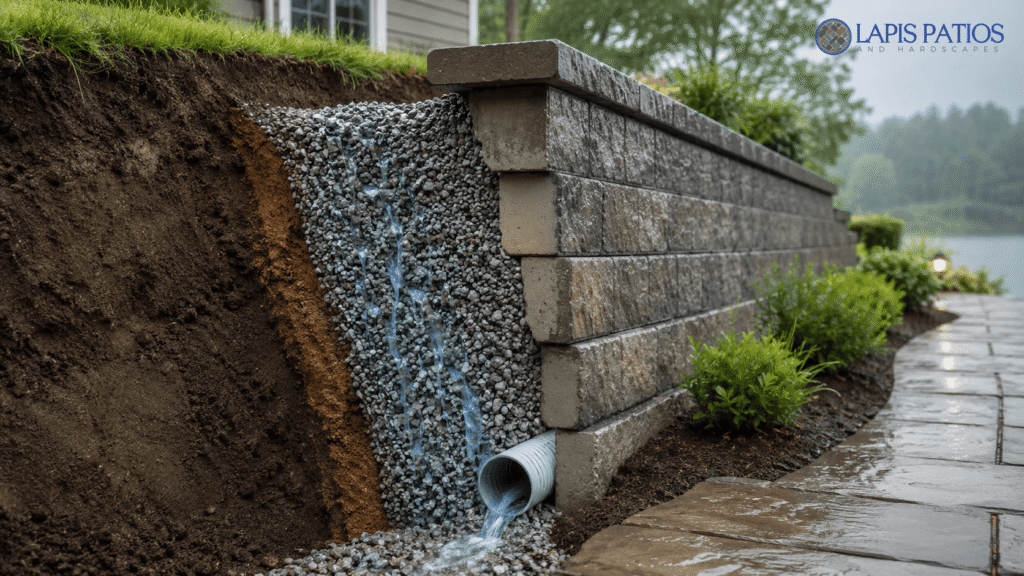
Choose the best gravel for retaining wall drainage to prevent water damage, protect patios, and keep walls strong for years.
A retaining wall can look solid on the outside and still fail underneath.
Most of the time, water is the problem.
After a heavy rain, water sinks into the soil behind the wall. If it cannot drain out, the pressure starts building. At first, the signs are small. A crack in the joint. A low spot near the patio. A section of the wall is leaning a little more each season.
Then the repairs start.
Around Charlotte, North Carolina, this happens often because clay soil holds water for a long time. That puts extra stress on retaining walls, especially on commercial properties with slopes, parking lots, and large paved areas.
Lapis Patios builds retaining walls for HOAs, apartment communities, commercial properties, and large residential projects across the Charlotte area. Drainage is part of every wall system because trapped water shortens the life of the entire structure.
The gravel behind the wall matters more than most people realize.
Retaining Wall Drainage Basics
- Clean angular gravel drains water faster than rounded stone.
- Drain pipe, gravel, and filter fabric should work together as one system.
- Clay soil in Charlotte holds water longer and increases wall pressure.
Why Does Gravel Matter For Retaining Wall Drainage?
Gravel creates an open space behind the wall so water can move out instead of staying trapped in the soil.
Without that space, water builds pressure behind the wall every time the ground gets saturated.
The heavier the soil gets, the harder it pushes.
This becomes a bigger issue on commercial properties because retaining walls often support larger slopes and carry more surface runoff from roofs, sidewalks, parking lots, and paved areas. The choice of retaining wall materials also affects how well the wall handles long-term drainage pressure and soil movement.
Lapis Patios sees the same pattern during retaining wall repairs across Charlotte. Water collects behind the wall. Drainage slows down. Soil starts shifting. Eventually, the wall moves.
Common warning signs include:
- Water is pooling near the wall
- Cracks in nearby patios
- Soil washing out near the base
- Leaning wall sections
- Standing water after storms
Most drainage problems start underground long before the wall visibly fails.
Quick Guide To Choosing Retaining Wall Gravel
For most retaining walls, clean crushed stone works best.
The gravel should be angular, not smooth or rounded. Angular stone locks together better and still leaves enough space for water to drain through.
Most retaining wall drainage systems include:
- ¾-inch clean gravel
- #57 stone
- Perforated drain pipe
- Non-woven filter fabric
- Compacted gravel base
Most walls also need at least 12 inches of gravel behind the structure.
For taller commercial retaining walls, drainage requirements may change depending on slope conditions, runoff, and local code requirements.
Good drainage depends on the whole system, not one material.
What Is The Best Gravel For Retaining Wall Drainage?
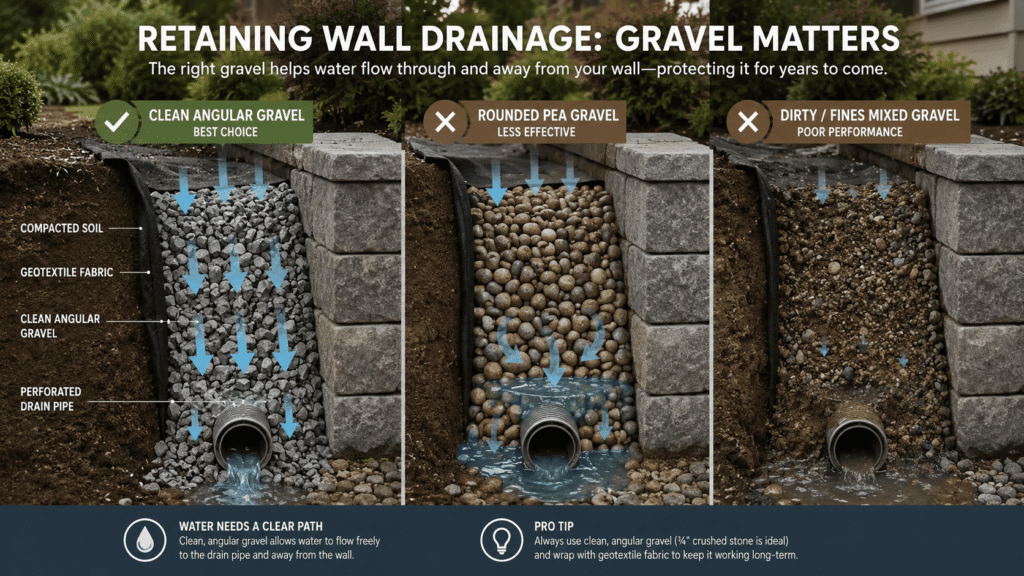
The best gravel for retaining wall drainage is clean crushed stone with no dirt, clay, or stone dust mixed into it.
Dirty gravel clogs over time. Once the drainage space fills with sediment, water slows down, and pressure starts building again.
Lapis Patios commonly uses:
- #57 stone behind retaining walls
- #67 stone around drain pipes
- ¾-inch clean gravel for drainage zones
- Crusher run under the wall base
Pea gravel is usually a bad choice behind retaining walls. The smooth stones shift too easily under pressure.
Materials that should stay out of the drainage zone include:
- Clay soil
- Fill dirt
- Pea gravel
- Stone dust
- Mixed gravel with fines
Those materials trap water instead of moving it away from the wall.
Research from the National Center for Biotechnology Information shows
“The implementation of a gravel drain requires a lot of material and financial outlays. For the gravel layer, values [of volumetric flow rate] of up to 140 dm³ · min⁻¹ were recorded. The results were compared with the values for the gravel layer, in earthwork, they perform very different functions” – National Center for Biotechnology Information
| Gravel Type | Drainage Speed | Stability | Best Use |
| #57 Stone | High | High | Main drainage backfill |
| ¾-Inch Clean Gravel | High | High | Behind retaining walls |
| #67 Stone | Medium | High | Around drain pipe |
| Pea Gravel | Medium | Low | Decorative areas |
| Crusher Run | Low | High | Wall base material |
The gravel behind the wall affects how long the retaining wall lasts.
Where Should Gravel Go In A Retaining Wall System?
Gravel belongs in three main areas:
- Under the wall
- Behind the wall
- Around the drain pipe
Each part handles water differently.
The gravel below the wall helps support the structure and reduce settling.
The gravel behind the wall creates a drainage path so water moves downward toward the pipe instead of pushing against the blocks.
The gravel around the drain pipe helps water reach the pipe faster.
Most commercial retaining wall systems in Charlotte use 6 to 12 inches of compacted base gravel, depending on wall height and soil conditions.
The drain pipe should always sit at the bottom of the wall system where water naturally collects.
Lapis Patios builds retaining wall drainage systems designed for heavy rainfall, clay soil, and long-term site performance across the Charlotte area.
How Wide Should The Gravel Zone Be?
Most retaining walls need at least 12 inches of drainage gravel behind the wall.
Taller walls usually need more space because they collect more groundwater and hold more soil pressure.
General drainage guidelines include:
- Walls under 4 feet: 12 inches
- Walls between 4 and 6 feet: 12 to 18 inches
- Walls over 6 feet: 18 to 24 inches
Commercial retaining walls may need engineered drainage layouts depending on runoff and site conditions.
More wall height means more pressure behind the system.
Can You Skip The Drain Pipe And Use Only Gravel?
No.
Gravel helps water move through the system, but the drain pipe carries water away from the wall.
Without a pipe, water collects at the base, and pressure keeps building underground.
Lapis Patios installs perforated drain pipes as part of complete retaining wall drainage systems throughout Charlotte and nearby areas.
A few problems show up often on failing retaining walls:
- No drain pipe
- Pipe installed too high
- No outlet for water
- Missing filter fabric
Water needs somewhere to go. If it stays trapped behind the wall, the wall eventually starts moving.
How Thick Should The Gravel Base Be Under A Retaining Wall?
Most retaining wall systems need 6 to 12 inches of compacted base gravel under the wall.
Base gravel is different from drainage gravel.
The base layer must compact tightly to support the wall weight. Drainage gravel stays loose enough for water to move through it.
That difference matters on commercial retaining wall projects where settlement can damage nearby pavement, sidewalks, patios, or landscape areas.
Base depth usually depends on wall height:
- Walls up to 3 feet: 6-inch base
- Walls between 3 and 6 feet: 8-inch base
- Walls over 6 feet: at least 12 inches
Proper installation also matters. Base gravel should be added in small layers and compacted during installation.
Most professional retaining wall crews follow these steps:
- Install gravel in 2- to 4-inch lifts
- Compact each layer with a plate compactor
- Check elevation and slope with a laser level
Poor base preparation is one of the biggest causes of retaining wall failure.
When the base settles, the wall shifts. Once the wall shifts, cracks and drainage problems usually follow.
What Gravel Mistakes Cause Retaining Wall Failure?
Most retaining wall failures start with poor drainage. In many cases, the wrong gravel or missing drainage materials allow water to build up behind the wall over time.
One of the biggest problems is using gravel that contains dirt, sand, or stone dust. Those fine materials block water flow and clog the drainage system.
Skipping the geotextile fabric creates another major issue. Without a fabric separating the gravel from the soil, clay and sediment slowly move into the drainage stone and reduce water flow.
Lapis Patios sees these problems often during retaining wall repairs across Charlotte-area commercial and residential properties. Many failing walls were built without complete drainage systems from the start.
The most common drainage mistakes include:
- Using rounded pea gravel behind the wall
- Using crusher run as drainage backfill
- Installing the drain pipe too high
- No drainage outlet or daylight exit
- Missing geotextile fabric between soil and gravel
Retaining walls usually fail slowly at first. Small cracks appear. Sections begin to lean. Water collects near the base. Then the damage spreads quickly.
For commercial properties, drainage failure can affect parking areas, sidewalks, stormwater flow, and access routes. That creates larger repair costs and possible liability concerns for property owners and managers.
How Does Retaining Wall Drainage Connect To Patio Drainage?
Credits: Western Interlock
Retaining wall drainage and patio drainage should work together as one system.
When drainage systems are separated, water often collects where the patio meets the wall. Over time, that moisture softens the soil and weakens the base under nearby pavers and retaining blocks.
Lapis Patios designs retaining walls and paver patios together so water flows away from the structure instead of collecting behind it. This is especially important in Charlotte, where heavy rain and clay soil can overload poorly planned drainage systems.
A connected drainage system usually includes:
- Shared compacted base material
- Connected French drains
- Surface slope between 1% and 2%
- Drainage routes toward collection areas or daylight exits
Proper base preparation matters because using gravel for patio foundation areas can directly affect how water moves near retaining walls and surrounding hardscape.
Patio runoff matters because that water often ends up near the retaining wall.
If stormwater drains behind the wall, the added water pressure shortens the life of the entire system.
For commercial outdoor spaces, HOA properties, and multifamily developments, drainage planning should happen before installation begins, not after problems appear.
How Do You Install Gravel Behind A Retaining Wall Step By Step?
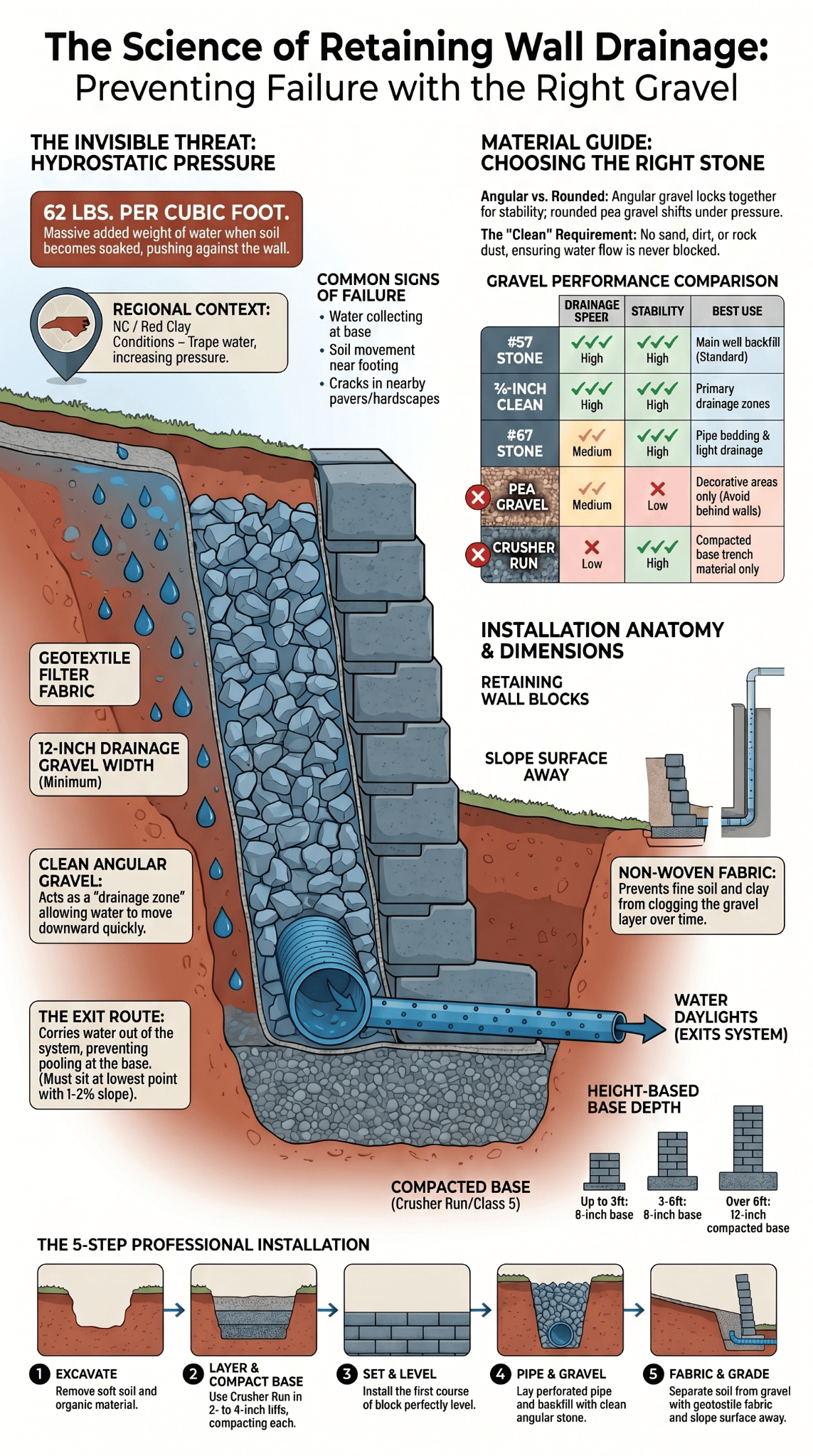
Retaining wall drainage must be installed in the correct order. Each step affects how well the system handles water over time.
Lapis Patios follows structured installation methods designed for commercial durability, long-term drainage performance, and Charlotte-area building requirements.
1. Excavate The Base Trench
Remove soft soil, roots, and organic material. The trench must provide enough space for the wall base, gravel, and drain pipe.
2. Install Base Material
Place compactable gravel such as crusher run or Class 5 gravel in layers.
3. Compact The Base
Compact the gravel every few inches using a plate compactor to reduce future settlement.
4. Set The First Course
Install the first row of retaining wall block level and straight. This step controls the alignment of the entire wall.
5. Install The Drain Pipe
Place a 4-inch perforated drain pipe at the lowest point behind the wall. The pipe should slope about 1% to 2% so water can exit the system.
6. Add Drainage Gravel
Place clean angular gravel behind the wall in small lifts. Proper gravel placement helps water move evenly toward the drain pipe. Similar drainage control methods are often used during gravel patio installation projects where water management and stable base layers are critical for long-term performance.
7. Install Geotextile Fabric
Separate the gravel from the surrounding soil with non-woven filter fabric. This helps prevent clogging inside the drainage zone.
8. Final Grade The Area
Shape the finished surface so water drains away from the retaining wall, not toward it.
Good drainage depends on proper installation from the ground up. Shortcuts during excavation, compaction, or pipe placement often lead to drainage failure later.
What Do Engineers Say About Gravel Vs Sheet Drain Systems?
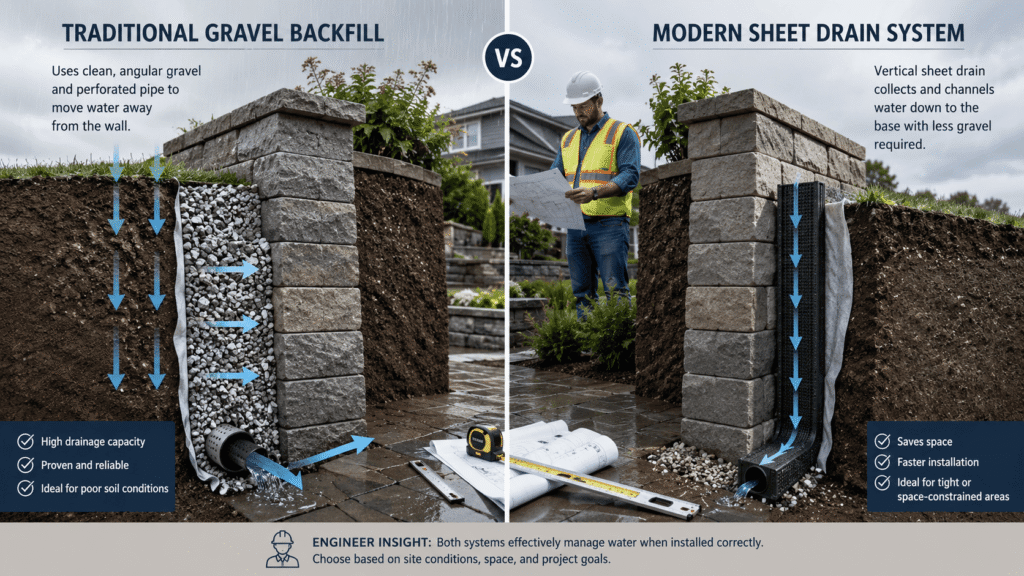
Engineers often use both gravel and sheet drain systems on large retaining wall projects. One does not replace the other.
Commercial retaining walls handle more soil pressure, water flow, and surface load than most residential walls. Because of that, drainage systems usually need multiple layers of protection.
Sheet drains help direct water downward. Gravel helps move water through the system while supporting the wall structure.
They do different jobs.
As highlighted by the U.S. Army Corps of Engineers
“This manual is intended primarily for retaining walls which will be subjected to hydraulic loadings such as flowing water, for the design of retaining walls which will not be subjected to hydraulic loadings, TM 5-818-1 may be used for computing the loadings and evaluating the stability of the structure” – U.S. Army Corps of Engineers
On larger retaining wall projects in Charlotte, engineers may specify both materials for better long-term performance, especially on sites with heavy runoff or clay soil.
Combined drainage systems are common for:
- Commercial building foundations
- HOA retaining walls
- Large slope retention projects
- High water table areas
- Multifamily developments
Drainage panels can improve water flow behind the wall, but gravel is still needed for stability and load support.
Lapis Patios builds retaining wall systems with drainage layouts designed around site conditions, wall height, and long-term structural performance. On commercial properties, drainage design affects more than the wall itself. It also impacts nearby pavement, stormwater control, and soil stability across the site.
What Real Failures Teach About Retaining Wall Drainage
Most retaining wall failures start below the surface long before visible damage appears.
In many failed walls, the drainage system was incomplete, clogged, or poorly installed. Water became trapped behind the wall and pressure slowly increased over time.
Lapis Patios often sees the same warning signs during retaining wall repairs across Charlotte and nearby areas.
One common problem is dry weep holes with soaked soil behind the wall. That usually means water never reached the drainage outlet.
Another frequent issue appears after winter weather. Water freezes inside the wall system, expands, and pushes sections of the wall outward.
Some of the most common retaining wall failures include:
- Block walls leaning forward
- Boulder walls sliding downhill
- Wood retaining walls rotting too early
- Soil erosion under concrete footings
- Cracks forming near patios or sidewalks
Most wall failures begin underground where drainage problems cannot be seen right away.
By the time cracks or movement appear, water has usually been damaging the system for years.
That is why commercial retaining wall construction depends heavily on proper drainage design, compaction, and material selection from the beginning.
FAQ
What type of gravel is best for retaining wall drainage?
The best gravel for retaining wall drainage is drainage gravel made from angular crushed gravel, crushed stone, or crushed rock.
These materials create open spaces that let water pass through while staying packed in place. This setup reduces water buildup and lowers hydrostatic pressure behind the wall. Avoid smooth gravel because it shifts and supports the wall less.
Can pea gravel work for retaining wall drainage?
Pea gravel can move water, but it is usually not the best choice for a retaining wall. Its round shape makes it less stable than angular stone or drainage stone. The stones can roll and shift over time, which weakens the gravel backfill. Pea gravel works better for light drainage jobs than for supporting heavy wall loads.
Why should I install a perforated drain pipe behind a retaining wall?
A perforated drain pipe carries water away from the back of the wall before it collects. This pipe works with drainage gravel to build a complete drainage system. Many walls also use French drains and Weep Holes to improve water flow. This system reduces soil saturation, protects the wall, and helps prevent cracking or leaning.
Does landscape fabric help with retaining wall drainage?
Landscape fabric or geotextile fabric helps keep soil out of the drainage aggregate layer. The fabric separates the native soil from the gravel, so dirt does not clog the drainage paths. Clean gravel drains water faster and lasts longer. This extra layer also reduces soil erosion and helps the drainage system stay effective over time.
How deep should the base material be for a retaining wall?
The base material under a retaining wall should be deep enough to support the wall and spread the weight evenly. Most walls need a base trench filled with compactable gravel, crusher run, or Class 5 gravel. A strong base creates a stable structural foundation, improves drainage, and reduces the risk of frost heave or wall movement.
Build a Retaining Wall Drainage System That Lasts
Water problems usually show up long before a wall fails, and commercial properties can’t afford drainage mistakes that lead to repairs, surface damage, or HOA complaints. Poor gravel selection or weak drainage planning can shorten the life of a retaining wall quickly. That’s the reality property managers and developers deal with.
For large-scale retaining wall projects in Charlotte, proper drainage requires experienced installation that follows code requirements and engineered specs. Lapis Patios works with developers, HOA communities, commercial properties, and homeowners who want retaining walls built to last, not patched a few years later. Schedule a site evaluation with Lapis Patios to plan a drainage system that protects your investment for decades.
References
- https://pmc.ncbi.nlm.nih.gov/articles/PMC8585300/
- https://www.publications.usace.army.mil/portals/76/publications/engineermanuals/em_1110-2-2502.pdf