
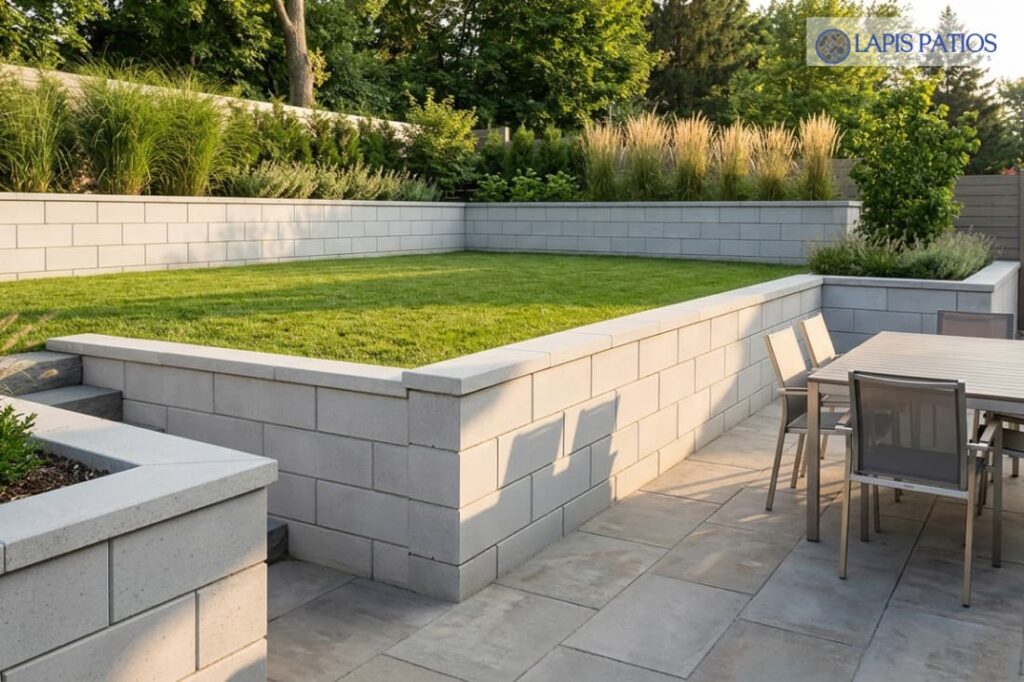
Explore geometric retaining wall layouts that balance structure, drainage, and modern patio design without wasting space.
Geometric retaining walls aren’t just decorative borders, they are structural engineering systems designed to hold back thousands of pounds of moving earth. If you ignore the natural slope and water path of your yard during the layout phase, the wall will fail.
The layout choice, straight, terraced, or angular, affects how it’s built, how long it lasts, and if it follows local codes and HOA rules.
At Lapis Patios, we engineer every wall first. The shape serves both a job and a style. Keep reading for tips on planning a wall that lasts.
Retaining Wall Layout Rules That Matter Most
These key points explain how smart retaining wall geometry balances drainage, structural stability, patio usability, and long-term performance from the very beginning.
- Let the site shape the layout: The best wall designs respond to slope, water flow, and patio circulation before decorative style decisions are made.
- Drainage should guide every major choice: Soil pressure and water management determine wall height, reinforcement needs, terrace spacing, and base design.
- Small design details prevent major failures: Proper gravel backfill, drainpipes, and weep holes are essential because trapped water is the leading cause of retaining wall damage.
What Makes Geometric Retaining Wall Layouts Effective?
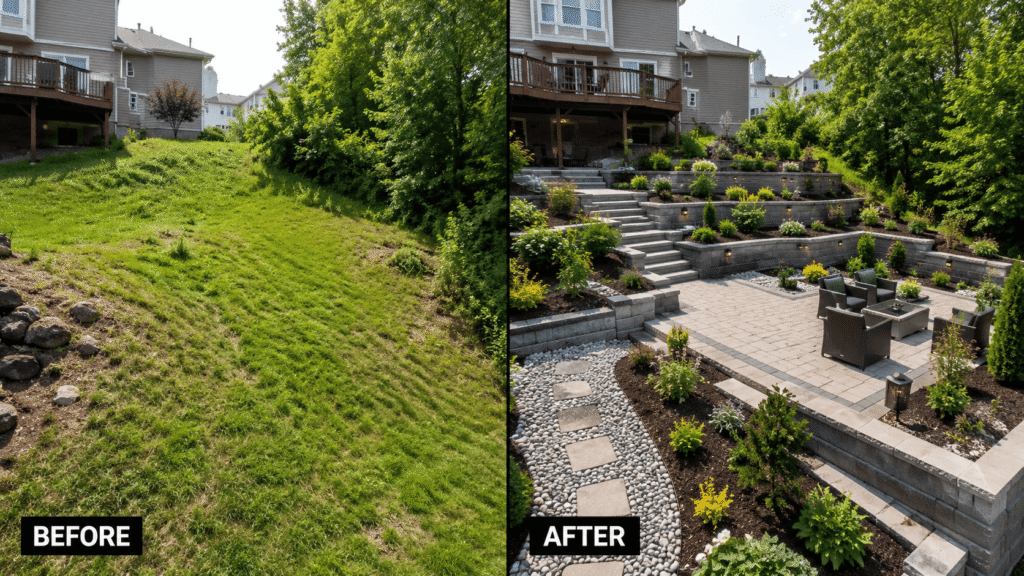
Geometric layouts improve structural stability and outdoor use by organizing slopes into clear patio zones. A straight wall along a property line creates a clean edge for a patio.
A series of stepped terraces can turn a steep slope into several flat areas for dining or landscaping. The geometry is not just for looks; it solves problems of grading and creating space.
These layouts provide key functional benefits beyond holding back soil. They manage surface water runoff, directing it away from buildings and pavement. By creating flat areas, they make clear walkways, improving access and safety.
The walls themselves become part of the landscape. Thoughtful retaining wall design can turn a wall cap into built-in seating while the wall face supports lighting or raised planters.
This multifunctional approach gives a strong return on investment. It turns a required structural element into a central feature of the outdoor space. For commercial properties and homeowners, it maximizes usable area and enhances property value.
When Should You Use Straight, Stepped, or Angular Wall Designs?
Choosing the right wall shape balances what your land is like with what you want to build.
A straight wall is the simplest and cheapest choice for gentle slopes. It works well to make one flat patio or to mark a clean property line. Its simple shape makes building easy and helps it line up with other paved areas.
For big slopes, a terraced or stepped layout is usually best. Proper retaining wall height and design considerations help divide a tall, unstable hill into several shorter, more stable walls with flat areas between them.
This greatly reduces the push of the soil on each wall and creates usable space on different levels.
An angular design, with corners and flat sides, gives a modern look. In some layouts, curved retaining wall designs are also used to soften hard edges, frame fire pits, or flow naturally around obstacles.
The table below shows the main points for each common layout type:
| Layout Type | Best Use Case | Primary Advantage | Key Consideration |
| Straight Linear | Gentle slopes, clean property lines, modern designs. | Construction efficiency, easy alignment, cost-effectiveness. | Less flexible on complex slopes; needs careful drainage planning. |
| Stepped Terrace | Large elevation changes, creating multiple usable zones. | Distributes soil pressure, creates flat areas, improves stability. | Needs more excavation and material; precise leveling is critical. |
| Angular/Faceted | Modern patios, defining specific activity zones, navigating obstacles. | Strong visual structure, creates architectural interest. | More complex construction; drainage must be carefully planned. |
| Hybrid (Curved/Straight) | Transitional spaces, softening formal edges, guiding foot traffic. | Blends formal and natural looks; can improve traffic flow. | Needs skilled craftsmanship for smooth transitions and strength. |
Why Do Terraced Retaining Walls Work Better on Steep Slopes?
Credits: Structures Explained
Terraced retaining walls are the built answer for steep slopes. They change the problem. Instead of one tall wall fighting the huge push of deep soil, a terraced system builds a series of shorter walls.
Each wall only has to hold the dirt right behind it and the weight from the level above. This is much less force. This method makes everything more stable and cuts the risk of a big collapse.
From a practical view, terracing turns an unusable hill into useful space. It creates separate outdoor “rooms” connected by built-in stairs. This is very useful for apartments, businesses, or homes where you want to use all the outdoor area.
Benefits of Terraced Walls:
- Creates Usable Space: Makes flat areas for dining, lounging, or gardens.
- Improves Drainage: Breaks a long, steep water path into smaller parts. This reduces erosion and slows water down.
- Common Uses We Build:
- Defining separate dining and lounge zones.
- Creating sunken firepit areas.
- Building raised planting beds.
- Designing split-level patios that follow the land’s shape.
How Does Drainage Change Retaining Wall Geometry?
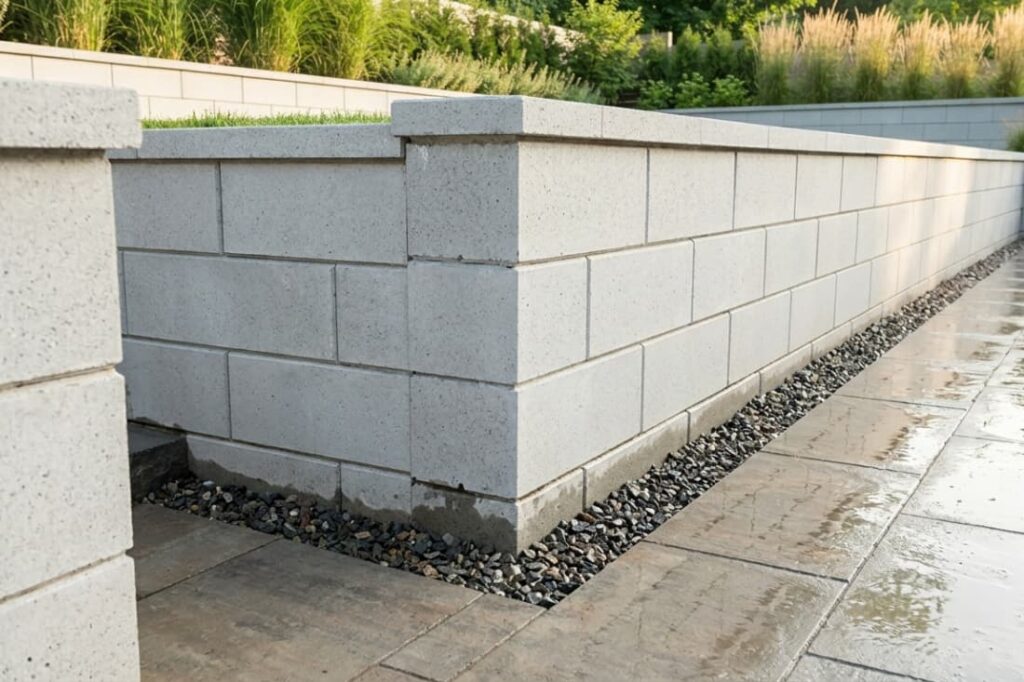
Drainage is the essential rule that must guide every design choice. Without proper water control, pressure builds up behind the wall. This always leads to bulging, cracking, or collapse.
Drainage Needs by Layout:
- Straight Wall: Needs a continuous drainpipe at its bottom, connected to outlets.
- Terraced System: Needs drainage at the base of every wall, with a plan for how water flows from one level to the next.
The wall’s shape directly affects the drainage plan.
- The space behind the wall must be filled with free-draining gravel. This creates a “drainage blanket” that guides water to the weep holes and base pipe.
- The wall’s slight backward lean is a key design feature. It adds stability and helps water run away from the wall face.
- The layout must also give water a clear way out, either through gravel paths to daylight, solid pipes to a storm system, or dry wells.
For commercial projects, these systems must handle the extra runoff from new patios and walls. This often requires working with the site’s overall drainage plan and meeting local city standards.
Which Retaining Wall Materials Fit Geometric Layouts Best?
The choice of material is tied to the shape you want, your budget, and how long it needs to last. For clean, precise shapes, especially ones with angles, corners, and steps, modular concrete blocks are often the best choice.
Their even size and interlocking design allow for straight layers and reliable strength. This makes them ideal for the straight lines and sharp corners used in commercial and modern home design.
These systems are certified and built for strength. With the right reinforcement, they can be built very high.
For projects wanting a more natural or high-end look, natural stone offers great beauty and a 100+ year life. While less even, skilled masons can create beautiful patterns. Cast-in-place concrete is the choice for the toughest jobs, like tall walls holding up roads or buildings. It offers great strength and design options.
Insights from Library Journal indicate
“Readers are shown how to create their own landscape design, taking into account their own lifestyle to enhance and personalize their property. . . . A wide variety of materials and techniques is covered for each area: walks include gravel, wood, brick, concrete, or tile; walls include dry-laid stone, mortared stone, block, and brick; and patios include both soft-set and mortar bed designs.” – Library Journal
The table below compares common material choices:
| Material | Estimated Durability | Best For Geometric Layouts | Primary Limitation |
| Modular Concrete Block | 50+ years | Angular designs, terraces, straight lines; high flexibility. | Can have a more manufactured look than natural stone. |
| Natural Stone | 100+ years | Premium projects; can be cut for precise shapes or used in dry-stack. | Higher material and labor cost; needs highly skilled installation. |
| Cast-in-Place Concrete | 100+ years | Curved or unique structural walls; commercial-grade applications. | Less flexible for design changes; needs forming and curing time. |
| Gabion Baskets | 50+ years | Very large, sculptural forms; excellent for sites with lots of drainage. | Industrial look may not fit all home settings. |
Why Do Retaining Wall Failures Usually Start Below Ground?
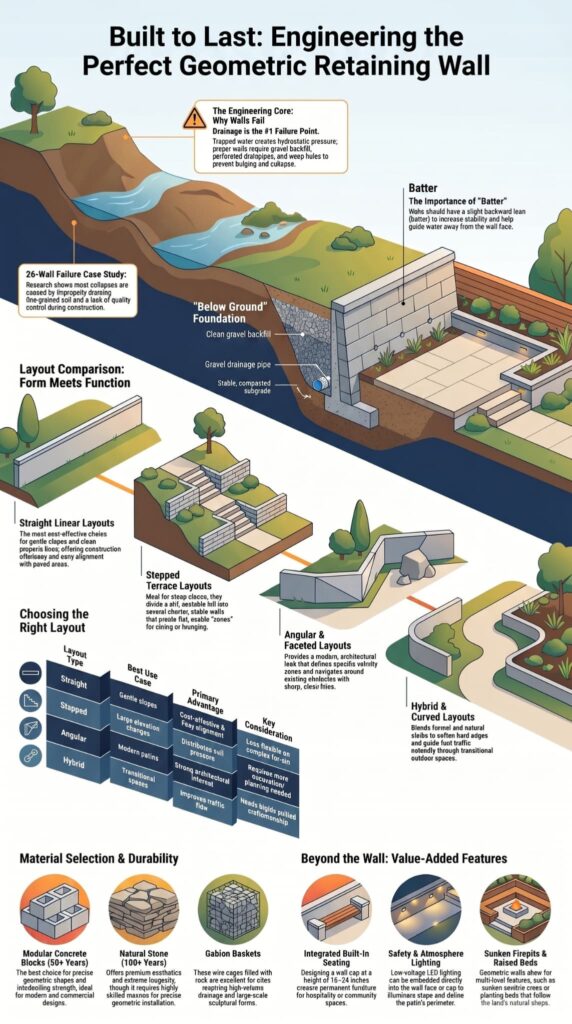
The visible shape of a retaining wall is only the final part of a much more important structure below ground. Most failures start with problems during site prep and base construction, long before the first block is set.
Common Causes of Wall Failure:
- Weak Footing: A poorly compacted base will sink unevenly, causing the wall above to shift and crack.
- Inadequate Drainage: This is the most common cause. Wet soil pushes hard and can freeze, expanding to push the wall out.
- Ignoring the Wall’s Lean: Skipping the necessary backward lean (batter) reduces stability.
- Building Too Tall Without Reinforcement: An unreinforced wall built higher than the material’s limit is at risk.
- Improper Backfill Compaction: Failing to compact the soil behind the wall in proper layers.
Research from Geotextiles and Geomembranes shows
“A survey of the literature is included where it is seen that there have been approximately 26 walls which suffered either excessive deformation or actual collapse. The overwhelming causes for these cases of poor performance were (i) backfilling with improperly draining fine grained soil and (ii) contractors deficiencies which could have been avoided with proper quality control and inspection.” – Geotextiles and Geomembranes
For taller walls or those holding heavy loads, like a patio or driveway, a professional engineering review is essential. This checks overall stability, weight support, and sliding resistance.
At Lapis Patios, our process starts with a full site check of soil and load needs. This ensures the chosen design is backed by a solid structural plan, preventing expensive fixes and legal problems later.
How Can Retaining Walls Improve Patio Living Spaces?
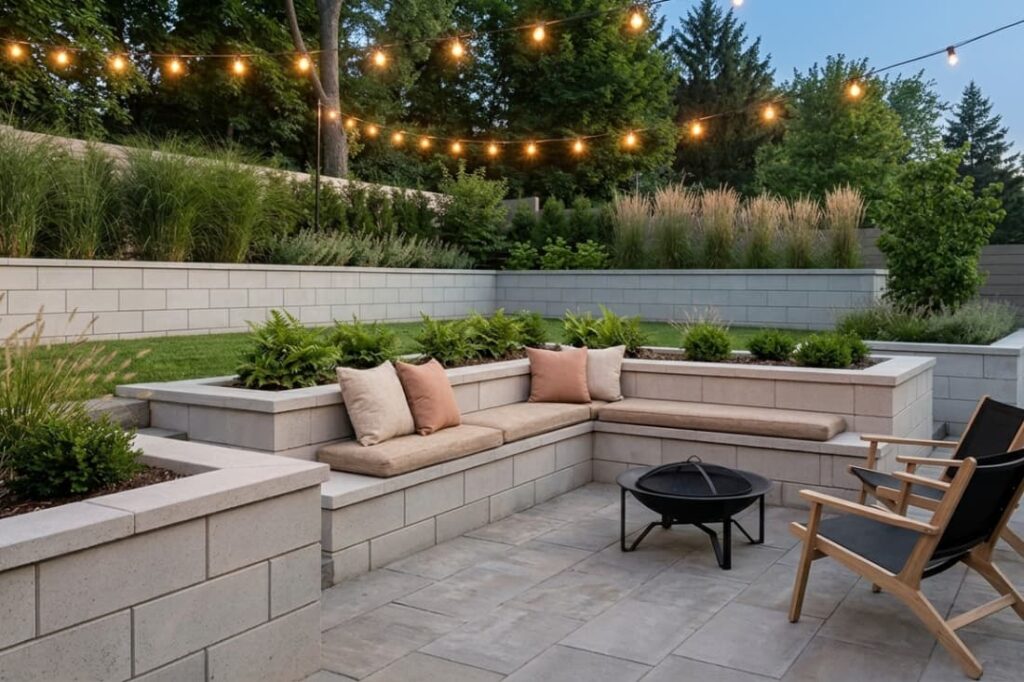
A well-planned retaining wall does more than hold back soil; it becomes a key part of the patio’s use and look. By thinking of the wall as part of the furnishings, not just the base, we create spaces that do more.
Built-In Seating: A wall cap built at standard seat height (usually 18-24 inches) provides permanent seating for groups. This removes the need for movable furniture that can clutter an area. It’s especially useful for commercial hospitality or community spaces.
Integrated Features: The vertical face of the wall offers other options. Low-voltage LED lighting can be set into the cap or face for atmosphere and safety on steps. The walls can frame raised planting beds, adding greenery and color. In terraced designs, the changes between levels are ideal spots for built-in staircases, creating a natural flow.
Poolside Solutions: For pools, a retaining wall can solve slope issues while providing a wide coping for lounging.
These features turn a simple boundary into an active part of the outdoor area, adding value and function.
How Should Homeowners and Developers Choose the Right Retaining Wall Geometry?
Choosing the best layout is a step-by-step process that starts with a full site check, not just a style choice.
The first step is to accurately measure the total slope and map where water flows now. This information, plus the planned use for the new spaces, guides the basic choice between a single wall, a terrace, or an angular design.
For commercial developers and property managers, other important factors include HOA rules, local building codes (which often require engineering for walls over 4 feet), and long-term maintenance needs.
A Checklist for Planning:
- Measure the slope’s severity.
- Plan for surface and underground drainage.
- Define the patio’s different use areas.
- Check property line setback rules.
- Consult a geotechnical engineer if the soil is poor or the wall will support a structure.
The most cost-effective and long-lasting wall is one whose design is a direct, logical answer to these site-specific conditions.
FAQ
How does wall geometry affect retaining wall performance?
Wall geometry affects retaining wall strength, drainage performance, and long-term ground stability. Engineers review wall height, block depths, reinforced soil conditions, and geogrid options during retaining wall design planning.
Proper retaining wall layouts also help limit excavation, improve site drainage, and reduce pressure on nearby property lines, local drainage systems, and Transportation Systems infrastructure.
When should reinforced soil systems be used?
Reinforced soil systems are commonly used when retaining wall height increases or ground stability becomes difficult to maintain.
Engineers evaluate soil properties, ground-improvement systems, and design methodologies before selecting a Gravity retaining wall or Gravity Wall System.
While the same geogrid reinforcement principles apply to heavy civil highway projects, on a residential patio, we use these layered soil grids to support the immense weight of outdoor kitchens or multi-level pavers built right above the wall.
Why are drainage plans important for retaining walls?
Site drainage protects retaining wall structures from water pressure, erosion damage, and long-term structural movement. Engineers review HEC RAS models, Hydraulic structures, scour analysis envelope data, and local drainage systems before finalizing grading plans.
Effective Erosion Control and Sediment Control measures also reduce damage risks near hike-and-bike facilities, toll roads, and farm-to-market roads during severe weather conditions.
What documents are needed for retaining wall construction?
Most retaining wall projects require site plans, grading plans, design specifications, specifications and cost estimates, and a detailed Plan Sheet package.
Larger Geotechnical structures may also require utility resolution records, Temporary Traffic Control plans, and Railroad Exhibit A documentation.
Many agencies follow AASHTO LRFD standards and Federal Highway Administration requirements during PS&E Review Branch approval procedures.
How can geometric retaining wall layouts reduce project costs?
Efficient retaining wall layouts reduce unnecessary excavation, improve construction access, and simplify bridge layouts near local streets and commercial developments. Engineers review analysis mode data, Safety Features, and installation resources to improve construction efficiency.
Accurate cost estimates, stable reinforced soil design, and proper wall geometry planning also help reduce maintenance expenses and future structural repair costs.
Building Retaining Walls Engineered for Long-Term Stability
The performance of any retaining wall depends on what lies beneath the surface. Proper drainage, reinforced foundations, and code-compliant engineering are what protect commercial and residential properties from costly structural failure over time. For developers, property managers, and homeowners alike, investing in professionally designed retaining walls ensures safer, more functional outdoor spaces that retain their value for years.
Ready to turn a difficult slope into a stable, high-value landscape feature? Contact Lapis Patios for a professional consultation on geometric retaining walls, terraced layouts, and large-scale outdoor projects in Charlotte and surrounding areas.
References
- https://reginalibrary.ca/search/116169
- https://www.sciencedirect.com/science/article/abs/pii/S0266114401000127