
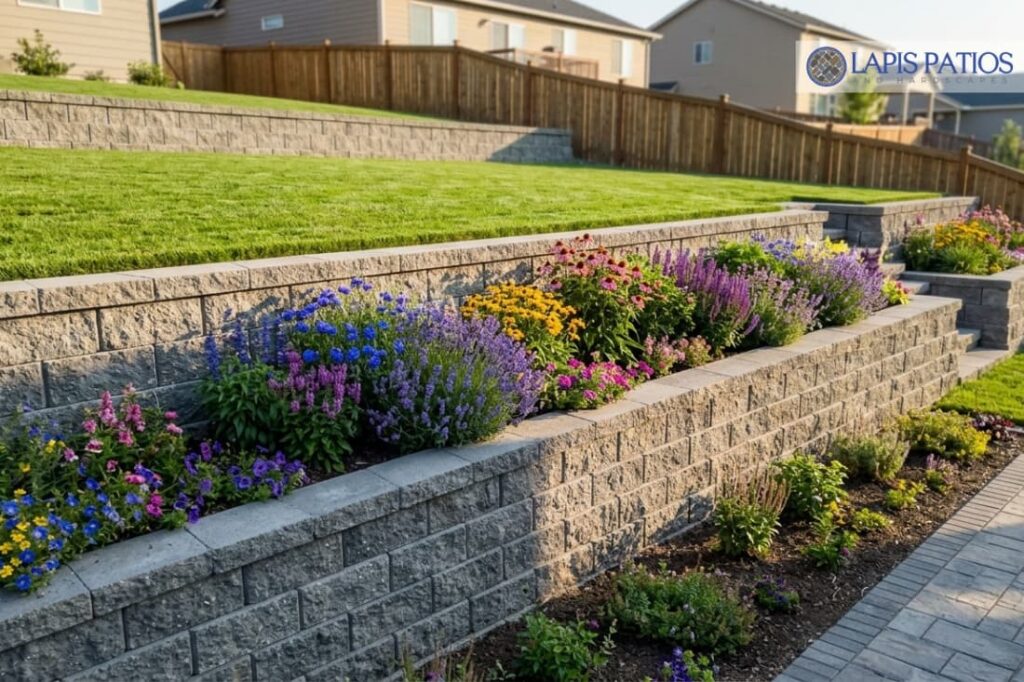
Looking to build a patio on a slope? These vertical retaining wall solutions help maximize space while improving layout and function.
A vertical retaining wall transforms an unusable slope into a level, functional outdoor space. For commercial developers and property managers in Charlotte, NC, these are critical engineered systems that create valuable real estate from challenging terrain.
At Lapis Patios, we build every wall as a structural solution designed to manage soil pressure, ensure drainage, and provide lasting stability. This turns a problem into a premier amenity.
Keep reading to learn how the right wall system protects your investment and maximizes your property’s potential.
Quick Patio Insights
Before starting, know the main job of a retaining wall in a commercial or large home project.
- They create usable space: Retaining walls turn sloped ground into flat areas that can hold patios, seating areas, and other outdoor features.
- They protect your property: Proper building helps control erosion, manage water flow, and lower risks to nearby structures and landscaping.
- They need professional planning: Following local rules, HOA requirements, drainage standards, and soil conditions is key for long-term success.
- They provide lasting value: A well-built retaining wall can give decades of reliable service with little upkeep and fewer future repair costs.
What Does a Vertical Retaining Wall Do for a Patio?

At its core, a retaining wall is a system that holds back soil, allowing you to create a sudden change in ground level.
For a patio, this means carving out a flat area on a slope or building up a raised platform. The wall does more than hold dirt; it reshapes the land itself. A thoughtful retaining wall design can also define traffic flow, create usable levels, and support key outdoor amenities.
We’ve built walls to support large pool decks, outdoor kitchens for clubhouses, and tiered spaces for apartment complexes. The wall is the silent workhorse that makes the design possible.
What are the primary applications of retaining structures in commercial developments?
- Execution of High-Load Amenity Decks: Engineering level structural sub-bases over severe grades to safely accommodate high-density pedestrian traffic, outdoor kitchens, and communal commercial furnishings.
- Integrated Tiered Zoning: Constructing multi-level terrace frameworks that segment steep topography into functional, accessible outdoor common spaces for multi-family complexes or hospitality properties.
- Civil Infrastructure Stabilization: Mitigating active soil migration and slope failure along property lines to safeguard nearby foundations, parking lots, and utility pathways.
When Is a Retaining Wall Needed for Patio Installation?
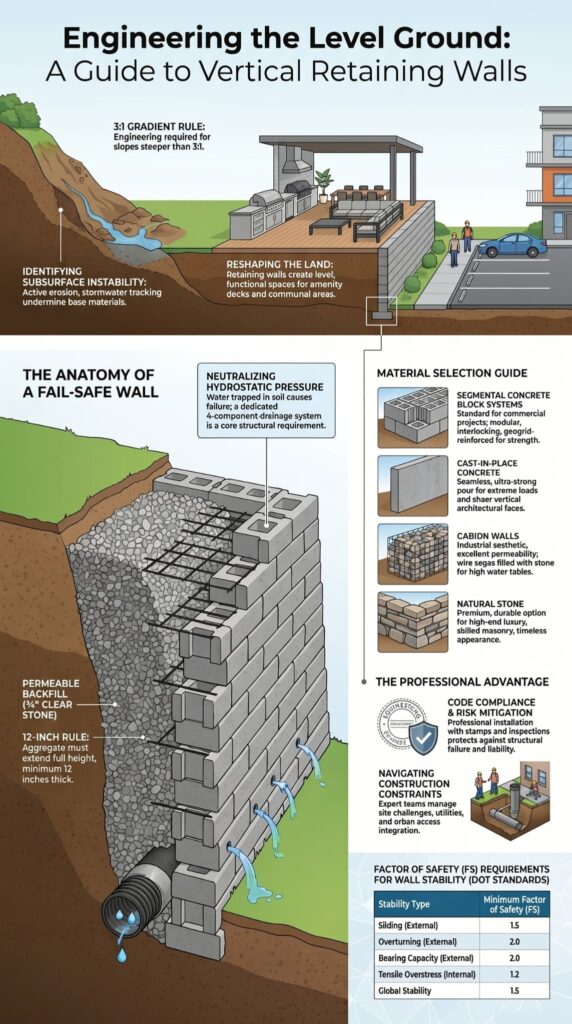
The choice to build a wall depends on your site and goals. We start with a full site check, looking at soil type, slope steepness, and drainage.
A wall is usually needed when the patio’s planned level is much different from the existing ground. This isn’t just about looks; it’s about physics. Without a properly built wall, soil will slowly move downhill, ruining any patio built on it.
For HOAs and commercial jobs, this isn’t a guess, it’s a calculation based on soil volume, strength, and expected weight. Proper retaining wall height and design considerations help determine the structural requirements needed to support those loads safely.
Several critical site conditions dictate the immediate necessity of an engineered retaining structure during initial earthwork. Topography that exhibits a slope steeper than a 3:1 gradient requires a structural wall to establish a reliable, level construction footprint.
Additionally, active surface erosion or chronic stormwater tracking across the planned layout indicates severe subsurface instability that will rapidly undermine unreinforced base materials.
Which Retaining Wall Material Is Best for Your Patio?
The material choice balances structural needs, looks, budget, and long-term upkeep. There’s no single “best” option, only the right solution for a specific project. Our work across Charlotte informs a practical selection process.
| Material | Key Characteristics | Ideal Project Profile |
| Segmental Concrete Block Systems | Modular, interlocking units with built-in setback. Engineered for strength with options for geogrid reinforcement. Offers various textured or stone-like finishes. | The standard for most commercial and large residential projects. Excellent for tall walls, curved designs, and sites needing reinforced soil. Provides a uniform, clean look with predictable installation. |
| Cast-in-Place Concrete | A single, ultra-strong, seamless pour. Can be formed into almost any shape and finished with stains, textures, or veneers. | Ideal for projects with extreme weight loads, complex curves, or a desire for a sleek, modern look. Often used in architectural settings or where a sheer vertical face is needed. |
| Natural Stone | Premium, timeless appearance with unique variation. Exceptionally durable and long-lasting. | Best for high-end estates, luxury communities, or projects where a natural, elegant look is most important. Requires skilled masonry and typically a higher initial investment. |
| Gabion Walls | Industrial, modern aesthetic. Made of wire cages filled with stone. Offers excellent permeability and drainage. | Suited for contemporary designs, sound barriers, or sites with very high water tables. Provides a unique texture and is often used as a design feature itself. |
Why Does Drainage Matter Behind a Retaining Wall?
Water is the main enemy of any retaining wall. Hydrostatic pressure, the force from trapped water in the soil, is huge and is the top reason walls fail. A wall without proper drainage is like a dam holding back a rising lake.
We build drainage into every system we install. This isn’t an optional extra; it’s a core part of the wall’s strength. A full drainage system relieves this pressure, moving water away from the back of the wall and its base.
Insights from Los Angeles County Building Code indicate
“Drainage pipes and aggregate backfill shall be provided between the facing units and the reinforced soil mass as recommended by the Geotechnical Engineer and the manufacturer of the wall system. The backfill shall extend full height and length of the wall at a minimum thickness of 12 inches. Surface drainage at the top and bottom of the wall shall be directed away from the wall and shall not connect with any sub-drains associated with the geogrid wall.” – Los Angeles County Building Code
What Makes Up a Proper Drainage System?
A reliable wall requires these four components:
- Permeable Backfill: A layer of clean, crushed stone (often ¾” clear) is placed directly behind the wall blocks. This lets water flow down freely.
- Perforated Drain Pipe: A perforated pipe is installed at the base of this stone layer. It collects water and sends it to safe outlets.
- Filter Fabric: A non-woven geotextile fabric is placed between the original soil and the clean stone backfill. This layer stops fine soil from washing into the drainage stone and clogging it.
- Weeep Holes or Drainage Channels: In some systems, small holes or channels in the blocks let incidental moisture escape from the front of the wall.
What Factors Influence Retaining Wall Design?
Credits: Oscito
Designing a retaining wall is a geotechnical engineering task, not just a landscaping choice. We begin with a site-specific analysis that guides every decision.
Data from Iowa Department of Transportation (Iowa DOT) demonstrates
“External Stability Minimum Factor of Safety: Sliding, Fssl 1.5; Overturning, Fsot 2.0; Bearing Capacity, Fsbc 2.0. Internal Stability Minimum Factor of Safety: Tensile Overstress, Fsto 1.2; Pullout, Fspo 1.5. Global Stability 1.5.” – Iowa Department of Transportation (Iowa DOT)
The primary design factors we evaluate include:
- Soil Conditions: Soil type (clay, sand, silt) determines its weight and strength, critical for calculating pressure.
- Wall Height & Extra Loads: Taller walls face greater force. We account for extra weight from patios, foot traffic, or vehicles.
- Global & Local Stability: We check the entire slope’s stability, looking for deep weak spots and ensuring proper wall depth.
- Local Building Codes: Charlotte and Mecklenburg County have specific rules for walls over certain heights. We ensure all designs meet or exceed these codes.
- Materials & Reinforcement: Based on the analysis, we choose the wall type, add soil reinforcement (like geogrid), and prepare the foundation for long-term safety.
How Do Construction Constraints Affect Patio Retaining Walls?
Real-world installation is where planning meets practice. On commercial sites and busy residential projects, we often handle big problems that directly affect the wall. Our project management makes sure these challenges are solved without taking shortcuts on the final structure.
What Are Common Installation Challenges?
- Arranging for big machines and material delivery in tight city lots or established neighborhoods without hurting the existing land.
- Finding and working around gas, water, electrical, and communication lines that may run through the work area.
- Designing and building walls close to building foundations, pools, or other paved areas without causing sinking or damage.
- Fitting wall building into the schedules of other workers (like electricians or plumbers) on a large project.
- Making sure the wall’s drainage system fits with the site’s overall water plan to stop flooding or erosion downhill.
What Are the Benefits of Professional Vertical Retaining Wall Solutions?
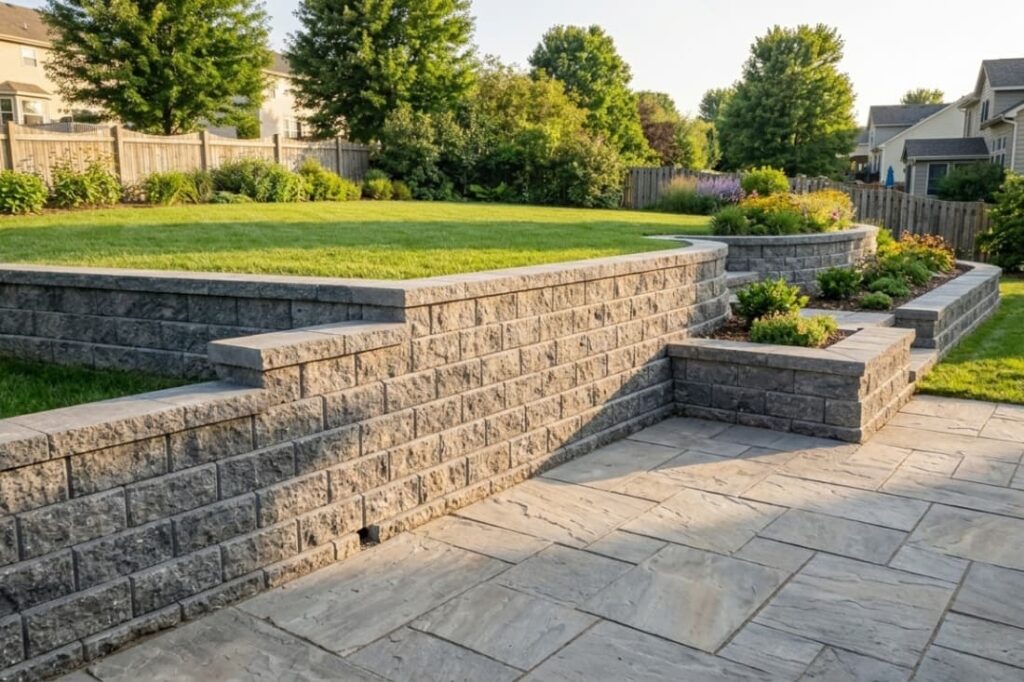
Partnering with an experienced contractor turns a retaining wall from a potential problem into a valuable asset. The benefits go far beyond creating a flat space.
- Code Compliance & Risk Mitigation: We handle the permits, engineering stamps, and inspections. This makes sure your project follows the law and protects you if the structure fails.
- Long-Term Durability & Cost Savings: A professionally built wall stops costly repairs or property damage later. It’s a permanent upgrade, not a quick fix.
- Maximized Usable Space & Property Value: We unlock the full use of your land, creating space you can sell or rent that was useless before.
- Integrated Aesthetic & Functional Design: The wall becomes a natural part of the overall patio and yard design, making the place look better and work better. In some layouts, curved retaining wall designs can soften hard transitions and create a more natural connection between patio zones.
- Single-Source Accountability: From the first site check and design to the final build, you have one team in charge of how the whole system works.
FAQ
How do I choose the right retaining wall system for my yard?
The right Retaining Wall Systems depend on your slope, drainage needs, and soil conditions. A contractor should evaluate soil pressure, soil volume, and wall height before recommending a solution.
Common options include gravity walls, reinforced concrete walls, and modular block systems. Choosing the correct system helps improve safety, durability, and long-term performance.
How do vertical earth-retaining systems preserve structural integrity across decades?
Long-term structural stability depends entirely on counteracting continuous lateral earth pressure through a combination of mass and mechanically stabilized earth mechanics.
Integrating high-tensile geogrid reinforcement layers binds the interlocking segmental concrete blocks directly to the structural backfill zone behind them.
When this setup is paired with a clear path for water to exit via unobstructed weep holes, it eliminates the hydrostatic build-up that threatens unengineered walls.
Are retaining walls a good solution for steep slopes?
Yes. Retaining Walls are often used for slope stabilisation on steep properties. They help control erosion, manage elevation changes, and create level areas for outdoor spaces.
Depending on site conditions, builders may use mechanically stabilised earth systems, gabion walls, or concrete blocks. These Earth Retaining Systems help improve stability and make land more usable.
What helps a retaining wall last longer?
A long-lasting wall starts with proper installation techniques and quality materials. Contractors should follow design plans, local building codes, and geotechnical engineering recommendations.
Good drainage, proper Backfill compaction, and strong foundations help prevent future problems. Regular inspections can also identify small issues early and reduce the need for expensive wall repairs.
Can retaining walls support sustainable landscaping projects?
Yes. Some Retaining Walls are designed to support sustainable landscaping goals. Vegetated retaining walls and plantable retaining wall blocks can help with erosion control while adding greenery.
These systems support urban greening, improve outdoor spaces, and may reduce urban heat. They also combine practical slope stabilization with a more natural and attractive appearance.
Building Long-Term Value With Expert Retaining Wall Construction
A vertical retaining wall is the foundation for safe, functional, and lasting outdoor spaces. For developers, property managers, and HOAs, a professionally built wall makes better use of land, follows local rules, and protects long-term value. The difference comes down to engineering, drainage, and expert building.
Ready to unlock your site’s potential? Schedule a retaining wall consultation with Lapis Patios. Our experienced team delivers durable, code-compliant solutions for commercial and residential projects across Charlotte, NC.
References
- https://up.codes/viewer/los-angeles-county/ca-building-code-2022/chapter/J/grading
- https://secure.iowadot.gov/iowadot/erl/current/GS/content/2431.htm