
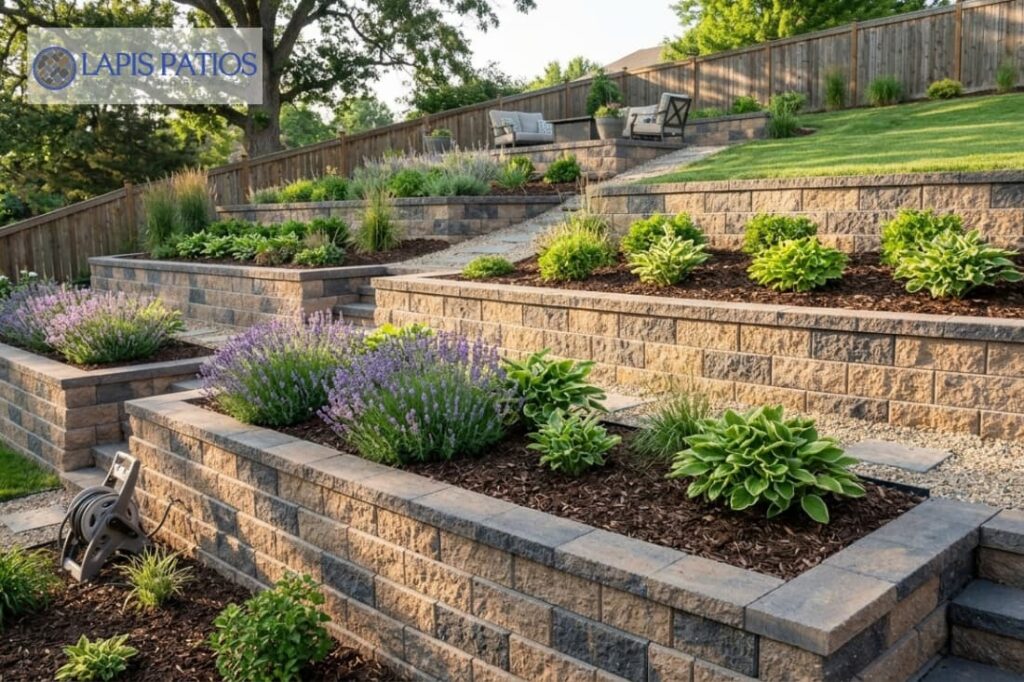
Thinking about segmental retaining walls for garden areas? Learn what commercial contractors consider before planning a lasting outdoor project.
Segmental retaining walls are built systems that change sloped or shaky land into flat, useful space. They use locking blocks to give important support and stop dirt from washing away. This allows for terraced gardens, raised beds, and smooth changes for patios.
For business builders and managers in Charlotte, using them the right way is very important. It makes projects last longer, keeps you in line with HOA rules, and stops costly mistakes.
Read on to see how they work.
Commercial Retaining Wall Essentials: Build on the Right Foundation
For any commercial or large-scale residential project, these three points are non-negotiable.
- They are engineered gravity structures. Stability comes from precise design for weight, soil pressure, and loads, not just stacking blocks.
- Drainage is the main failure point. Incorrect water management behind the wall causes pressure buildup and major movement.
- Local codes and soils dictate design. Charlotte’s building codes and clay-heavy soils need specific knowledge for base prep and reinforcement.
What Are Segmental Retaining Walls?
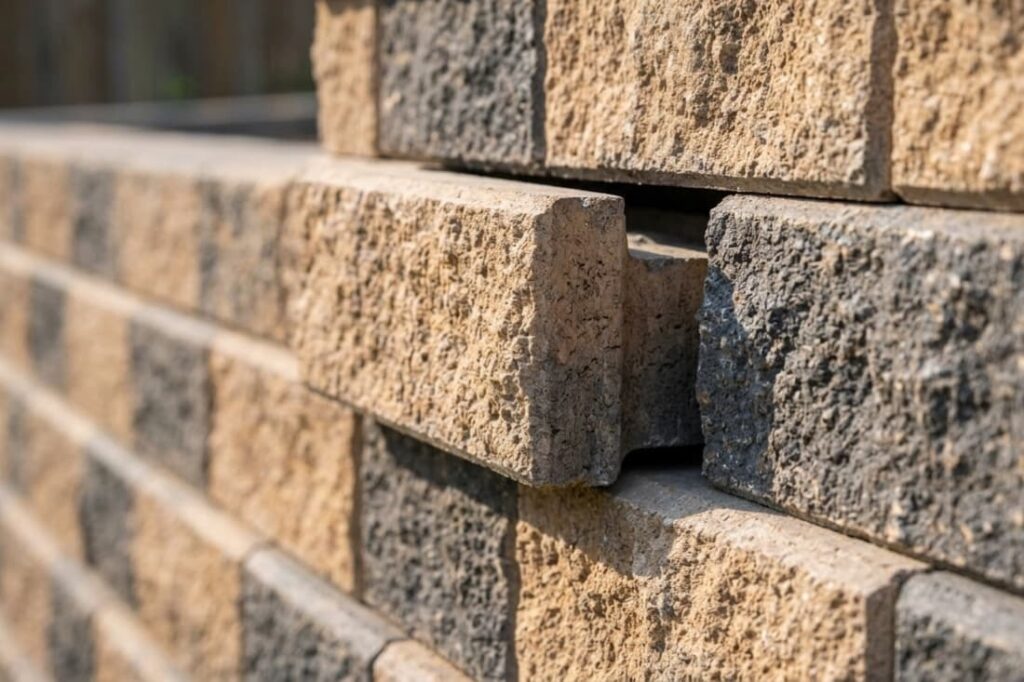
In commercial hardscaping, a segmental retaining wall (SRW) is a gravity wall system. It is built from dry-stacked, interlocking concrete blocks. This is different from poured concrete or mortared stone walls.
Each row of blocks is set back from the row below it. This creates a slope that uses the wall’s own weight to hold back dirt.
This engineered way of building allows for curves and tall walls, making thoughtful retaining wall design an important part of areas like parking lot borders and landscapes. It gives a neat, strong finish for commercial sites.
The key point for business projects is that these are load-bearing systems. Their strength is figured out based on wall height, soil type, and loads like foot traffic or nearby buildings. Treating them as simple decoration is a basic error that leads to failure.
How Do Segmental Retaining Walls Transform Garden and Patio Design?
For developers and property managers, SRWs add value and fix problems. They turn tough slopes into flat, usable space. This is key for getting the best value from land in Charlotte’s hilly areas.
A terraced garden can stop bad soil erosion. A low seat wall built into a patio adds extra seating and visual structure, while curved retaining wall designs can create smoother transitions between patios, planting beds, and outdoor living areas.
How These Walls Work with Your Site
These walls allow smooth changes between hard surfaces (like patios) and soft areas (like gardens).
- A retaining wall can neatly separate a patio from a planting bed.
- It can direct rainwater toward a drainage system.
- It can include features like landscape lights or planting pockets.
This integration is where professional design is better than DIY. It makes sure the wall works with the site’s full drainage plan and look, creating one complete outdoor space.
Where Are the Primary Applications for Commercial and High-End Residential Projects?
Credits: Belgard Canada
The uses go far beyond a simple garden edge. For the projects we handle at Lapis Patios, these walls are key for solving tough site problems.
Common Business Uses
- Terraced Gardens & Erosion Control: Making flat planting areas on sloped land. This turns erosion problems into nice landscape features.
- Raised Planters & Patio Borders: Defining outdoor kitchens and seating areas with clean lines that hold soil and mulch in place.
- Parking Lot & Driveyard Edging: Giving strong, low-maintenance borders. These can handle being near cars and trucks and manage rainwater runoff.
- Recreational Area Definition: Shaping the edges of pools, sport courts, or common areas in apartment or HOA communities.
- Structural Support for Raised Decks & Patios: Building a solid, hidden base for raised outdoor living spaces.
Why Are Drainage and Base Preparation Non-Negotiable?
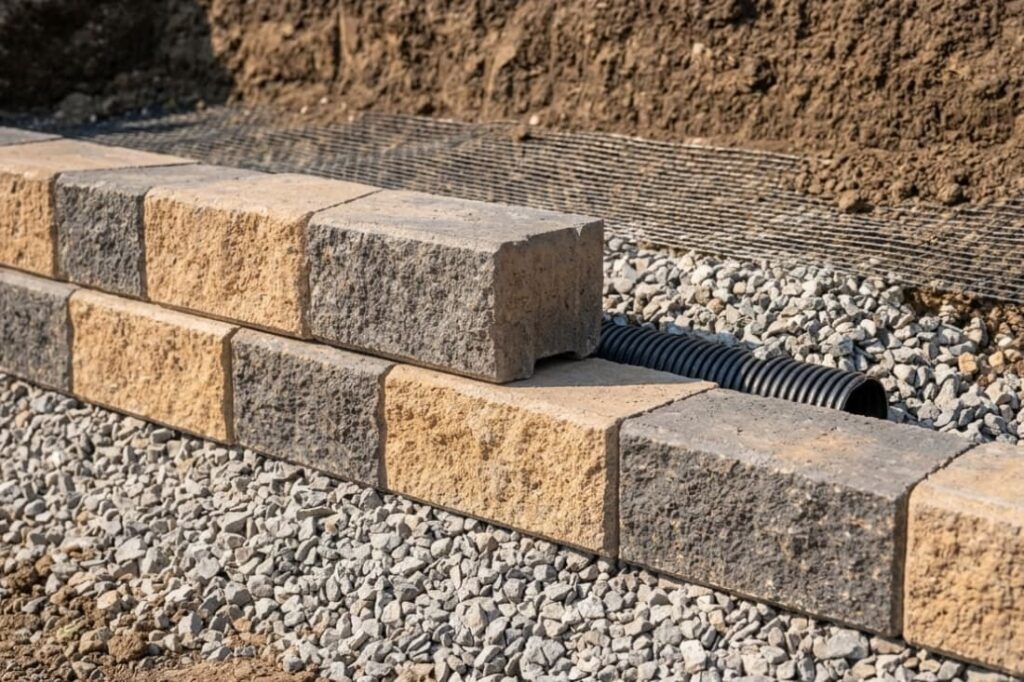
In our climate, drainage isn’t just a feature; it’s what keeps the wall standing. Pressure from trapped water is the top reason walls bulge and fall.
A proper build needs a compacted base of #57 stone, a perforated drain pipe wrapped in fabric at the wall’s base, and clean gravel backfill. This system moves water away to relieve pressure.
Insights from Taylor & Francis indicate
“Investigations revealed bad quality backfill coupled with insufficient drainage as one of the key factors for the distress… when using low permeable soil as a backfill material within the reinforced soil structures, it is imperative to provide sufficient measures to reduce the development of pore water pressure of the reinforced zone by collecting and discharging it away from the reinforced zone for stability of the structure.” – Taylor & Francis
Base Preparation for Charlotte Soils
Base prep is just as important. Charlotte’s clay soils swell and shrink with moisture. This requires a sub-base that goes below the frost line to create a stable, solid platform. Skipping proper compaction or using local soil as backfill, a common shortcut, will cause uneven settling.
For commercial projects, we document soil tests and base compaction reports. This ensures the foundation meets the exact design specs.
When Is Engineering and Reinforcement Required?
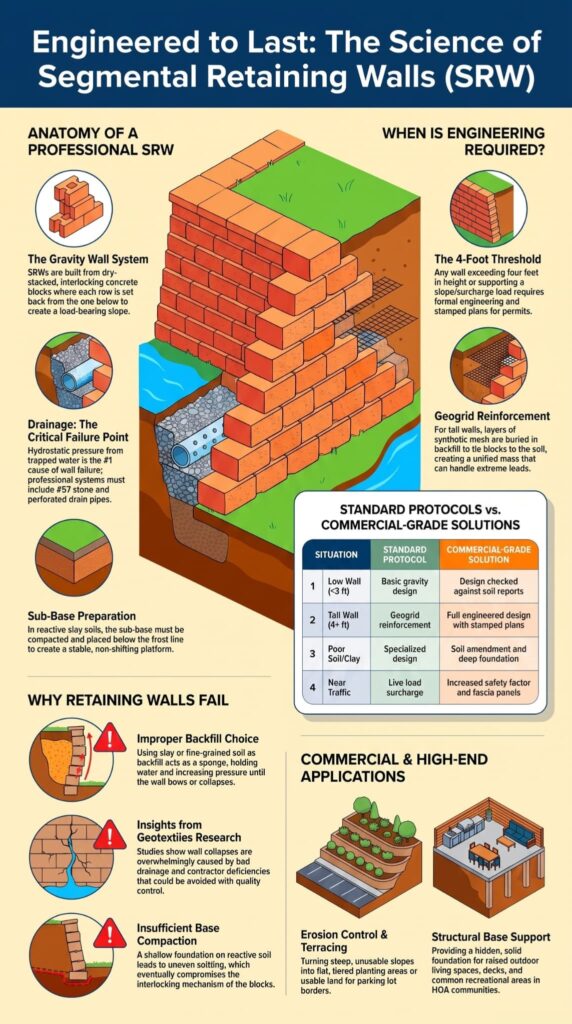
Not every wall needs geogrid reinforcement. Knowing when it’s required is what separates a true contractor from a basic installer.
As a rule, any wall over four feet high, holding back a slope, or next to a load-bearing structure needs formal engineering, especially when vertical retaining wall solutions are needed for sites with limited space or steeper grade changes.
Geogrid reinforcement uses layers of synthetic mesh buried in the backfill. This ties the wall blocks to the soil behind it, creating a stronger system that can handle much greater loads.
| Situation | Standard Protocol | Commercial-Grade Solution |
| Low Wall (<3 ft.) in Stable Soil | A basic gravity wall design may be enough. | Engineered design checked against site-specific soil reports. |
| Tall Wall (4+ ft.) or Surcharge Load | Geogrid reinforcement is required by design. | Full engineered design with stamped plans for permits. |
| Poor/Draining Soil Conditions | Needs a specialized design. | Soil amendment, deep foundation, and custom reinforcement. |
| High Traffic or Vehicular Proximity | Must include live load surcharge. | Increased design safety factor and possible use of fascia panels for extra durability. |
What Are the Common Causes of Retaining Wall Failure?
Our team is often called to fix or rebuild failed walls. The reasons are predictable and almost always come from not following engineering standards.
Research from Geotextiles and Geomembranes shows
“A survey of the literature is included where it is seen that there have been approximately 26 walls which suffered either excessive deformation or actual collapse. The overwhelming causes for these cases of poor performance were (i) backfilling with improperly draining fine grained soil and (ii) contractors deficiencies which could have been avoided with proper quality control and inspection.” – Geotextiles and Geomembranes
Common Causes of Wall Failure
- Improper Drainage: This is the top cause. Without proper gravel backfill and a working drain pipe, water pressure builds until the wall pushes outward. We see this after heavy rains, where poorly drained walls simply bow or come apart at the seams.
- Insufficient Base Preparation: A shallow or poorly compacted base on Charlotte’s reactive clay soil will settle unevenly. The wall fails because its foundation moves.
- Lack of Required Reinforcement: Trying to build a wall taller than its natural strength without geogrid is a plan for collapse. The outward push of the soil eventually overcomes the blocks.
- Use of Unapproved Backfill: Using clay or fine soil as backfill turns the area behind the wall into a sponge that holds water. This makes water pressure and frost heave much worse.
How Do Segmental Retaining Walls Integrate Into a Complete Patio Project?
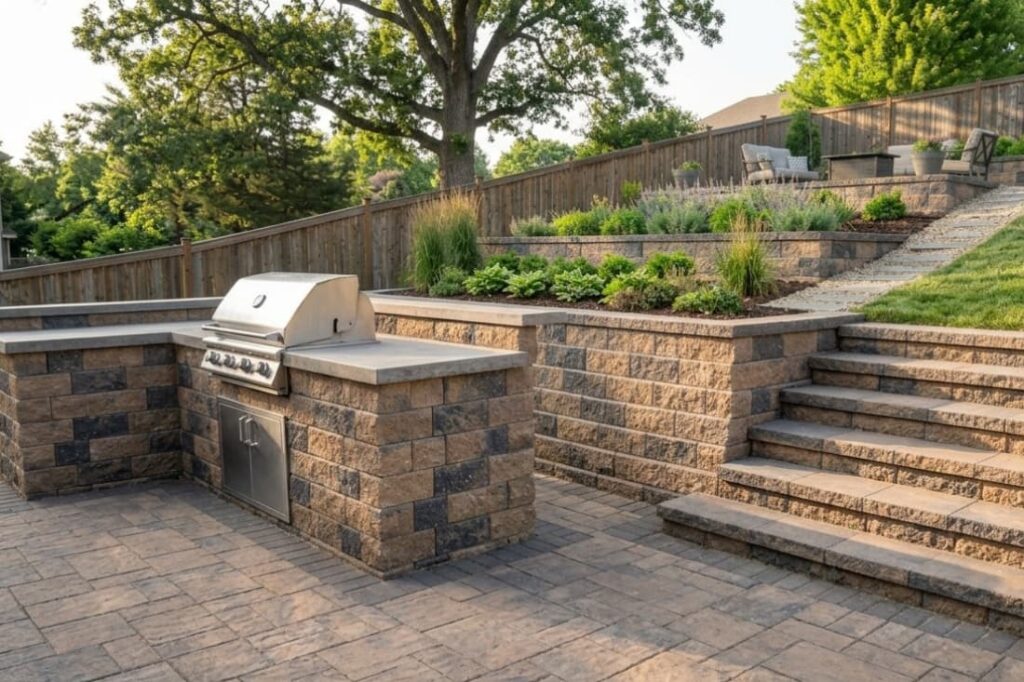
At Lapis Patios, we do not see these walls as a separate feature. They are a basic part of the site’s full design. For a patio project, this means the wall plan is finished together with the paving layout, drainage system, and planting plan.
This combined way of working is key for HOA rules in Charlotte. In these communities, landscape plans often need to be sent in and approved.
We make sure every part follows local building codes for height, distance from property lines, and drainage. For business clients, this careful planning means less long-term repair risk, better property looks, and a finished outdoor space that works well for years.
Our process, from the first land check and soil test, through engineered design and build, is made to give you that confidence.
What Is the Lapis Patios Difference for Commercial Projects?
The difference between a wall that works and a great wall is in the details a business builder focuses on. We treat every retaining wall as a structure project first and a landscaping project second. This means we start with the site’s soil and how water drains. We design for the worst weather, like a long Charlotte rainstorm, not just for calm days.
Our skill with geogrid-reinforced walls and complex terrace designs lets us handle projects bigger than simple gardens. This includes business erosion control and parking lot jobs.
We handle the permits. We follow the block maker’s instructions exactly. We give clear paperwork for property managers and HOA boards.
This strict, rule-following method is what builds trust. It makes sure the walls we build are long-term investments, not future headaches.
FAQ
How do segmental retaining walls help prevent soil erosion?
Segmental retaining walls hold soil in place and reduce soil movement on sloped ground. A properly built retaining wall uses retaining wall blocks, solid base preparation, a drainage system, and a drainage pipe to move water away from the wall.
This design reduces hydrostatic pressure, improves soil stabilization, and provides effective erosion control for garden terracing and other outdoor spaces.
Can segmental retaining walls support outdoor living features?
Yes. Segmental retaining walls create stable, level areas for outdoor living spaces such as outdoor seating, fire pits, and outdoor kitchens. They also improve property line definition and help solve grading problems on uneven lots.
A retaining wall contractor can recommend retaining wall systems that fit your landscape design, soil conditions, and long-term goals.
When is geogrid reinforcement needed for a retaining wall?
Geogrid reinforcement is usually needed when a retaining wall is tall or must support heavy loads. Geogrid-reinforced retaining walls strengthen the soil behind the wall and increase structural support.
The design should match the soil conditions, frost depth, local building codes, and reinforced construction methods. Following the manufacturer’s instructions helps improve long-term performance.
What materials work best for garden retaining walls?
Common choices include segmental concrete block, modular concrete blocks, natural stone, cast stone, and poured concrete. Some homeowners also choose Natural Stone Retaining Walls or fieldstone retaining walls for a more natural appearance.
The right material depends on your budget, garden design, drainage infrastructure, maintenance needs, and the style of your outdoor space.
How can I make my retaining wall last longer?
A retaining wall lasts longer when it is built with proper installation methods and maintained over time. Using geotextile fabric, #57 stone, and a well-designed drainage system improves water management solutions and protects soil retention.
Routine inspections and Retaining Wall Repairs also help prevent small problems from becoming costly structural damage.
Building Retaining Walls That Stand The Test Of Time
A segmental retaining wall is only as strong as the system behind it. Long-term performance depends on quality materials, proper drainage, sound engineering, and expert installation. For developers, construction companies, property managers, and homeowners across Charlotte, NC, choosing an experienced contractor helps ensure your project meets building codes, HOA requirements, and delivers lasting value.
When your project demands commercial-grade expertise, contact Lapis Patios. Our team designs and builds durable retaining wall solutions that combine structural integrity with attractive outdoor spaces built to perform for years to come.
References
- https://www.taylorfrancis.com/chapters/edit/10.1201/b10554-195/centrifuge-model-studies-behavior-geocomposite-reinforced-soil-slopes-viswanadham-raisinghani
- https://www.sciencedirect.com/science/article/abs/pii/S0266114401000127